
A link building expert can be a solo freelancer, a boutique agency, an enterprise firm, a marketplace, or software that automates outreach, and each type carries a different level of risk to your site's SEO. The fastest way to separate a legitimate provider from a bad one isn't asking more questions. It's checking their answers yourself, with free tools, before any money changes hands. This guide covers the provider types you'll run into, exactly how to verify a claim instead of taking it on faith, the red flags that mean you should walk away, and what legitimate link building typically costs.
What "Link Building Expert" Actually Covers
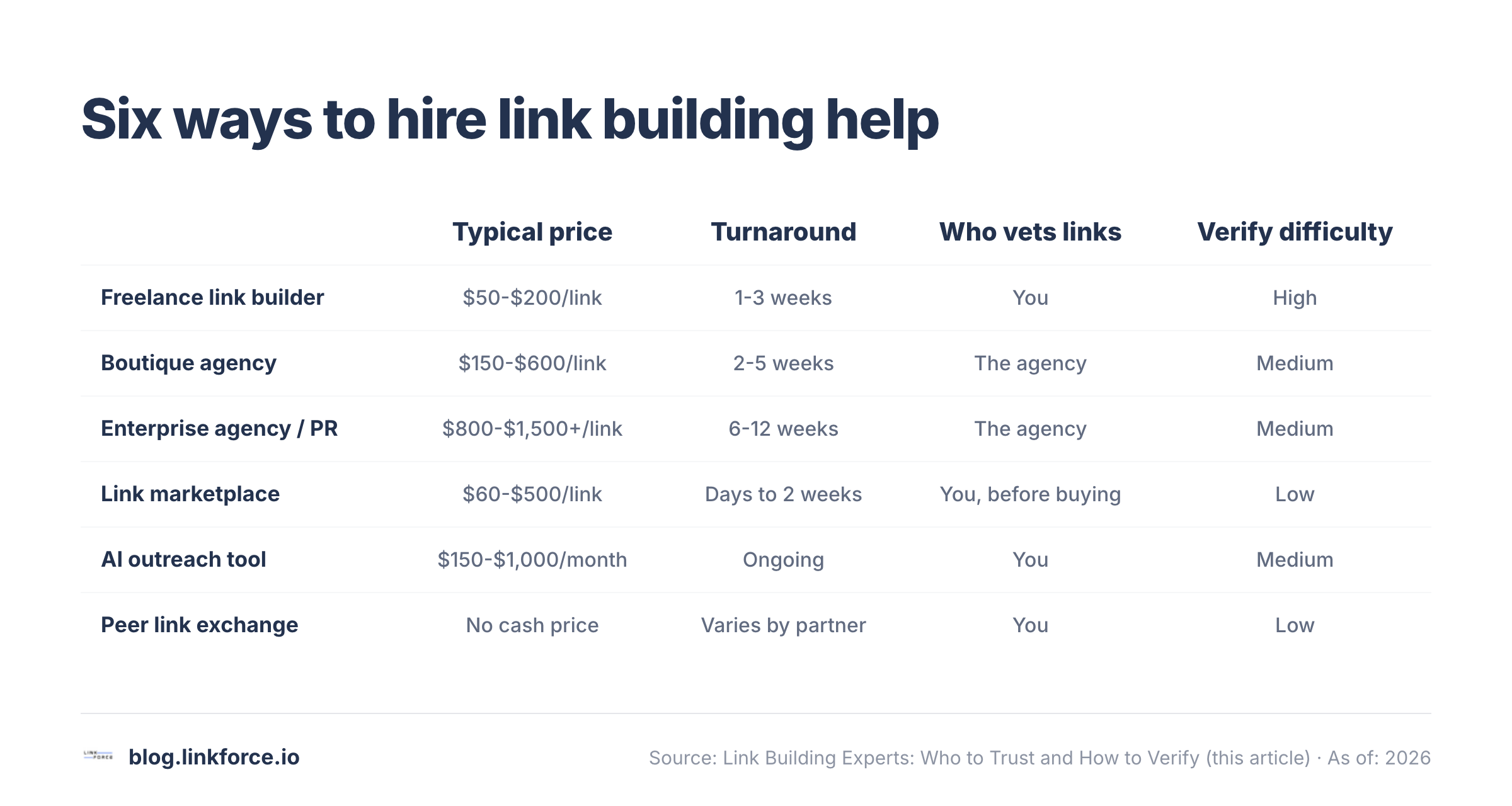
"Link building expert" isn't one job description. It spans six different setups, and the differences matter because they change who checks the work and how hard that work is to verify from the outside.
| Provider type | Typical price | Typical turnaround | Who vets the links | Verification difficulty |
|---|---|---|---|---|
| Freelance link builder | Roughly $50-$200 per link | 1-3 weeks | You | High |
| Boutique agency | Roughly $150-$600 per link, DR-tiered | 2-5 weeks | The agency | Medium |
| Enterprise agency / digital PR | Roughly $800-$1,500+ per link, or several thousand per campaign | 6-12 weeks | The agency | Medium |
| Link marketplace | Roughly $60-$500 per link, you choose the site | A few days to 2 weeks | You, before you buy | Low |
| AI outreach tool | Roughly $150-$1,000 per month, subscription | Ongoing | You | Medium |
| Peer link exchange | No cash price, reciprocal | Varies by partner | You | Low |
A freelancer and a marketplace put the most work on you because nobody else is checking the placement before it goes live, but that's also why they're the easiest to verify: you're looking at the actual site, not trusting someone else's description of it, whereas an agency hands you a finished report instead of a raw site to inspect. An agency or enterprise PR team vets sites on your behalf, which saves time but means you're trusting their standards instead of your own, unless you spot-check their work the way this guide walks through below. A peer link exchange, where two sites link to each other directly with no fee, carries the lowest cash risk simply because there's no invoice to dispute.
How to Verify a Link Building Expert Before You Pay
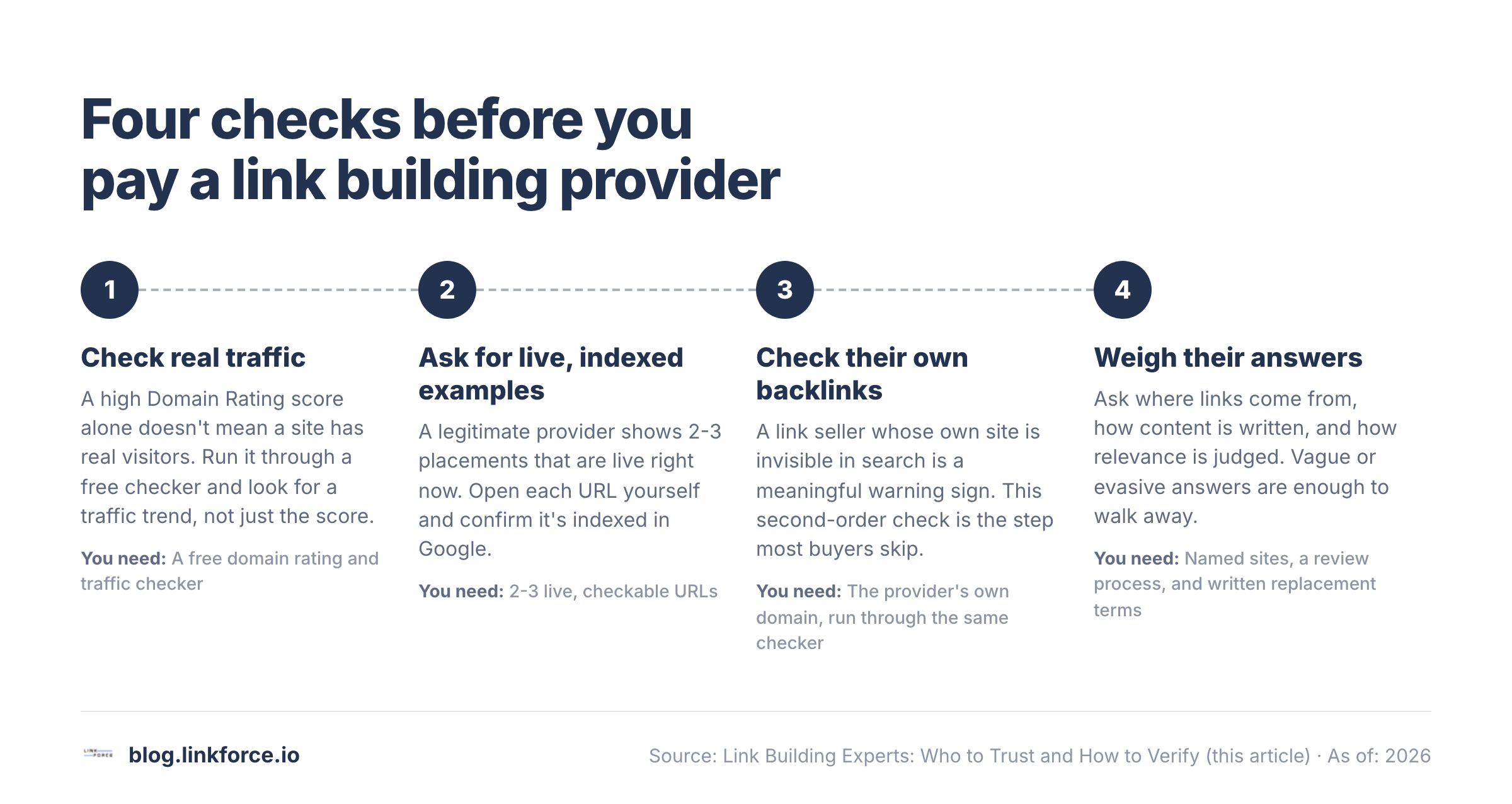
Don't just ask a provider the right questions. Check the answer yourself before you pay, using free tools, not their word for it.
1. Check the linking site's real traffic, not just its score. A high Domain Rating score doesn't mean a site has real visitors. Sites that exist mainly to sell links can carry an inflated authority score with little or no organic search traffic behind it. Before accepting a site, run its domain through a free domain rating checker and look for a traffic trend alongside the score, not the score alone.
2. Ask for live, indexed examples, then go look at them. A legitimate provider can show you two or three placements that are live right now, not screenshots, vague promises, or other plausible-sounding substitutes for an actual live link. Open each URL yourself, confirm your test link (or a comparable client's link) is actually there, and search for the exact page title in Google to confirm it's indexed.
3. Check the provider's own backlink profile. This second-order check is the step most buyers skip. If a company sells links for a living, its own site should have a visible, plausible backlink and traffic history. Run their domain through the same checker you used in step 1. A link seller whose own site is invisible in search is a meaningful warning sign, not a plausible-sounding coincidence.
4. Ask where the links come from, how the content is written, and how relevance is judged, then weigh the answer against what a real answer sounds like.
| Question | What a real answer sounds like | What a red-flag answer sounds like |
|---|---|---|
| Where do these links come from? | Names actual sites or clear site categories, and offers to show live examples before you pay | "Quality sites" or "our network," with no names offered |
| How is the content created? | Explains who writes it and that you can review it before it publishes | "We handle everything," with no mention of your review or your site's topic |
| How do you decide a placement is relevant to my site? | Describes matching the linking site's topic and audience to yours | "Any high-authority site works," with no questions about your niche |
| What happens if a placement gets removed later? | Names a specific replacement or refund window, in writing | No real answer, or "that doesn't happen" |
If a provider avoids two or more of these questions, or gives you the red-flag version of the answer, that's enough to walk away before you've spent anything.
Paste any domain into the free Domain Rating Checker by LinkForce.
800+ SaaS marketers swap partner, integration and content links. Free plan, no credit card.
Red Flags That Mean Walk Away
Each of these shows up repeatedly across link-selling pitches, and each has a specific mechanism behind why it's a problem, not just a vague "feels off."
- Bulk packages priced far below a single real placement, such as dozens of links for a couple hundred dollars. Individually placed editorial links are priced and vetted one at a time; a bulk price usually means directories, link networks, or private blog networks, not individually earned placements. A 2026 analysis of guest-post marketplace listings by BuzzStream found a large share of listed sites carry no measurable organic traffic at all, which is consistent with link inventory built to sell rather than to attract readers.
- A guaranteed ranking or a guaranteed date to reach page one. No provider controls Google's algorithm, period. A specific ranking promise is a sales line, not a deliverable you can hold anyone to.
- No live, indexed URL offered before you pay. If a provider won't show you where your link will actually sit, you have nothing to check once you've paid.
- The same exact-match anchor text across every link. Natural link profiles vary their anchor text; a provider who repeats one exact phrase across many placements is optimizing for keywords, not relevance, and that pattern itself can draw scrutiny.
- Private blog networks. A network of sites controlled by one owner, built specifically to pass links to paying clients, falls squarely inside Google's own spam policies on link schemes. If the network gets deindexed, every link you bought through it disappears with it.
- "Management" fees that appear after the quote. A transparent link-building quote is disclosed and itemized upfront, not padded once you've already committed.
- A "best link building experts" list that ranks its own publisher first. Such lists are often written by one of the companies they rank, and that company then takes the top spot. That's marketing copy wearing an editorial format, not independent research, so read the actual methodology before trusting the rank order, since a self-ranked list is a textbook conflict of interest.
Several of these red flags, bulk packages, PBNs, and repeated exact-match anchors in particular, are also exactly the patterns that can get a site penalized or deindexed, so walking away isn't just about wasting money. It's about keeping the rest of your site's rankings intact.
What Link Building Experts Actually Charge
Published pricing clusters by provider type and, for agencies, by the Domain Rating of the linking site. Reported ranges commonly run from roughly $150-$300 per link for DR 30-50 sites, $300-$600 for DR 50-70, and $600-$1,500 or more for DR 70+, with digital PR placements typically landing in the same $800-$1,500+ per-link range or several thousand dollars for a full campaign. Turnaround moves with the price: a boutique agency commonly reports managed outreach at roughly 14 to 35 days per placement, while a full digital PR campaign, pitch to published coverage, is commonly reported at around 90 days, per data cited by Fractl. Freelancers and marketplaces tend to sit below agency pricing precisely because you're doing more of the vetting work yourself.
However, none of that is a fixed price list. Treat every number here as a typical range, not a quote, and always get your own written quote before committing.
Price alone is not proof of legitimacy or ROI in either direction. A cheap link can be a perfectly good niche edit on a small, relevant site, while an expensive link can still come from an inflated-DR, no-traffic domain if you skip the verification steps above. Use price as one input alongside the checks in this guide, never as a stand-in for them.
Frequently Asked Questions
What's the difference between a link building expert and a link building agency?
"Link building expert" is the broader category: it covers freelancers, agencies, marketplaces, AI tools, and peer exchanges. A link building agency is one type within that category, typically a team working on retainer. If you've already decided an agency is the right fit, the contract terms, retainer tiers, and agency-specific vetting questions get more detail in our dedicated link building agency guide.
Is it legitimate to pay for backlinks at all?
It depends on what the payment is for and how the link is tagged. Google's spam policies treat paying for a link specifically to pass ranking value as link spam, unless that link is qualified with a rel="nofollow" or rel="sponsored" attribute. Paying for a disclosed, properly tagged placement for traffic or brand exposure is a different, compliant category from paying for an untagged link purely to manipulate rankings. If a provider can't or won't explain which category your placement falls into, that's itself a question worth pressing on.
What's a legitimate alternative to paying a provider?
Peer link exchanges, where two sites link to each other directly with no fee, remove most of the vetting problems above because there's no invoice and no third-party seller between you and the other site. Communities built specifically to match companies for direct link exchanges, including LinkForce, work this way. In-house digital PR and genuinely useful content that earns links on its own are the other common alternatives, though both take more time to produce results than a paid provider.
How long until a legitimate link building expert shows results?
Placement itself typically takes one to several weeks depending on the provider type. Ranking movement from that placement, if it happens at all, typically takes a few months on top of that, and no legitimate provider can give you a fixed date. Treat any specific ranking timeline as a sales claim, not a deliverable.
What should you get in writing before you pay?
At minimum: the actual URL where your link will appear (or a clear commitment to show it before publication), who writes the content and whether you can review it, how the site's relevance to your business was decided, whether the placement will be disclosed and tagged or left untagged, and what happens if the placement is removed later, including any replacement or refund window. If a provider won't put these in writing, that's plainly the same red flag as refusing to answer them out loud.