

A guest post only helps SEO when the host site is genuinely good, the link is tagged correctly, and the anchor text fits a natural pattern. Get any of those three wrong and the same tactic that builds authority for one brand quietly flags another for Google's spam systems. It isn't the writing that decides which outcome you get. This guide covers how to judge a placement before you pitch or pay for it, what Google's own policies say about guest-post links, how to handle anchor text, and why the byline on the post still matters.
What Counts as an SEO Guest Post
An SEO guest post is an article written for someone else's website that includes a link back to the author's own site or client. The content itself is usually the easy part, and it's not what decides whether the link does anything. The SEO value comes from the link, the site that hosts it, and how that link is coded, not from the word count of the article. A guest post on a relevant, well-read site with a clean editorial process can pass real authority and referral traffic. The same article on a site that exists only to sell placements doesn't do either, whatever its word count or Domain Rating says. This guide focuses on judging the placement itself; for the pitching and outreach process, see our guest post outreach guide.
What Google's Spam Policies Actually Say About Guest Posts
Google does not treat guest posting itself as a violation. Its spam policies describe link spam as any link intended to manipulate a site's ranking in Google Search, and they name a specific fix for paid or exchanged links: qualify them with a rel="sponsored" or rel="nofollow" attribute. A guest post arranged in exchange for payment, product, or a reciprocal link falls under that rule the moment it carries an unqualified, followed link built to pass ranking credit.
A second policy matters for sites that host a high volume of outside contributions: site reputation abuse. Google announced it on March 5, 2024, with enforcement starting May 5, 2024, and clarified it on November 19, 2024. It targets third-party pages published on a host site to take advantage of that site's already-established ranking signals. The November update states that this is a violation regardless of whether the host has first-party involvement or oversight of the content. Google also notes that not all third-party content violates the policy: its spam policies page lists third-party content published mainly to share it with the host's own readers, rather than to manipulate search rankings, as not inconsistent with the policy.
In short: a guest post that would make sense to the host's readers even without the link is far less likely to run into either policy. One arranged purely to move a link, on a site that exists mainly to sell that access, is the kind of arrangement both policies target.
How to Judge Placement Quality Before You Pitch or Pay
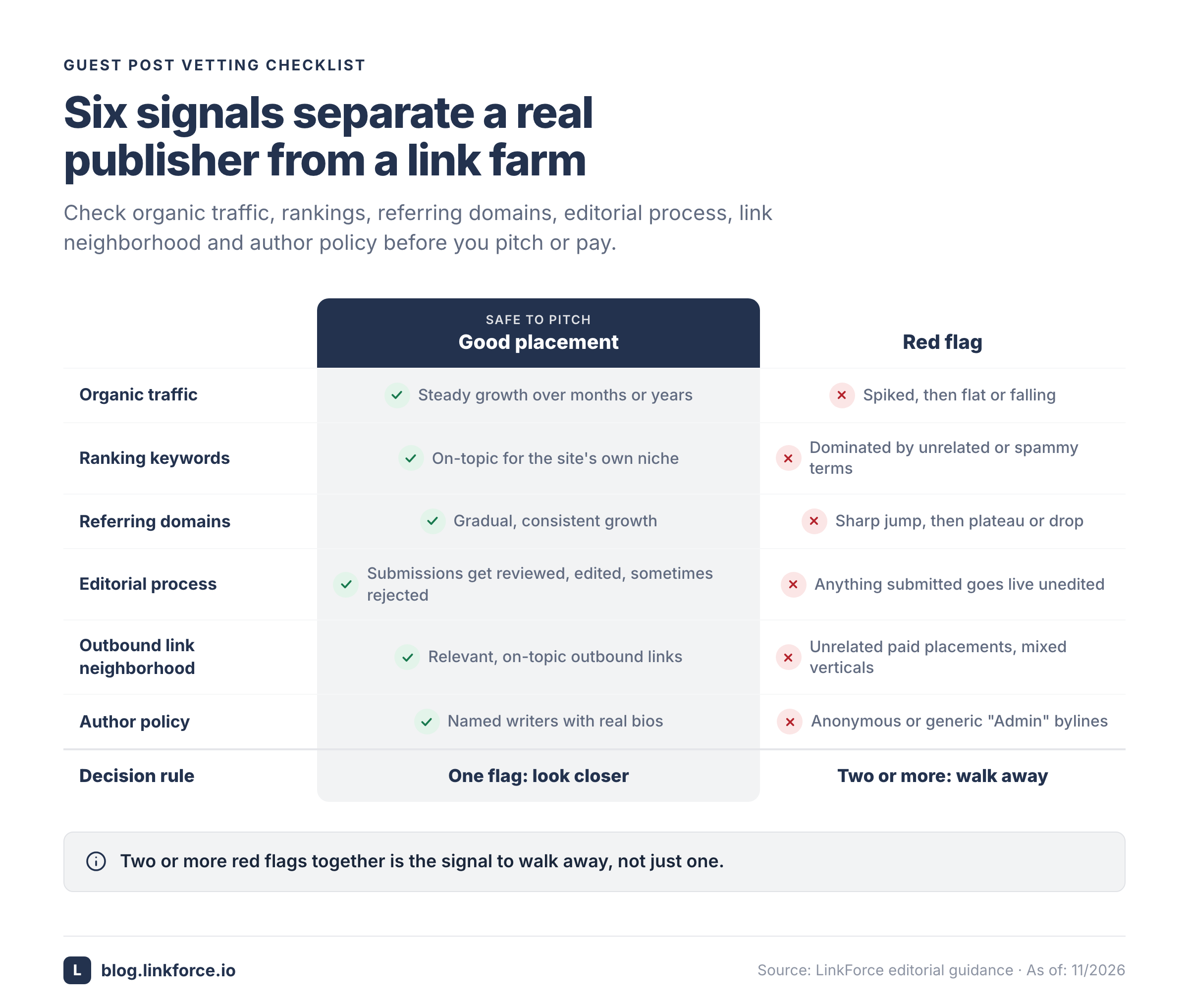
A site is worth a guest post when its traffic is real and growing, its content ranks for terms that matter to its own niche, and someone actually reads submissions before they go live. Domain Rating or Domain Authority alone can't tell you any of that, and honestly, most pitches that lead with those two numbers skip the questions that actually matter. A high score with no organic traffic behind it is a site metrics reward, not a site readers trust.
Before you pitch or pay for a placement, check these in order:
- Organic traffic trend, not the total. A site that grew steadily over two years is a different proposition from one that spiked last quarter and has been flat or falling since.
- What it actually ranks for. Pull its top organic keywords. A site that ranks for terms in your niche has real topical authority there. One that ranks mainly for unrelated terms is borrowing relevance it doesn't have, which many SEOs treat as a warning sign.
- Referring-domain growth shape. A smooth, gradual curve looks like a normal publication. A fast jump followed by a flat or falling line is a pattern many SEOs read as a possible sign of a private blog network or a bulk link purchase. It is a rule of thumb, not something Google has published as a test.
- Niche relevance over raw authority. A relevant site with a modest Domain Rating is worth more to your link profile than an unrelated site with a much higher one.
- Editorial review. Ask what the submission and review process looks like, or test it with a real pitch. A site that'll publish anything submitted, unedited, has no real editorial standard protecting its own readers, which is a quality problem whatever the policies say.
- The outbound link neighborhood. Scan the site's recent posts for the kind of links it carries. A page sitting next to unrelated paid placements for payday loans, gambling, or pharma tells you how the site actually makes its money.
| Signal | Good placement | Red flag |
|---|---|---|
| Organic traffic | Steady growth over months or years | Spiked, then flat or falling |
| Ranking keywords | On-topic for the site's own niche | Dominated by unrelated or spammy terms |
| Referring domains | Gradual, consistent growth | Sharp jump, then plateau or drop |
| Editorial process | Submissions get reviewed, edited, sometimes rejected | Anything submitted goes live unedited |
| Outbound link neighborhood | Relevant, on-topic outbound links | Unrelated paid placements, mixed verticals |
| Author policy | Named writers with real bios | Anonymous or generic "Admin" bylines |

800+ SaaS marketers swap partner, integration and content links. Free plan, no credit card.
Red Flags That Mean a Site Is a Link Farm, Not a Publisher
A few patterns show up often enough on bad guest-post sites that they are worth checking on their own, separate from the quality checklist above.
- Referring-domain velocity that doesn't match a real publication. A jump from a few hundred referring domains to several thousand in a matter of months, followed by a flat or falling line, is often read as a sign of a bulk link purchase or a private blog network rather than organic growth. Treat it as a prompt to look closer, since a legitimate site can also gain links in bursts, for example after a viral story.
- Traffic concentrated in an unrelated, often spammy vertical. A site that markets itself to your niche but earns most of its organic traffic from gambling, payday loans, or similar terms is monetizing through a different channel than the one it pitches to contributors.
- No visible editorial process. If a site publishes a submission exactly as sent, with no edits, no questions, and no rejections, there is no editorial standard behind it, only a paywall for access.
- A link list dominated by unrelated, obviously paid placements. Scroll the site's recent posts. A pattern of unrelated commercial links sitting in otherwise thin content is the clearest visible sign of a site built to sell links at scale.
- Reseller-style outreach behavior. A pitch that ignores what your site actually covers, or an inbox that starts sending you a different "opportunity" every week after one reply, usually means you are now on a broker's list rather than talking to an actual publisher.
None of these five on its own rules out a placement, since a legitimate site can have one odd metric for an innocent reason. Finding two or more together is the actual decision point, plainly, and the honest move at that stage is to walk away rather than talk yourself into it.
Anchor Text Strategy for Guest Post Links
Google's spam policies don't publish a safe ratio for exact-match anchor text. They do name "links with optimized anchor text in articles, guest posts, or press releases distributed on other sites" as an example of link spam, so repeating the same exact-match phrase across many guest posts is the pattern to avoid. A natural link profile mixes anchor types the way real citations do: a branded mention ("LinkForce"), a naked URL, a partial match that uses only part of the target phrase, and a generic phrase like "this guide" or "read more." Treat a guest post's anchor the same way you'd treat a citation in a real article. Let the surrounding sentence decide what reads naturally, rather than forcing the same money keyword into every placement you get. A single well-placed exact-match anchor inside a relevant article isn't inherently risky, but a pattern of exact-match anchors across every guest post you place is the kind of optimized-anchor pattern Google's link spam policy describes.
The free Anchor Text Analyzer shows distribution and ratios at a glance.
Link Attributes and Disclosure: rel=sponsored, Nofollow, and the FTC
A link arranged in exchange for payment, product, or any other compensation needs an attribute that tells Google it is not a pure editorial endorsement: rel="sponsored", which Google introduced alongside rel="ugc" in September 2019. Google describes it as the attribute for links created as part of advertisements, sponsorships or other compensation agreements, while rel="nofollow" is the older, more general option. Either qualifies a paid link under Google's spam policy. See our guide to the sponsored attribute and our guide to nofollow links for how each one behaves beyond guest posts specifically.
That attribute solves Google's concern, but it doesn't solve the reader's. In the United States, the FTC's Endorsement Guides (16 CFR 255.5) say a material connection between an endorser and the seller, such as payment or free products, must be disclosed clearly and conspicuously when the audience would not reasonably expect it. That is a rule about what readers understand, not about HTML markup. A link tagged correctly for Google can still leave a reader with no idea the post was paid for. Both pieces, the link attribute and the visible disclosure, are needed, and neither one substitutes for the other.
Why the Byline on a Guest Post Still Matters
A guest post with a real, named author and a visible bio is easier to judge than one credited to "Admin" or left unsigned, for the host site and for the brand behind the link alike. A named contributor with a presence across their own site and other publications gives both the host and the reader something to verify. An anonymous contributor pool, the kind a link-farm style site tends to run on, doesn't give either side anything to check. If you're placing or accepting guest content, treat the byline as part of the quality bar, not a formality to fill in after the fact.
Frequently Asked Questions
Does Google penalize guest posts?
No, writing or publishing a guest post is not in itself a violation. Google's rules bite at two different points instead: the individual link (unqualified paid links fall under the spam policy) and the host site's own pattern of publishing (third-party pages published mainly to borrow the host's ranking signals fall under site reputation abuse). A single well-placed, properly tagged guest post on a site with real editorial standards is unlikely to trigger either.
Do I need to use rel=sponsored or nofollow on a guest post link?
Yes, if payment, product, or a reciprocal exchange was involved in getting the link placed. You can check what's actually on a live link by right-clicking it, choosing "Inspect," and reading the anchor tag's attributes in the HTML, rather than taking the publisher's word for it. A link with neither attribute, acquired through any kind of exchange, is the exact configuration the policy is written to catch.
How many guest posts should I publish per month?
Google publishes no recommended number of guest posts per month, and the figures that circulate in guides (commonly one to two, or four to ten) are rules of thumb, not something Google has confirmed. A more useful cadence question is how many sites clear the vetting criteria above in a given month. Some months that's one site, some months it's none, and forcing a quota regardless pushes you toward the weaker sites still left on the list.
Is a guest post with an exact-match anchor automatically bad?
No, context decides that, not the anchor alone. A sentence like "see LinkForce's own guide to anchor text" reads as a normal citation even with an exact-match phrase inside it, while the same phrase bolted onto an unrelated sentence reads as inserted. Judge each anchor by whether the sentence around it would still make sense with the link removed.