

PageRank is one of the most important concepts in SEO, yet most practitioners only understand it at a surface level. If you build links for a living, understanding how PageRank actually works — and what it means for your strategy today — is not optional.
This guide covers everything: the algorithm mechanics, the history, the 2024 Google API leak that confirmed PageRank is still active, how to measure it with modern proxy metrics, and what you can do right now to improve it.
What Is PageRank?
PageRank is a link analysis algorithm developed by Google founders Larry Page and Sergey Brin during their research at Stanford University in 1996 and 1997. The algorithm assigns a numerical score to every web page based on the number and quality of other pages linking to it. The higher a page’s PageRank, the more important Google considers it to be.
The name is a double reference: it ranks pages, and it was developed by Larry Page.
PageRank was designed to solve a problem earlier search engines struggled with: determining which pages were actually authoritative versus which were just stuffed with keywords. The key insight was elegant — treat each hyperlink as a vote. Pages that receive many votes from other respected pages earn a high score. Pages with few or low-quality links earn a low score.
PageRank was designed to:
- Measure the relative importance of a web page within the broader web graph
- Identify authoritative sources by following the trail of links
- Reduce the influence of pages that tried to game rankings through keyword manipulation alone
This algorithm became the technical foundation that made Google superior to every competing search engine at the time of its 1998 launch. Alta Vista and Yahoo relied on keyword density and meta tags; Google used the entire link graph of the web as its quality signal.
How Does PageRank Work?
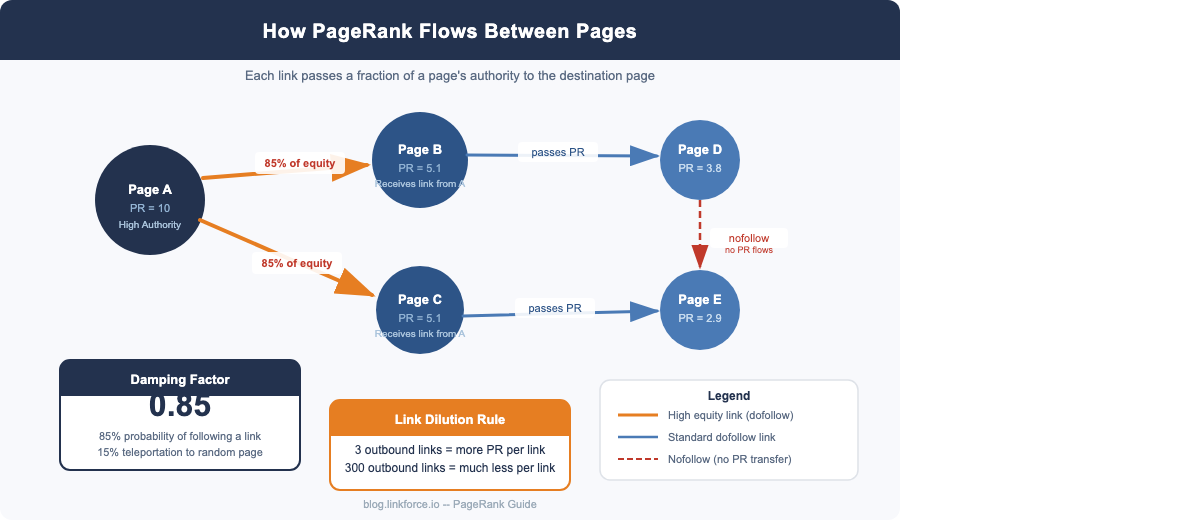
PageRank works by treating each link from one page to another as a vote of confidence. However, not all votes count equally. A link from a page that already has high PageRank is worth considerably more than a link from a page with low PageRank. This means the scores are interdependent — you need to calculate the whole web simultaneously.
The algorithm solves this through iterative calculation. It starts by assigning every page an equal score, then repeatedly recalculates scores based on the incoming links from neighboring pages. After enough iterations, the scores converge to a stable set of values. Research indicates convergence occurs in approximately 52 iterations for a web graph of 322 million links.
A link from a page with 3 outbound links passes more PageRank than a link from a page with 300 outbound links, because the total link equity is divided among all outbound links on the page. This is sometimes called link dilution, and it matters directly for link-building strategy: fewer, more focused outbound links on a page means each individual link carries more weight.
The Damping Factor Explained
The damping factor is the single most important parameter in the PageRank formula. It represents the probability that a user following links will continue clicking rather than jumping to a random page. Google set this value at 0.85 in the original algorithm.
In practical terms: a damping factor of 0.85 means there is an 85% chance that the random surfer clicks the next link on a page, and a 15% chance they get bored and navigate directly to a random URL. This 15% “teleportation” probability prevents the algorithm from getting stuck in loops where small clusters of pages keep passing PageRank back and forth indefinitely.
The damping factor also means that PageRank decays as it passes through a chain of links. Each hop transfers only 85% of the value. A direct link from a high-PageRank page is almost always more valuable than a link from a page two or three hops away from that same source.
The Random Surfer Model
The random surfer model is the conceptual framework behind PageRank. Imagine a web user who starts on a random page and either clicks links randomly or, with a small probability, jumps to a completely random page on the web. After an infinite amount of browsing, the proportion of time this imaginary user spends on any given page becomes that page’s PageRank score.
This framing matters for SEO because it explains why link placement and crawlability are so important. If a page is hard to reach through links — buried deep in a site with few internal links pointing to it — the random surfer rarely arrives there, and PageRank accumulates slowly. Crawlability and link architecture are not just technical concerns; they are PageRank concerns.
The History of Google PageRank
PageRank Is Born (1996-1998)
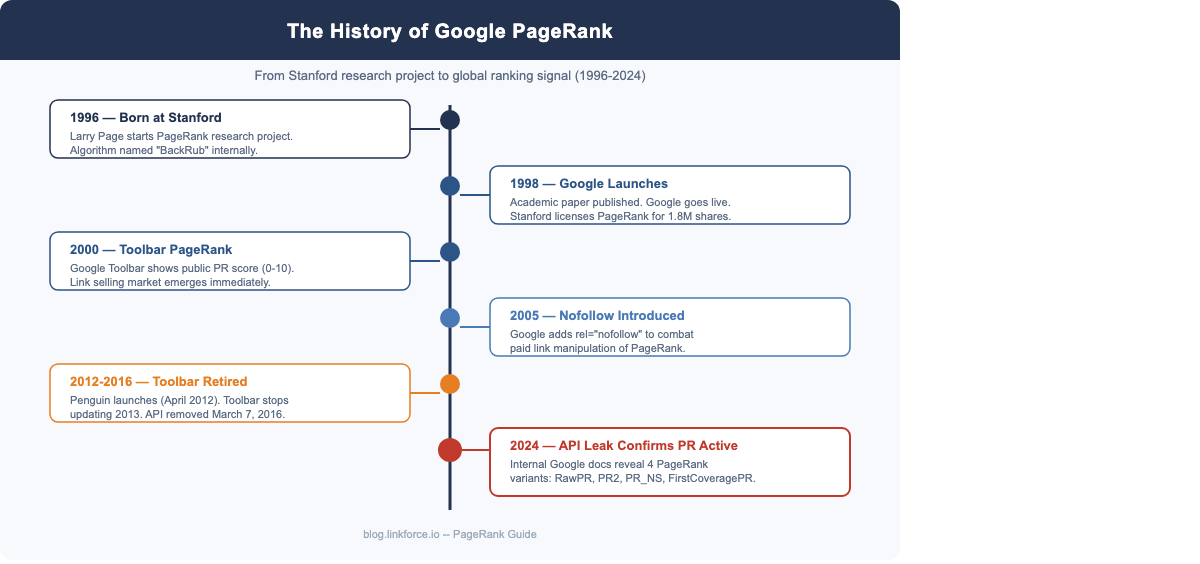
Larry Page began developing the PageRank algorithm as a research project at Stanford in 1996. He and Sergey Brin described the algorithm and their early search engine (then called “BackRub”) in a 1998 academic paper titled “The Anatomy of a Large-Scale Hypertextual Web Search Engine.” The paper introduced PageRank to the academic community and laid out the core formula.
Stanford University filed for a patent on PageRank and licensed it to Google as part of the spin-out agreement. In exchange, Stanford received 1.8 million shares of Google stock, which the university sold in 2005 for approximately $336 million. The original PageRank patent expired on January 9, 2018, though a follow-on patent expired September 24, 2019.
Google incorporated PageRank as the central algorithm of its search engine and launched publicly in September 1998. The algorithm gave Google an immediate quality advantage over Alta Vista and Yahoo, which relied more heavily on keyword density and meta tags.
The Google Toolbar and Public Scores (2000-2016)
In 2000, Google introduced the Google Toolbar for web browsers. The toolbar included a visible PageRank display showing a page’s score on a scale of 0 to 10. This made PageRank transparent to the public for the first time and immediately turned it into an SEO metric that webmasters and link builders tracked obsessively.
The public availability of PageRank scores had an unintended consequence: it created a market for selling links on high-PageRank pages. If a page had a toolbar score of 6 or 7, it could command significant fees for paid links. Google responded by introducing the nofollow attribute in 2005, allowing site owners to signal that a link should not pass PageRank, and by penalizing sites caught selling links.
Google also launched the Penguin algorithm in April 2012 to target manipulative link-building practices directly, followed by SpamBrain (announced December 14, 2022) — an AI-powered spam detection system that operates on links at scale.
Google stopped updating toolbar PageRank scores after November 2013. The PageRank data was removed from the Google Toolbar API on March 7, 2016, ending public access entirely. The algorithm was also substantially rewritten around 2006 to use a faster computation method than the original iterative formula.
The 2024 Google API Leak
In March 2024, a large cache of internal Google Search API documentation was leaked and analyzed by SEO researchers. The documents confirmed that Google still actively uses PageRank internally and revealed that multiple variants of the algorithm exist:
- RawPageRank — the baseline computed PageRank value for a page
- PageRank2 — an updated variant of the algorithm
- PageRank_NS — a namespace-aware PageRank variant
- FirstCoveragePageRank — a variant that appears to track initial coverage or crawl priority
The existence of these variants confirms that PageRank has evolved significantly beyond the original formula. It is not a single number but a family of signals that Google uses in different ways within its larger ranking system.
What Factors Influence PageRank?
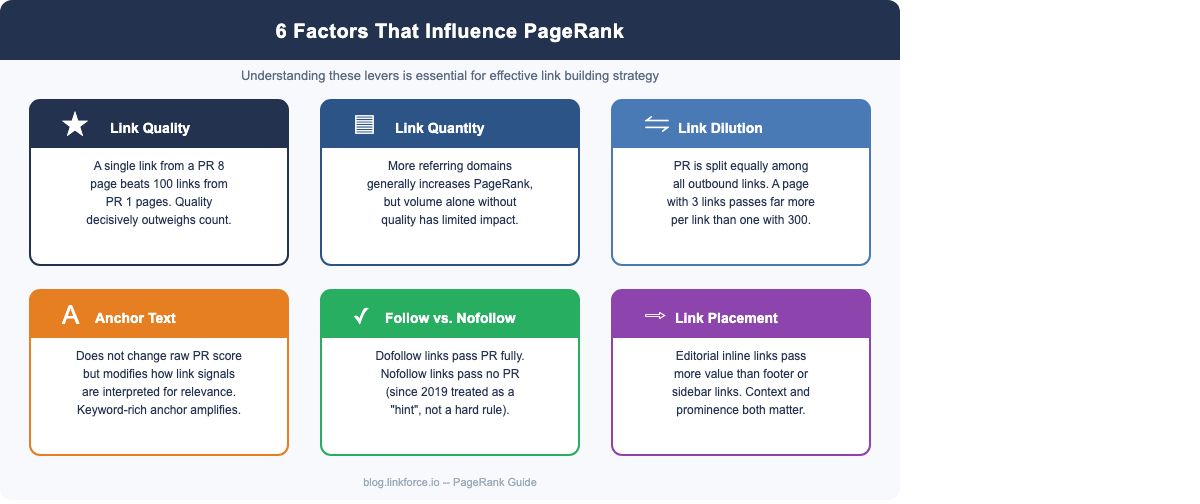
PageRank is not just a count of backlinks. Several factors modify how much link equity flows from one page to another.
| Factor | Effect on PageRank |
|---|---|
| Link quantity | More links generally means higher PageRank, but quality outweighs count |
| Linking page authority | High-PageRank pages pass substantially more link equity |
| Outbound links on linking page | More outbound links = less equity per link (dilution) |
| Anchor text | Contextual signal that modifies relevance (not the raw PageRank score) |
| Follow vs. nofollow | Nofollow links do not pass PageRank; dofollow links do |
| Link placement | Editorial inline links typically pass more value than footer/sidebar links |
Link Quantity vs. Link Quality
The number of linking pages matters, but quality outweighs quantity decisively. A single link from a page with a PageRank of 8 is worth more than a hundred links from pages with a PageRank of 1. The formula distributes a page’s PageRank evenly across all its outgoing links — so a link from a page that only links to 3 other pages passes far more equity than a link from a page that links to 300 other pages.
This is link dilution in action: the more outbound links a page has, the less PageRank each individual link carries. For link builders, this means the placement context of a link matters, not just whether a link exists.
Anchor Text
While anchor text does not directly change the PageRank score, the 2024 Google API leak and multiple research papers confirm that anchor text is treated as a modifier that influences how link signals are interpreted. Descriptive, keyword-relevant anchor text helps Google understand the context of the link and can amplify its relevance signal even if the raw PageRank value is unchanged. Exact-match anchor text that looks unnatural can also attract negative attention from SpamBrain.
Nofollow Links
Google introduced the nofollow attribute in 2005 specifically to address paid link manipulation of PageRank. A nofollow link instructs Google’s crawlers not to pass PageRank to the linked page. Originally this was a hard rule; Google updated its interpretation in 2019 to treat nofollow as a “hint” rather than a directive, meaning some nofollow links may pass partial link equity in certain contexts.
For practical link-building purposes, dofollow links remain far more valuable for PageRank purposes than nofollow links. For a complete overview of how dofollow and nofollow links work in practice, see our guide on do-follow and no-follow links.
Internal Links
Internal links — links between pages on your own site — pass PageRank exactly the same way external backlinks do. Your homepage typically accumulates the most PageRank from external sources. By creating thoughtful internal links from your homepage and high-authority hub pages to your important target pages, you distribute that accumulated equity throughout your site. Many sites unknowingly let PageRank pool in pages that nobody important links to, rather than routing it toward revenue-generating content.
What Is Link Juice and How Does It Relate to PageRank?
Link juice is the popular SEO term for the PageRank value that flows from one page to another through a hyperlink. When a page with high PageRank links to your page, it passes link juice — a portion of its own authority — to you. The more link juice flows into your page, the higher your PageRank climbs.
Think of link juice as water flowing through a pipe network. Each pipe (hyperlink) carries a flow of authority from one reservoir (page) to another. If a pipe is blocked by a nofollow attribute, the flow stops at that junction. If a reservoir (high-PageRank page) connects to too many pipes simultaneously (many outbound links), the flow through each individual pipe decreases because the total volume is divided.
The flow of link juice follows the same rules as PageRank: it decays with each hop (because of the damping factor), it is divided among all outbound links on the linking page, and it stops flowing through nofollow links.
For link builders, thinking in terms of link juice is useful because it frames link acquisition as a resource with flow and direction, not just a count. You can have many links but receive little juice if the linking pages are low-authority. Conversely, a few links from very high-authority sources can pass enormous amounts of juice.
Link juice also flows through your own site architecture. An orphaned page — one with no internal links pointing to it — receives no internal link juice regardless of how strong your domain is. Pages buried three or four levels deep in the site structure receive less accumulated juice than pages accessible from the homepage. Strong internal linking is therefore a way to pump juice from high-authority pages down to pages you want to rank.
For a deeper look at link equity and how to maximize it, see our guide on link juice.
Does Google Still Use PageRank in 2025?
Yes. Google confirmed this through multiple sources spanning almost a decade.
In 2017, Google Search Advocate Gary Illyes stated publicly that PageRank is still calculated for all pages Google crawls and that it continues to be part of the ranking process, even though Google no longer makes scores publicly visible. This was not a vague corporate non-answer; Illyes was speaking directly about PageRank as an active signal.
The March 2024 Google API documentation leak provided the most detailed confirmation yet. The leaked documents revealed not just that PageRank exists, but that Google operates multiple PageRank variants simultaneously:
- RawPageRank: the baseline computed value
- PageRank2: a next-generation variant
- PageRank_NS: a namespace-aware variant (relevant for handling site structure)
- FirstCoveragePageRank: a variant that influences crawl priority and initial indexing
These variants are used as inputs to Google’s broader machine-learning ranking systems alongside other signals.
PageRank today is not a standalone ranking factor in the simple 0-10 scale sense. It has been absorbed into Google’s larger quality and authority framework, which includes:
- E-E-A-T signals (Experience, Expertise, Authoritativeness, Trustworthiness)
- Link spam detection via SpamBrain
- Anchor text and context signals
- User behavior and engagement signals
The bottom line: while the public toolbar is gone and the original formula has been updated substantially, the concept of link-based authority — which is what PageRank measures — remains central to Google’s approach to ranking. Building high-quality links still builds PageRank, which still influences rankings.
How to Check PageRank Today
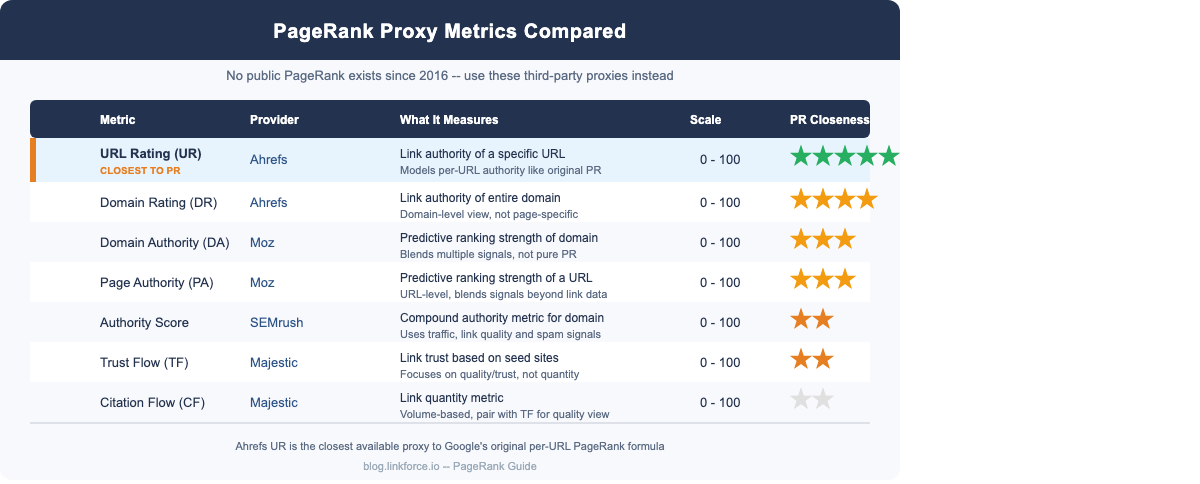
Google removed public PageRank data in 2016. There is no official way to check a page’s actual PageRank score. However, several third-party tools offer proxy metrics that correlate strongly with Google’s internal PageRank:
| Metric | Provider | What It Measures | Scale |
|---|---|---|---|
| URL Rating (UR) | Ahrefs | Link authority of a specific URL | 0-100 |
| Domain Rating (DR) | Ahrefs | Link authority of the entire domain | 0-100 |
| Domain Authority (DA) | Moz | Predictive ranking strength of a domain | 0-100 |
| Page Authority (PA) | Moz | Predictive ranking strength of a specific URL | 0-100 |
| Authority Score | SEMrush | Compound authority metric for a domain | 0-100 |
| Trust Flow (TF) | Majestic | Link trust quality based on seed sites | 0-100 |
| Citation Flow (CF) | Majestic | Link quantity metric | 0-100 |
None of these metrics is identical to Google’s internal PageRank. They are third-party estimates computed from the same raw data (backlinks) using different algorithms. Ahrefs URL Rating (UR) is generally considered the closest proxy to Google’s original PageRank formula, because it specifically models the per-URL link authority rather than blending in domain-level signals the way DA does.
Use these metrics to compare relative authority between pages and sites, prioritize link targets, and track the impact of link-building campaigns. Avoid treating them as absolute ground truth or assuming a given score directly translates to a Google ranking position.
For a deeper comparison of backlink data across tools, see our guide on backlinks analysis.
How to Improve Your PageRank
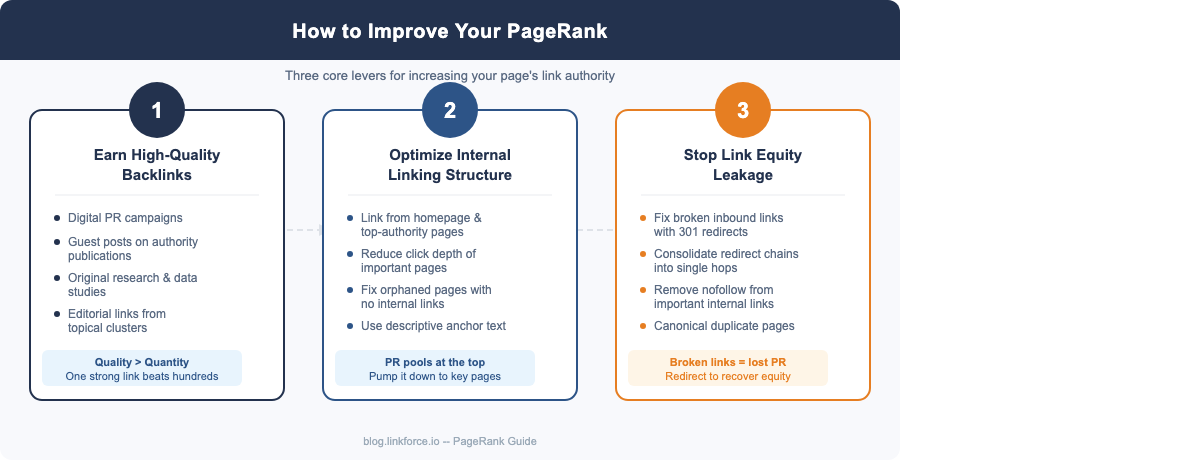
Since PageRank flows through links, improving it comes down to three levers: acquiring more high-quality links, distributing existing link equity more effectively through internal linking, and stopping unnecessary equity leakage.
Earn High-Quality Backlinks
The most direct way to increase PageRank is to earn links from pages that already have high PageRank. A single editorial link from a major news site or industry authority can pass more equity than dozens of directory or forum links.
Tactics that produce high-PageRank links include:
- Digital PR campaigns that earn coverage from high-authority news sources
- Guest posting on established industry publications (dofollow editorial links only)
- Creating original research, data studies, or tools that attract natural citations
- Building relationships with authoritative bloggers and journalists in your niche
- Pursuing editorial links from topically relevant domains in your cluster
For a systematic approach to acquiring these links, see our guides on backlink outreach and backlinks analysis.
Build a Strong Internal Linking Structure
Internal links are an underused PageRank lever. Your homepage and top-level category pages typically receive the most external links and therefore accumulate the most PageRank. Without deliberate internal linking, that equity sits in your homepage rather than flowing to the pages you want to rank.
Best practices for internal linking to maximize PageRank flow:
- Link from your highest-authority pages (homepage, top-performing posts) to your target pages
- Reduce the click depth of important pages — the fewer clicks from the homepage, the more PageRank they accumulate
- Use descriptive anchor text in internal links rather than “click here” or “read more”
- Audit your site for orphaned pages that receive no internal links and therefore no internal PageRank
- Consolidate thin or duplicate content to avoid splitting link equity across multiple similar pages
Fix Broken Links and Redirect Chains
Broken links are PageRank sinkholes. If an external site links to a page on your site that now returns a 404 error, all that link equity is lost. Use a crawler like Ahrefs Site Audit or Screaming Frog to find broken inbound links and redirect them (301) to the most relevant live page.
Redirect chains (page A redirects to page B which redirects to page C) also cause PageRank loss at each hop. Consolidate chains into direct single redirects wherever possible.
For a deeper look at recovering PageRank through broken link reclamation, see our guide on broken link building.
Avoid Wasting Link Equity
Common sources of PageRank leakage that are easy to fix:
- Nofollow tags on important internal links (removes them from the PageRank flow entirely)
- Links to low-value pages (pagination, tag archives, admin pages) from high-authority pages
- Excessive outbound links on important pages (each additional link dilutes the equity passed to every destination)
- Duplicate pages that split incoming links between two URLs (canonical tags consolidate the signals)
- Crawl blocks via robots.txt or noindex tags that prevent Google from seeing and crediting internal links
Common PageRank Myths
Several persistent misconceptions circulate in SEO communities that are worth addressing directly.
Myth: PageRank is dead. This is false. The public toolbar scores are gone, but PageRank as an internal signal is confirmed active by Google employees and by the 2024 API leak.
Myth: Domain Authority is Google’s replacement for PageRank. Domain Authority is a Moz invention with no relationship to Google’s systems. Google never created a public replacement for toolbar PageRank.
Myth: More links always means higher PageRank. A large volume of links from low-authority, newly created, or spammy sites may have little positive effect and could trigger SpamBrain. Quality of linking pages matters more than raw count.
Myth: You can sculpt PageRank with nofollow on internal links. Google’s 2009 update to how it handles PageRank sculpting via nofollow internal links largely eliminated this as a tactic. The equity that does not pass through a nofollowed link is simply lost rather than redistributed to other followed links.
Myth: Nofollow links are worthless. They do not pass PageRank, but they can pass referral traffic, build brand awareness, and increase the likelihood that you earn future dofollow links from those sources.
Frequently Asked Questions About PageRank
Is PageRank the same as Domain Authority?
No. Domain Authority (DA) is a metric created by Moz, a third-party SEO software company. PageRank is Google’s proprietary algorithm. Both measure link authority, but they use different formulas and data sources. Domain Authority attempts to predict ranking ability; PageRank is Google’s actual signal for measuring page importance. Ahrefs URL Rating (UR) is generally considered a closer proxy to PageRank than Domain Authority is.
What is a good PageRank score?
Google no longer publishes public PageRank scores, so there is no current reference scale. In the era of toolbar PageRank (before 2016), most average pages scored between 1 and 3. A score of 5 or higher was considered strong. A score of 7 or above indicated a major authority page. Today, an Ahrefs URL Rating (UR) of 40+ is typically considered solid for most niches, while 70+ is reserved for top-tier authoritative pages.
Does getting more links always increase PageRank?
Not necessarily. PageRank is influenced by the quality and authority of linking pages, not just the raw count. A large volume of links from low-authority, newly created, or spammy sites may have little positive effect on PageRank and could potentially trigger Google’s SpamBrain spam filters. Focus on earning links from pages that are themselves well-linked and trusted.
Do internal links affect PageRank?
Yes. Internal links pass PageRank between pages on the same site in exactly the same way external links do. A strong internal linking strategy can significantly boost the PageRank of specific pages by routing equity from your most link-rich pages to your conversion-critical content. Many sites ignore internal linking and leave significant PageRank potential unrealized.
What happened to the Google Toolbar PageRank?
Google stopped updating toolbar PageRank scores after November 2013, though the data remained visible. The PageRank data feed was removed from the Google Toolbar API on March 7, 2016, making public PageRank scores inaccessible. Google stated that maintaining the public-facing metric was no longer worth the effort, as it had become primarily a tool for link sellers rather than a useful signal for webmasters. The toolbar itself was discontinued on April 15, 2016.
Can nofollow links hurt my PageRank?
No. Nofollow links do not pass PageRank, but they also do not reduce the PageRank you have already accumulated. If a high-authority site links to you with a nofollow attribute, you receive no direct PageRank benefit from that link, but your existing PageRank is not reduced. Nofollow links can still drive referral traffic and increase visibility that leads to future dofollow links.
How long does it take to improve PageRank?
PageRank changes take time to register because they depend on Google crawling and indexing links. Typically, you might see measurable changes in proxy metrics like Ahrefs URL Rating within four to twelve weeks of acquiring a high-quality backlink, depending on how frequently Google crawls both the linking and linked pages. Major improvements require sustained link acquisition over months. PageRank is an accumulation of earned authority over time, not a metric that responds to short-term bursts.
Is PageRank calculated at the page level or the domain level?
PageRank is calculated at the individual page level. Each URL on the web has its own PageRank score based on the specific links pointing to that URL. However, the overall link profile of a domain influences how much equity individual pages accumulate, because strong pages on the same domain can pass PageRank to each other through internal links. This is why both page-level metrics (like Ahrefs UR) and domain-level metrics (like DR or DA) are useful for different purposes.