
AI SEO services combine two things: software that automates repeatable search tasks, and human strategists who handle judgment calls, brand risk, and anything the software gets wrong. Here is the short version. Some work is safe to hand to AI today: schema validation, keyword clustering, rank tracking, first-draft content structuring. Other work still needs a person who understands the business, not just the query: E-E-A-T judgment, brand voice, fact-checking, prioritization. Most SEO agency and digital marketing agency offerings in this category now test brand visibility across ChatGPT, Perplexity, Gemini, and Google AI Overviews, then adjust schema markup, structured data, and entity signals (the technical building blocks of AEO and GEO) to fix what those systems get wrong. This guide breaks that split down task by task. It prices out what AI SEO services cost, and it gives you a checklist for evaluating a vendor before you sign a contract.
What Are AI SEO Services?
AI SEO services use AI tools, plus human strategy, to optimize a brand’s visibility across AI Overviews, generative engine results (GEO), answer engines (AEO), and traditional organic search at the same time. In practice, that means testing how a brand shows up across large language models like ChatGPT, Perplexity, Gemini, and Bing Copilot. From there, providers adjust content, structured data, and entity signals so those systems can find, understand, and cite the brand accurately.
This is not a replacement for traditional SEO. Think of it as traditional SEO’s scope, extended to cover surfaces that did not exist a few years ago. A page still needs to rank in classic blue links. But it also needs to be structured well enough that an AI Overview or a chatbot can lift an accurate answer out of it and attribute the source correctly. Most providers test visibility across four AI surfaces at minimum: ChatGPT, Perplexity, Gemini, and Bing Copilot. They then work backward from those results to fix the structural and entity gaps causing a brand to be missing or misrepresented.
What AI Can Reliably Automate in SEO
AI is dependable for tasks that are repeatable, rules-based, and have one broadly correct answer. Low failure risk, high time savings. That combination is what makes a task worth automating first:
- Keyword clustering and query grouping. Sorting hundreds of keywords into topic clusters by search intent is pattern-matching work AI does quickly and consistently.
- Technical audits. Crawling a site for broken links, missing alt text, duplicate titles and slow Core Web Vitals is a checklist task, not a judgment task.
- Schema and structured data validation. Checking that FAQPage, Product, Article and Organization markup is present and error-free is binary. It either validates or it does not.
- Rank tracking and AI citation monitoring. Logging where a page ranks, and whether a brand gets cited inside an AI Overview or chatbot answer, is a monitoring job suited to automation.
- Internal link suggestions. Finding orphaned pages or suggesting contextual internal links across a site’s existing content is a mapping problem AI handles well.
- First-draft content structuring. Turning an approved outline into a structured first draft or heading skeleton is a safe starting point, as long as a human edits before publish.
What Still Needs a Human in AI SEO
The tasks that stay human are the ones where the “right” answer depends on context or brand risk, judgment a model cannot fully see:
- E-E-A-T and factual judgment. Verifying that a claim is true, current and properly sourced is not something AI can self-certify. Someone has to check the facts before they go live.
- Brand voice and positioning. AI can draft in a house style. But decisions about what a brand should and should not say, especially on sensitive or competitive topics, need a person who understands the business.
- Strategic prioritization. Deciding which pages, clusters or markets get attention first is a resourcing decision. It is not a pattern to detect.
- Client and stakeholder relationships. Explaining why a strategy changed, negotiating scope or managing expectations during a slow month requires a person, not a dashboard.
- Quality control before publish. Reviewing AI-drafted content for hallucinated facts, awkward phrasing or off-brand claims before it goes live is a human checkpoint. It should never be skipped.
- Ethical and legal judgment. Anything touching regulated claims, comparative advertising or sensitive topics needs a human sign-off. AI has no accountability if it gets this wrong.
The AI SEO Task Matrix: Automate, Assist, or Human-Led
Most AI SEO tasks fall into one of three categories, not a strict automate-or-not binary. The middle category, AI-assisted with mandatory human review, covers more ground than either extreme.
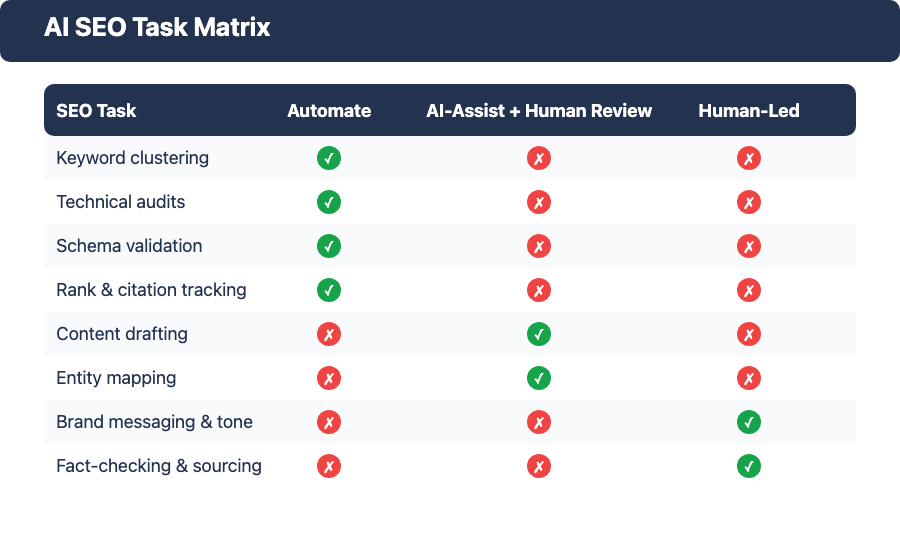
| SEO Task | Automate | AI-Assist + Human Review | Human-Led |
|---|---|---|---|
| Keyword clustering | Yes | ||
| Technical/crawl audits | Yes | ||
| Schema markup validation | Yes | ||
| Rank and AI-citation tracking | Yes | ||
| Content drafting | Yes | ||
| Internal linking strategy | Yes | ||
| Entity mapping | Yes | ||
| Competitor analysis | Yes | ||
| Brand messaging and tone | Yes | ||
| Fact-checking and sourcing | Yes | ||
| Client strategy and prioritization | Yes | ||
| Crisis or reputation response | Yes |
Use this matrix as a starting checklist when you scope a project or review a vendor’s proposal. One flag to watch for: if a vendor claims full automation on anything in the Human-Led column, that is not an efficiency win. It is a warning sign. The AI-Assist row for competitor analysis is worth a closer look on its own; see this SEO competitor research guide for what a human still needs to verify before acting on an AI-generated competitor report.
What AI SEO Services Typically Include
Most providers bundle the same core deliverables, even when the branding differs. The common categories:
- AI visibility and entity audit. A benchmark of how, and whether, a brand currently appears across ChatGPT, Perplexity, Gemini and Bing Copilot, plus Google AI Overviews.
- Structured data implementation. Adding or fixing Organization, Product, Service, FAQPage and HowTo schema so AI systems can parse the page correctly.
- Entity mapping. Connecting the pages on a site to the real-world entities, brands and concepts they should be associated with, so AI systems attribute the right expertise to the right source.
- Content structuring for answer-first formatting. Rewriting pages so the most useful answer appears early, in a form that is easy to extract and cite.
- AI citation and inclusion reporting. Ongoing measurement of whether a brand gets cited inside AI-generated answers, not just where it ranks in classic search results.
- AI-assisted link building and outreach. A newer category. Some providers now use AI to speed up prospecting and personalization in outreach email software; tools like Respona use AI to draft and personalize pitches at scale, while a human still approves the target list and the final message. Many teams pair this with dedicated link building software to manage prospecting, tracking, and reporting in one place, rather than folding it into a generic AI SEO retainer.
How Much Do AI SEO Services Cost?
Pricing splits into three clear tiers, and which one applies depends on whether you buy software or a managed service. Treat every figure below as a reported benchmark from published 2026 pricing pages and rate guides, not a fixed list price or a quote for your project.
| Pricing Tier (benchmark estimate) | Typical Monthly Range | What It Covers |
|---|---|---|
| Self-serve software | $49 to $299 | AI-assisted recommendations and monitoring, no managed strategy |
| Small business / mid-market retainer | $1,500 to $6,000 | Schema markup, technical audits, ongoing content, human team attached |
| Enterprise engagement | $10,000 to $45,000+ | Large-scale entity work, multi-model citation tracking across a big site footprint |
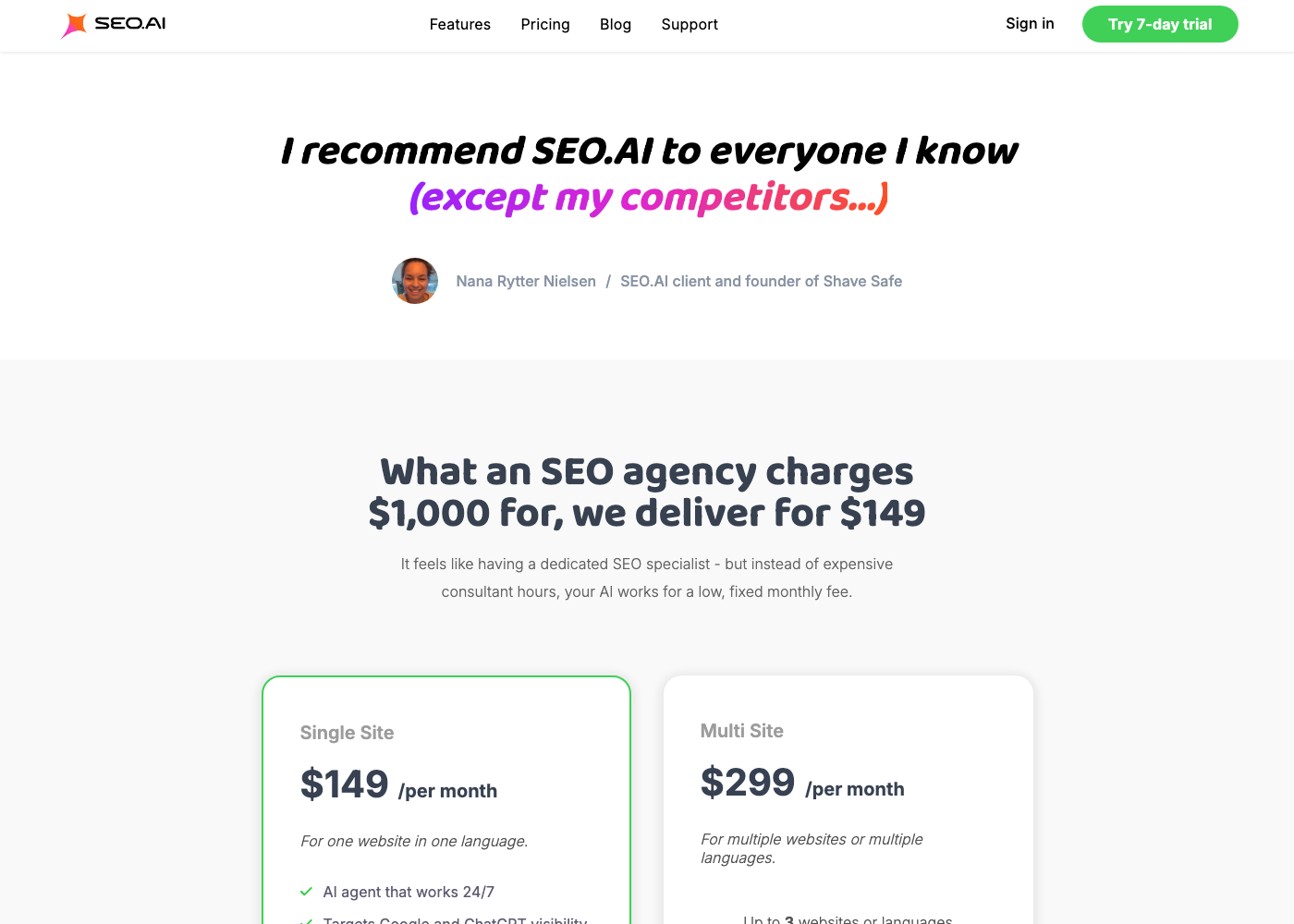
For a real, published example rather than an estimate: seo.ai’s pricing page lists a single-site plan at $149 per month and a multi-site plan at $299 per month, both inside the self-serve range above.
On top of a monthly retainer, expect a one-time setup or audit fee, usually $500 to $2,500 for an audit alone, or up to $10,000 when the fee bundles in the first round of technical fixes and strategy work. Need only the audit, not a retainer? Ask whether the provider offers an audit-only engagement. Not all do.
Keep software pricing and agency retainer pricing on two separate budget lines. A $149-per-month tool gives you AI-assisted content recommendations and monitoring. It does not give you a managed strategy, a human reviewing output, or someone accountable when something goes wrong. That gap is exactly what the retainer tiers above are paying for.
The Risks of Unchecked AI Automation in SEO
The most common failure in AI SEO is not that the AI is unreliable across the board. It is that automation gets applied to a task that needed a human checkpoint, and nobody caught it before publish. Four recurring risks to watch for:
- Hallucinated facts. AI models can generate confident, specific-sounding claims (statistics, dates, product details) that are simply wrong. Every AI-drafted fact needs a human source check before it goes live.
- Bulk content without review. Publishing AI-generated content at scale, without editorial review, tends to produce thin or repetitive pages that hurt trust more than they help visibility.
- Structured data errors at scale. One systemic error in an automated schema rollout can propagate across every page it touches. That is worse than doing schema by hand on fewer pages, correctly.
- Over-reliance on a single AI platform. Optimizing only for ChatGPT while ignoring how a brand appears in Google AI Overviews or Perplexity creates blind spots as the AI-search landscape keeps shifting.
None of this means AI SEO tools are unreliable. It means the Human-Led column in the matrix above exists for a reason: this is where things go wrong when nobody is checking.
How to Evaluate an AI SEO Vendor
Before signing a contract, ask a prospective AI SEO vendor these questions, and expect specific answers, not marketing language:
- What is automated, and what does a human review before it publishes? A vendor that cannot draw this line clearly for their own process is not one you want managing your brand.
- Which AI platforms do you actually test and report on? ChatGPT, Perplexity, Gemini and Bing Copilot coverage is close to the current baseline. Ask what happens when a new major AI surface appears.
- Does your reporting include AI citation tracking, not just rankings? Rank tracking alone is no longer a complete report for AI SEO work.
- Who fact-checks AI-drafted content before it publishes, and what does that process look like? Get a concrete answer, not “we use quality AI.”
- Is pricing a flat retainer, project-based, or usage-based, and what triggers a scope increase? This should land inside the ranges above. Anything far outside them deserves a direct question about what is different.
- Can you show a task you deliberately keep human-led, and explain why? A vendor who says “everything is automated” either has not thought this through, or is not being straight with you.
A vendor’s answers here tell you more about fit than their case studies do. Case studies show best outcomes. These questions show process.
Frequently Asked Questions
Is AI SEO different from traditional SEO?
Not entirely. AI SEO extends traditional SEO practices, technical health, content quality, link authority, to also cover AI Overviews, generative engines and answer engines. The two work together rather than replacing one another.
Can AI fully replace an SEO strategist?
No. AI automates repeatable execution tasks well: audits, clustering, schema validation. Strategic prioritization, brand judgment and fact-checking still need a human who understands the business and its risk tolerance.
What is the difference between AEO and GEO?
AEO (answer engine optimization) focuses on getting content selected as a direct answer, often inside AI Overviews or voice results. GEO (generative engine optimization) is the broader practice of optimizing for generative AI platforms like ChatGPT and Perplexity. Most AI SEO services cover both under one umbrella.
How much do AI SEO services cost per month?
Software tools run about $49 to $299 per month. Small business and mid-market agency retainers run about $1,500 to $6,000 per month. Enterprise engagements run $10,000 to $45,000 or more per month, plus a possible one-time setup or audit fee.
Do AI SEO services include link building?
Many do. Some providers now use AI tools to speed up prospecting and outreach personalization, while a human still approves targets and final pitches before anything gets sent.