
Most "best link building agency" lists just rank vendors and move on. They do not help once you have a name in front of you, a quote in your inbox, and a contract to sign. A link building agency builds backlinks on your behalf to help your SEO rankings, and the quality of that work varies enormously between vendors. This guide skips the ranking and gives you the part that matters more. It covers what a link building agency actually does, what it should cost, how to check its backlinks before you pay, the red flags that mean walk away, the contract terms to demand, and whether an agency is even the right call compared with building the skill in-house. A single bad agency can cost you months of budget. In the worst cases it can trigger a Google penalty that takes far longer to undo than it took to create.
What Does a Link Building Agency Actually Do?
A link building agency gets other websites to link back to your site, with the goal of improving your search rankings and referral traffic. The deliverable is almost always one of four types, and most agencies mix them depending on your budget, niche, and how aggressive you want the campaign to be. This guide covers agencies in general; if you specifically run a SaaS product, our link building for SaaS guide covers the SaaS-specific angles (product-led link opportunities, SaaS directories) this one does not.
- Guest posts and blogger outreach. The agency pitches a relevant blog or publication, writes or supplies an article, and gets a link back to your site placed naturally in the content. This is the most common deliverable because it scales predictably: more outreach volume generally means more placements, within the limits of how many relevant sites exist in your niche.
- Digital PR. The agency builds a newsworthy asset, a study, a data story, a survey, or an interactive tool, and pitches journalists and publications to cover it, earning links as a byproduct of the coverage rather than paying for placement. This tends to produce fewer but much stronger links, often from sites a guest-post pitch could never reach. If this is the deliverable you care about most, see our guide to digital PR agencies for how to choose one.
- Resource page and niche-edit placements. The agency finds existing pages that already rank for related terms. It then either gets your link added to a relevant resource list, or inserted into existing content as a "niche edit." These are usually faster and cheaper than a full guest post, because no new content needs to be written by the publisher.
- Content partnerships. Ongoing arrangements where two sites exchange or place links as part of a broader content relationship, usually with an editorial calendar attached. This model shows up most often between established publishers in the same industry rather than between a brand and a random blog.
Pricing, risk, and turnaround time differ sharply by type. A niche edit can go live in days; a digital PR placement can take weeks of pitching and still fail to land. That is why the next section breaks cost down by deliverable rather than giving you a single number.
How Much Does a Link Building Agency Cost?
Link building agencies price their work two ways: a flat fee per link, or a monthly retainer that bundles a set number of links with strategy, outreach, and reporting. Both models are common, and the right one depends on how much volume you need and how hands-off you want to be. For a closer breakdown of what a typical retainer actually bundles, see our guide to link building packages.
As of October 2026, two US agencies publish detailed pricing on their own sites, and the spread between them is a useful real-world range:
| Link building pricing model | Range (USD) | Source |
|---|---|---|
| Guest posts / blogger outreach (per link) | $297-$600 | Stellar SEO, own pricing page |
| Niche edits (per link) | $225 | Stellar SEO, own pricing page |
| Digital PR placements (per link) | roughly $750-$1,500+ | Stellar SEO, own pricing page |
| Monthly retainer, entry tier | $900-$2,500 | Pronto Marketing ($900) and Stellar SEO ($2,500), own pricing pages |
| Monthly retainer, mid tier | $1,800-$7,500 | Pronto Marketing and Stellar SEO, own pricing pages |
| Monthly retainer, top tier | $2,600-$10,000+ | Pronto Marketing and Stellar SEO, own pricing pages |
The spread is wide on purpose, not a typo. Pronto Marketing's four tiers (Novice through Advanced) run from $900 to $2,600 a month. These are aimed at smaller sites that need a steady, modest link flow in a less competitive niche. Stellar SEO's three tiers (Starter/Foundation, Growth, Authority/Enterprise) start at $2,500 and scale past $10,000 a month. These are aimed at competitive niches that need higher volume and heavier digital PR work. Neither number is "the" market rate. Both are the vendor's own listed rates for different levels of ambition, not a binding quote for your specific site, and any agency you talk to should still confirm its price in writing for your exact scope before you sign.
Three things to check before you compare any quote against this table:
- Ask what counts as a "link." A niche edit and a fully-written, pitched guest post are not the same deliverable, even if a vendor prices them the same per unit. Make the agency define exactly what one "link" in their package includes.
- Ask about minimum commitment. Most agencies require a minimum number of months before results are measurable, often three to six. Get that number in writing before you sign, in a contract that also states a link-replacement clause and a cancellation notice period; it is the single biggest factor in your total spend, not the monthly figure alone.
- Treat any single-number "average cost of a backlink" claim with suspicion. Prices vary this much by link type, domain authority, and niche competitiveness that a blended average tells you almost nothing about what you will actually pay for your specific site.
The free Anchor Text Analyzer shows distribution and ratios at a glance.
How to Vet a Link Building Agency Before You Sign
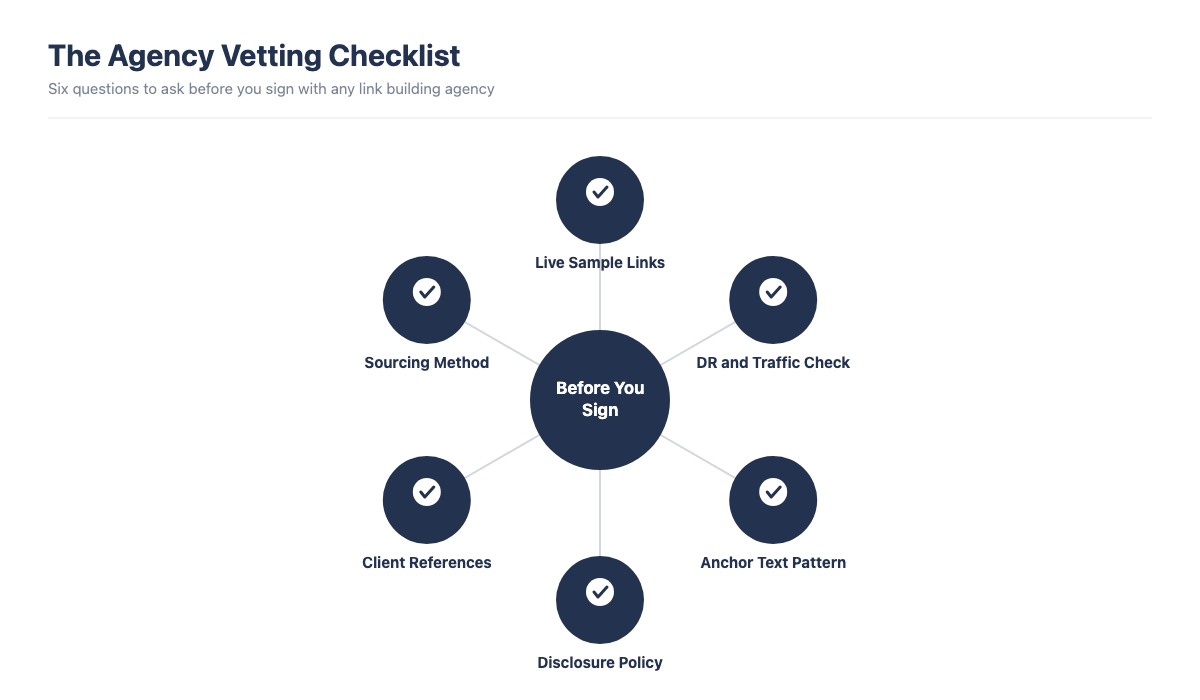
Before you commit a budget, run every agency you are considering through the same checklist. This is the step most buyer's guides skip entirely, and it is the one that actually prevents wasted spend, because a confident sales pitch and a real, verifiable process are not the same thing.
- Ask for live, working sample links, not screenshots or a PDF case study. A screenshot can show a link that was removed months ago; a live URL you can click proves the placement still exists today.
- Check the domain rating and organic traffic of the sites in those samples, not just the domain name. A recognizable-sounding site with near-zero organic traffic is a weak placement no matter how legitimate the brand name looks on a case study slide.
- Check the anchor text pattern across the samples. A heavy skew toward exact-match commercial anchors ("best [your product] software") on every link is a spam signal, not a strength; natural link profiles mix branded, generic, and partial-match anchors.
- Ask whether placements are disclosed as sponsored or paid where required. An agency that will not answer this directly, or gets defensive about the question, is telling you something about how it operates.
- Request two or three client references you can actually contact, not just logos on a case-studies page. A real client will tell you about response times, reporting accuracy, and whether links actually stayed live.
- Ask how they source placements: do they own or control the sites they place links on, buy access to a private network, or pitch genuinely independent publishers? The honest answer to this one question tells you more about long-term risk than anything on a pricing sheet.
If an agency cannot or will not answer these six questions with specifics, not generalities, that alone is a reason to keep looking before you sign anything.
800+ SaaS marketers swap partner, integration and content links. Free plan, no credit card.
Red Flags That Signal a Spam or Low-Quality Agency
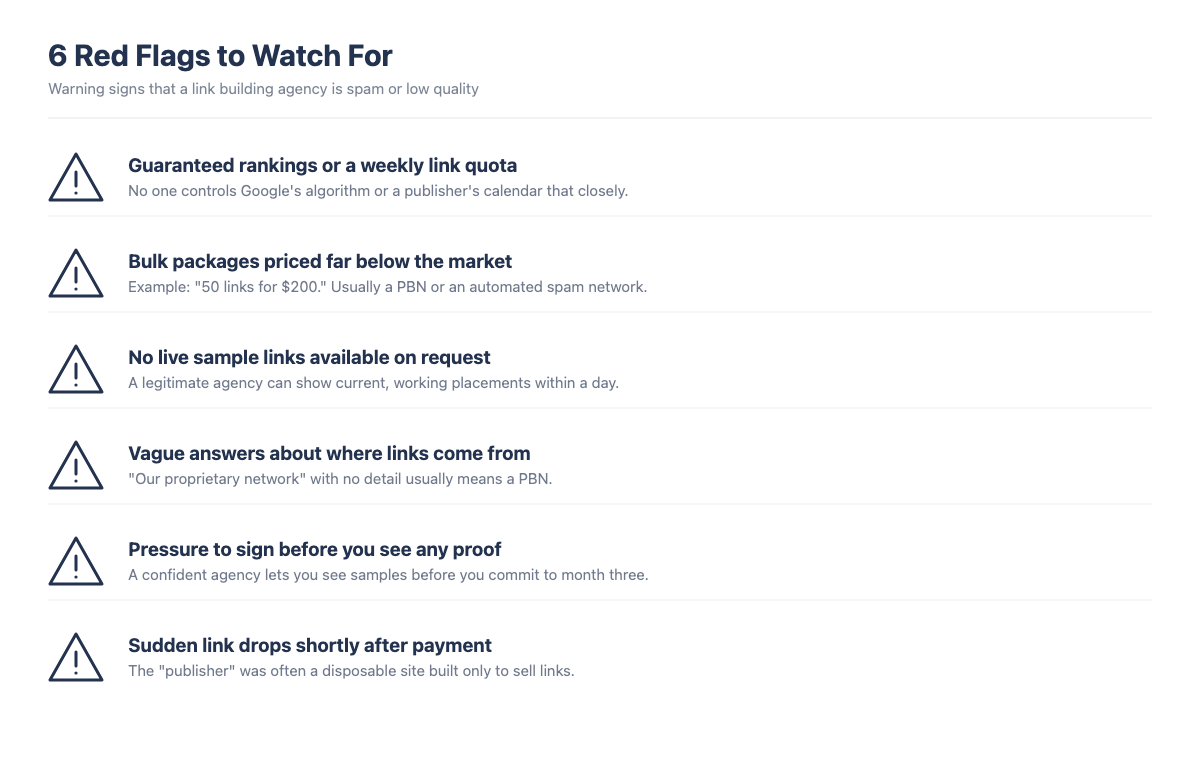
Some warning signs show up before you even sign a contract, and they are worth memorizing because sales pitches are built to talk past them.
- Guaranteed rankings or a guaranteed number of links per week. No agency controls Google's algorithm or a publisher's editorial calendar closely enough to promise either; a guarantee like this usually means the "links" come from sites the agency fully controls, not independent publishers.
- Bulk packages priced far below the market ranges above, for example "50 links for $200." At that price, the links are almost always from a private blog network (PBN) or an automated spam network, not real publishers with real audiences. They carry real penalty risk.
- No live sample links available on request. A legitimate agency can show you current, working placements within a day, because it already has them.
- Vague answers about where links come from. "Our proprietary network" with no further detail, and no willingness to show you a sample site, usually means a PBN dressed up in marketing language.
- Pressure to sign a long-term contract before you see a single sample placement. An agency confident in its own work will let you see proof before you commit to month three. One that pushes you to sign first is protecting itself, not you.
- Sudden link drops shortly after payment, where placements disappear within weeks. This usually means the "publisher" was a disposable site built only to sell links, not an ongoing audience. Treat it as a strong signal to request your link-replacement clause immediately.
Contract Terms and Reporting You Should Demand
Once an agency clears the vetting checklist above, the contract itself still needs the right terms, because a good sales process does not guarantee a good contract.
- A stated minimum commitment length, in writing, not just "most clients stay 6+ months." Know the exact number of months you are agreeing to before you sign, not after the second invoice.
- A link-replacement clause. If a placement gets removed or deindexed within a set window, commonly six to twelve months, the agency should replace it at no extra cost, not just mention the loss in a monthly report as if it were expected.
- A defined monthly reporting format. It should include the live URL of every link placed, its anchor text, and its domain rating or organic traffic at the time of placement. A headline count of "links delivered this month" alone is not enough.
- A clear cancellation notice period. Month-to-month agreements should state the exact notice window in the contract itself, not leave it to be discovered through a support ticket at cancellation time.
- Written confirmation of the link-type mix (guest post, niche edit, digital PR) included in each pricing tier. This mix is what actually drives the price: a guest post typically runs $225-$600 and a niche edit around $225, so the type mix changes the total far more than the headline tier name does. A tier that quietly substitutes cheaper niche edits for the guest posts you were quoted is a common way agencies protect margin.
Get all five in writing before the first invoice, not after the first report.
Link Building Agency vs. In-House: Which Fits Your Team?
An agency is not automatically the right call, even for a team with budget. The table below is a quick filter before you start evaluating vendors at all.
| Link building agency decision factor | Agency fits better | In-house fits better |
|---|---|---|
| Budget (USD) | Can commit $900+/month on an ongoing, multi-month basis | Limited or one-time budget, no room for a standing retainer |
| Team bandwidth | No one internally has time for outreach, relationship-building, or pitching | Someone already has the time and writing skill to do outreach themselves |
| Speed needed | Need placements started within weeks, not months, and have budget to pay for that speed | Can absorb a slower ramp-up while a repeatable process gets built |
| Control over quality | Comfortable delegating vetting to the agency's own process | Want to personally verify every placement before it counts toward the campaign |
If you land on the in-house side of this table, the vetting checklist earlier in this guide still applies to every placement you make or buy yourself, whether through a freelancer, a marketplace, or a publisher you pitch directly. It does not stop mattering just because an agency is not involved. Tools that check anchor-text distribution and audit existing backlinks, including Linkforce's own free anchor and disavow tools, cover the verification step an agency would otherwise bill for as part of its monthly retainer. Our guide to running a link building campaign walks through the in-house process end to end.
FAQ
Is SEO still worth it in 2026?
Yes, for most businesses with any organic search demand. Paid acquisition costs have kept rising across most channels, and organic traffic from a well-linked, well-optimized site remains one of the few channels with compounding returns rather than a cost that resets every month.
What is the 80/20 rule in SEO?
It is the general observation that roughly 80% of your organic results come from about 20% of your effort, usually concentrated in a handful of high-intent pages and your strongest backlink sources. In practice, it means prioritizing your highest-opportunity pages and links instead of spreading link building budget evenly across every page on your site.
How long does link building take to show results?
Most agencies and in-house teams see measurable ranking movement in three to six months, with the full impact compounding over six to twelve months as authority builds up. New links need time to be crawled, indexed, and factored into rankings, and the pages receiving them need time to earn authority from that signal. Treat any promise of results inside a few weeks as a red flag, not a selling point.
How many links do I need per month?
There is no universal number, because it depends entirely on how competitive your niche is and what your competitors already have. A low-competition local niche might need two or three strong links a month to move rankings; a competitive national niche can require ten or more. This is a reason to ask an agency to show its reasoning for a proposed volume, not just accept a round number from a sales deck.
Do agency links need to be dofollow to count?
No. A healthy backlink profile includes a mix of dofollow and nofollow links, since an all-dofollow profile built in a short time window can itself look unnatural to search engines. What matters more is whether the placement sits on a real, relevant site with real traffic, not the attribute on the link tag.