
Running one-off outreach whenever someone remembers to isn't a link building campaign; earning backlinks against a written goal, budget, and deadline is. This guide covers what belongs in that plan: the six moves from goal-setting through follow-up, which tools actually earn their keep at each stage, the budget mistakes that quietly drain a campaign, and the part most guides skip entirely, what changes once you're also chasing citations inside AI-generated search answers.
What Is a Link Building Campaign?
Strip away the tactics and a link building campaign is really just a container: a start date, a stop date or review point, a target (a referring-domain count, a ranking position, whatever the goal is), and a written plan for closing that gap, all pointed at one page or site. Swap out that container and the same outreach tactics become just occasional link requests with no way to tell, afterward, whether they worked.
Ad-hoc link building, by contrast, is whatever gets done when someone remembers to send an outreach email. A campaign assigns a budget, a timeline, and an owner, and it gets measured against that plan at the end. The distinction matters because campaigns are the only version of link building that produces a clear answer to "did it work."
Do
- Set the target from the competitor referring-domain gap, not a round number
- Prioritize prospects by topical relevance and authority, not raw traffic
- Budget for backlink analysis and outreach tooling first
- Measure results against the goals set in step 1
- Run campaigns as a recurring rhythm
Don't
- Chase link volume over quality
- Send generic, unpersonalized outreach
- Repeat your exact target keyword as anchor text
- Skip the competitor audit
- Treat the campaign as one-and-done
Why a Link Building Campaign Matters
Backlinks remain one of the strongest ranking factors search engines use to judge which pages deserve trust and visibility, particularly for competitive commercial terms where content quality alone doesn't separate page one from page three. A page with a healthy, relevant backlink profile tends to rank and hold its position more reliably than an equally well-written page with none.
Running that link acquisition as a campaign, rather than leaving it to chance, gives you three things ad-hoc efforts don't: a way to forecast how many links a given budget should produce, a way to compare your pace against competitors instead of guessing, and a clear point to stop, review results, and decide whether to double down or change approach.
Paste any domain into the free Domain Rating Checker by LinkForce.
Types of Link Building Campaigns
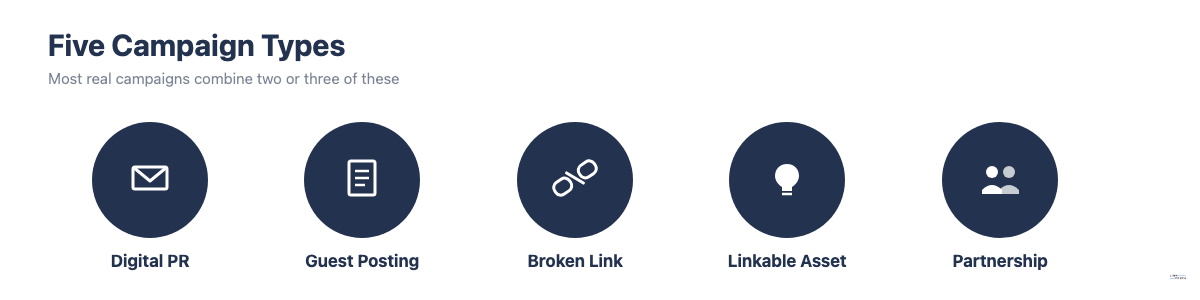
Most campaigns fall into a handful of recognizable categories, and if you don't choose the right one before you start prospecting, you'll waste weeks on misdirected outreach:
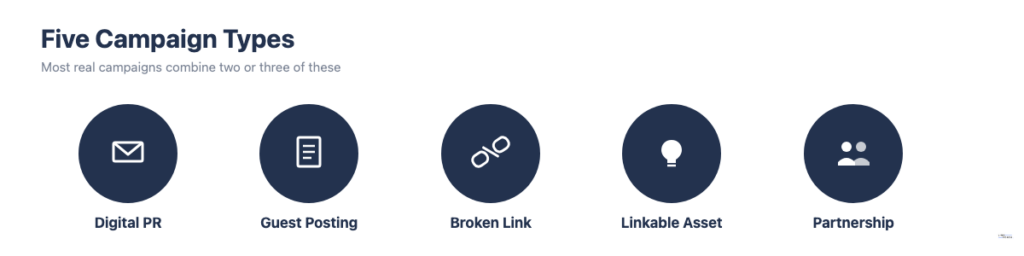
- Digital PR campaigns build a newsworthy asset (original data, a survey, a tool) and pitch it to journalists and industry publications for coverage links.
- Guest posting campaigns place bylined articles on relevant sites in exchange for an author bio or in-content link, and a growing list of SEO and marketing sites accept exactly this kind of pitch.
- Broken link building campaigns find dead links on relevant pages and offer your content as the replacement.
- Resource and linkable-asset campaigns publish a genuinely useful free tool, template, or guide designed to earn links passively over time.
- Partnership and community campaigns earn links through sponsorships, directories, and relationships with adjacent (non-competing) businesses in your niche.
Most real campaigns combine two or three of these; they don't run just one in isolation, and you shouldn't expect to either.
How to Plan and Run a Link Building Campaign (Step by Step)
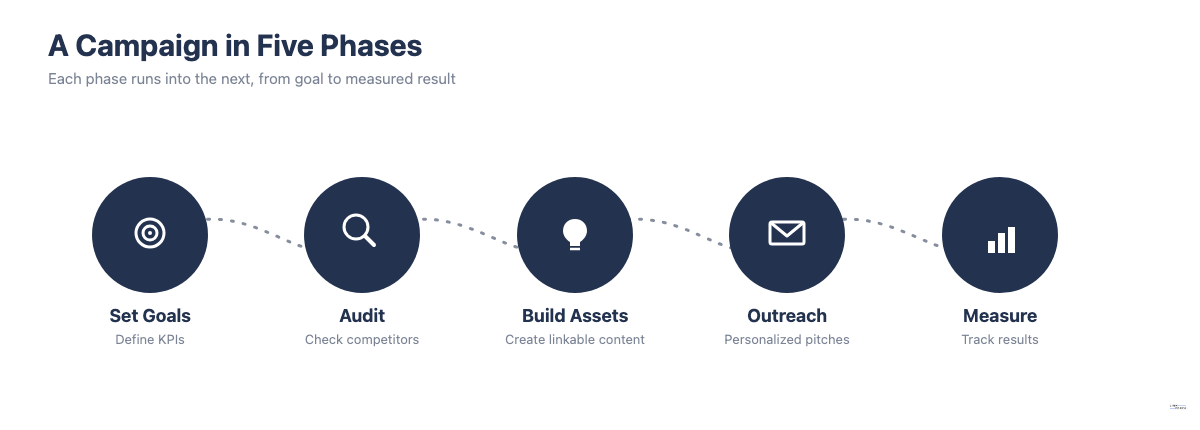
The sequence below covers a full campaign from first decision to final report. Each step builds on the one before it, so it's worth treating the order as load-bearing, not optional.
1) Set Goals and KPIs
Start by deciding what the campaign needs to produce: a target number of new referring domains, a ranking movement for specific keywords, or a measurable lift in referral traffic. Vague goals like "get more links" aren't measurable, so you won't be able to judge success later.
The most reliable way to set that target isn't to guess a round number. Compare your current backlink profile against two or three competitors who already rank where you want to. If they hold 40 referring domains on their equivalent page and you hold 12, the gap itself becomes your goal, expressed in linking domains, link quality tier, and timeframe rather than as an arbitrary figure. This competitor-gap method also gives you a built-in answer to "is this campaign working," since you can track the gap closing month over month instead of only checking a single end-of-campaign number.
2) Audit Competitor Backlinks
Skip this step and you'll spend the rest of the campaign re-discovering what a 30-minute check would have told you upfront: where your competitors' links actually come from. Their backlink profile hands you adaptable content ideas and a read on how fast they're piling up new referring domains, still a heavily-weighted ranking factor even as search evolves.
Identify who to audit by searching your target keyword in Google and noting the pages that already rank on page one. Then plug each competitor's URL into a backlink-analysis tool such as Semrush's or Moz's Backlinks tool; either one lets you view a domain's full link profile, top referring domains, and authority trend, and you don't need direct access to that site itself. Check their link velocity as well: the rate at which they're gaining new referring domains per month shows whether their authority-building is accelerating, and analyzing the pace of three to five close competitors gives you a realistic benchmark for how fast your own campaign needs to move.
A backlink-gap comparison is the single most actionable output of this step: checking which domains link to several competitors but not to you. It's what turns passive research into a prioritized prospect list for step 5 below, rather than leaving the audit as a one-off report nobody acts on. Reviewing competitors' most-linked pages also tells you what earns links in your niche, whether that's data-driven guides, free tools, or original research, which feeds directly into the asset you'll build next.
3) Choose Your Campaign Type
With your goals set and the competitive gap mapped, pick the campaign type (or combination) from the list above that best fits your resources and your site's niche. There isn't one universally best tactic: a B2B software niche with strong data or research capability is well suited to digital PR, while a niche with active industry blogs and forums but no data budget usually gets more traction from guest posting or broken-link outreach. A tightly regulated or highly technical niche, where few sites qualify as relevant linking partners, needs a narrower prospect list and slower pacing regardless of which tactic you pick. Matching the campaign type to what your team can execute well, and to what your specific niche actually rewards, matters more than copying whichever tactic performed best on someone else's case study.
4) Create Linkable Content/Assets
Whatever campaign type you chose, it needs something worth linking to: original research, a genuinely useful free tool, a comprehensive guide that's measurably better than what already ranks, or a data visualization built from a unique dataset. This is the step most campaigns underinvest in, and it's usually why outreach response rates stay low. If the asset's generic and thin, it'll get ignored no matter how well the outreach email is written.
5) Build a Prospect List
Compile a list of sites worth pitching, prioritized by topical relevance and authority, not just by raw traffic or domain rating. Pull candidates from your competitor backlink-gap analysis (step 2), from a search for your topic plus terms like "resources" or "guide," and from journalists or publications that have covered adjacent stories. Add a contact name and a specific reason that site is a fit for your asset before it goes on the list. If there's no stated reason for the match, the outreach that follows reads as mass-blasted, and site owners will notice.
6) Run Personalized Outreach
Send outreach that references something specific about the recipient's site or recent coverage, not a templated email with the site name swapped in. A simple four-step sequence works for most campaigns: research the specific page or writer you're contacting, open with the one detail that proves you actually looked at their site, state clearly what you're offering and why it fits their audience, and close with a single low-friction ask rather than several options. Multi-channel outreach (email plus a LinkedIn connection request, for instance) tends to outperform email alone, but only if each channel's message is tailored rather than copy-pasted.
7) Follow Up and Track Results
Most replies come from a follow-up, not the first email, so plan two to three follow-ups spaced several days apart before moving a prospect to "no response." Track every contact, response, and placed link in a spreadsheet or CRM so you can calculate your actual response and conversion rates. Those rates, not gut feeling, tell you whether it's worth keeping the campaign running as-is or changing the asset, the list, or the messaging.
Tools You Need for a Link Building Campaign
Different tools support different steps of the process above, and buying the wrong one first is a common reason campaign budgets stall in week one. You don't need an all-in-one platform up front; match the category below to the step you're currently executing instead.
| Tool category | Supports which step | What to look for |
|---|---|---|
| Backlink analysis (e.g. Semrush, Ahrefs, Moz) | Audit Competitor Backlinks | Full competitor link profiles, a backlink-gap comparison across multiple domains, historical link-velocity data |
| Outreach and CRM platforms | Build a Prospect List, Run Outreach | Email finding, sequence automation, reply tracking, and deliverability monitoring |
| Content and data tools | Create Linkable Content/Assets | Survey or data collection, chart/visualization building, plagiarism and originality checks |
| Rank and traffic tracking | Set Goals and KPIs, Measure Success | Keyword rank tracking, referral traffic segmentation, referring-domain trend over time |
A first-time campaign rarely needs all four categories on day one. Backlink analysis and outreach tooling cover the two steps every campaign type runs regardless of format, so it's worth budgeting for those first and adding content or tracking tools once the campaign's actually producing prospects to work.
Common Mistakes to Avoid
- Chasing volume over quality. A handful of links from relevant, authoritative sites outperforms dozens of links from low-quality or unrelated domains, and it can actively hurt trust signals if the pattern looks manipulative.
- Sending generic, unpersonalized outreach. Mass-blasted templates get ignored or marked as spam, and if response rates are low, that's usually a messaging problem, not a bad list.
- Over-optimizing anchor text. Repeating your exact target keyword as anchor text across many links looks unnatural to search engines; natural variation (brand name, URL, generic phrases) protects the campaign.
- Skipping the competitor audit. If you build assets and prospect lists without first checking what's already working for competitors, you'll waste effort re-discovering things a 30-minute audit would've surfaced.
- Treating the campaign as one-and-done. Authority built through a campaign fades if it's never followed by another round; the strongest sites don't treat link building as a single project, they run it as a recurring rhythm.
What a Successful Campaign Looks Like
The scenario below is illustrative, built from typical outcomes reported across multiple industry case studies, not a verified result from a single named client.
A mid-sized SaaS company runs a three-month digital PR campaign built around an original industry survey. Over that period, a realistic outcome looks like this: 15 to 25 new referring domains from a mix of industry publications and niche blogs, a handful of them from genuinely high-authority sites; a measurable increase in organic referral traffic to the linked page; and a ranking improvement for the target keyword cluster within one to four months of the bulk of links landing, since backlink-driven ranking gains typically lag the actual link acquisition and the exact lag varies by competition and niche.
The pattern that matters more than the specific numbers: results concentrate around the asset launch and the following few weeks, then taper off. That's why campaigns get re-run rather than treated as a one-time fix.
How to Measure Campaign Success
Measure a campaign against the goals set in step 1, using a small set of concrete metrics rather than a single vanity number:
- New referring domains gained during the campaign window, weighted by relevance and authority, not just counted.
- Domain rating or domain authority movement for the site or page the campaign targeted.
- Organic and referral traffic to the linked page, compared to the pre-campaign baseline.
- Keyword ranking movement for the terms the campaign was meant to support.
- Outreach response and conversion rate, which tells you whether to reuse or retire the asset and messaging for the next round.
- ROI, weighing the total campaign cost (tools, content, staff or agency time) against the traffic and ranking value the new links produced, so the next round's budget decision is based on a number rather than a hunch.
Reviewing these against the original KPI target closes the loop the goal-setting step opened, and gives the next campaign a real baseline to beat instead of a guess.
Is Link Building Still Part of SEO in the AI Search Era?
Yes, and the campaign you run for classic rankings largely doubles as the campaign that earns AI-answer citations. Who links to a page, how relevant those linking sites are, and how consistently a page gets referenced elsewhere are the kind of externally validated relevance signals both a traditional search algorithm and an AI-powered answer engine draw on when deciding which sources to surface or cite in a generated answer.
The underlying goal, authority you earn rather than authority you claim, doesn't change. What shifts is emphasis: original data, genuinely useful tools, and clearly structured, well-sourced content tend to earn both the links and the citations, while thin content that ranks on link volume alone is more exposed now that these systems weigh source quality over raw signal count.
800+ SaaS marketers swap partner, integration and content links on LinkForce.
Frequently Asked Questions
What is a link building campaign?
It's a time-boxed, goal-driven project built to earn a defined number of backlinks within a set budget and timeline, as opposed to sending the occasional link request whenever someone remembers to.
How much does a link building campaign cost, and how long does it take to see results?
Budgets vary widely by approach: tools-only, in-house campaigns often run $100 to $300 a month for software subscriptions plus staff time, while agency-run or fully outsourced campaigns typically start around $1,500 to $2,500 a month and can run past $20,000 a month for large-scale digital PR pushes. Whichever route you choose, you'll want to budget for tools, content creation, and outreach time as three separate line items rather than one bundled cost. On timing, most campaigns need several weeks to build assets and prospect lists before outreach even starts, and ranking movement from the links earned usually doesn't show up until weeks or a few months after the links go live.
Are backlinks still relevant in 2026?
Yes, with one important caveat: raw count doesn't carry the weight it used to, and relevance now depends more on link quality. A small number of links from authoritative, topically relevant sites still moves rankings; a large volume of low-quality or unrelated links can flag a site for manipulative link schemes and won't help, and may actively hurt.
Is link building part of SEO?
Yes, it's one of the three traditional pillars of SEO alongside technical optimization and content, and specifically the pillar responsible for off-page authority and trust signals.
Should I run a campaign in-house or hire an agency?
The right choice comes down to whether your team's already got the outreach capacity and content production ability the campaign type requires. Teams with strong writers or data skills but no dedicated outreach time often get more value from an agency or a done-for-you service handling prospecting and outreach, while teams with in-house capacity for both can run the full process described in this guide directly.
Conclusion
A link building campaign only works when it's run as a project with a start, an end, and a defined goal, not as an open-ended list of link requests. Set a competitor-gap-based target, audit before you build anything, create an asset actually worth linking to, and measure the result against the goal you started with. If your team needs outreach or software support for any step in this process, LinkForce's link building services and link building software roundup cover the outsourced and self-serve options in more depth.