
A link building package is a pre-structured offer from an SEO agency that bundles a fixed number of backlinks, the content needed to earn them and reporting into one price. Instead of negotiating each backlink one at a time, you buy a tier: a set link count, a quality range and a delivery window, all agreed up front.
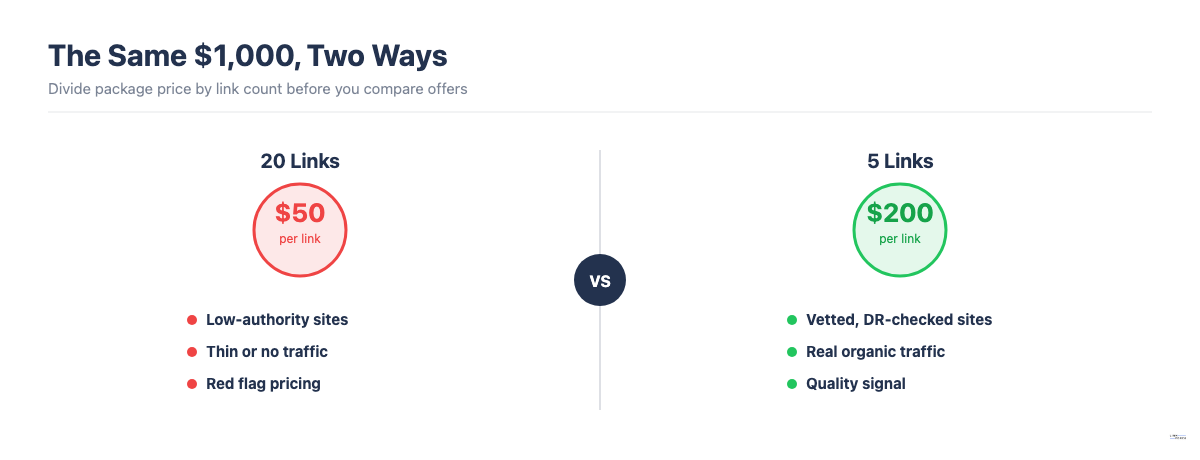
That structure makes packages easy to compare on paper. It also makes them easy to misrepresent. A package priced at $1,000 for twenty links looks like a bargain until you realize that works out to $50 a link, which is squarely in the range agencies use for low-authority, low-traffic placements. The number on the page and the value underneath it are not always the same thing.
This guide breaks down what a typical package includes, what it costs and the questions worth asking before you sign anything. It does not rank or recommend specific vendors. The goal is to give you the vocabulary and the math to evaluate any package on its own merits, whoever is selling it. If you're still deciding between package types and other link building services, that comparison is worth doing before you start collecting quotes.
What Is a Link Building Package?
A link building package is a bundled, fixed-price offer that combines a set number of backlinks with the outreach, content and reporting work needed to earn them. It's one of several link building services an agency might sell, alongside per-link buying and open retainers, and it's the one built around a fixed deliverable rather than an open-ended engagement. Instead of billing per backlink as it happens, the agency sets a tier such as ten links in thirty days and prices the whole bundle up front.
This differs from two other common buying models. Paying per link means negotiating and approving each placement individually, with no fixed monthly commitment. An open retainer means paying an agency a flat monthly fee for ongoing link building work without a guaranteed link count attached to that fee. A package sits between the two: it has the predictability of a fixed price with the specificity of a fixed deliverable.
Packages exist because buying links one at a time is slow and hard to budget for. Bundling standardizes the process for the agency and gives the buyer a number they can plan around. The tradeoff is that a bundle can hide quality variation behind a single headline price, which is why the rest of this guide focuses on what's inside that bundle.
What's Actually Included in a Link Building Package (and What Isn't)
A typical package includes a fixed number of backlinks per cycle, the content needed to earn each placement, vetted publisher sites, an anchor text plan and a delivery report. Most packages build their links through two methods: guest posts, where the agency writes and pitches an original article to a publisher in exchange for a placement, and niche edits, where the agency inserts a link into an existing published article that already ranks and gets traffic.
Beyond the links themselves, a properly scoped package usually covers:
- Content writing for each guest post, including topic selection and editing
- Outreach to publishers and negotiation of the placement
- Disclosure of the target site's domain rating (DR) and organic traffic before you approve it
- An anchor text plan that mixes branded, partial-match and generic anchors instead of exact-match keywords on every link
- A delivery report showing the live URL, the anchor text used and the publishing date for each link
- A named point of contact or account manager
What's usually not included
Packages are scoped narrowly on purpose, and the exclusions matter as much as the inclusions. Most packages do not include on-page SEO changes to your own site, technical SEO fixes, keyword strategy, internal linking work, conversion rate optimization or any guarantee of a ranking outcome. One agency states this outright in its own FAQ, describing its packages as "an order facilitation service" rather than a fully managed SEO engagement. That kind of clarity is rare, and it's worth asking for directly: find out in writing what the package does not cover before you buy, not after a placement disappoints you.
Delivery windows are fairly consistent across the market, typically fourteen to twenty-eight days from order to a live, indexed link. A package promising delivery far faster than that, especially at high volume, is worth double-checking against the red flags later in this guide.
Paste any domain into the free Domain Rating Checker by LinkForce.
How Much Do Link Building Packages Cost?
Most link building packages fall between $400 and $6,000 a month, with enterprise-scale packages running $10,000 to $20,000 a month or more. Entry-level or trial packages, aimed at buyers testing an agency before committing, typically start around $200 to $700.
Per-link cost is the more useful number for comparing across packages of different sizes. A quality placement, meaning a real site with organic traffic and a domain rating in a competitive range, usually costs between $100 and $375. Links priced well under $100 are a signal to look closer, not a bargain: at that price, the site is usually low-authority, has little or no real traffic or the link is going into a network built specifically to sell links rather than a publication with an actual audience.
How to calculate your real cost per link
The headline price on a package page can obscure what you're paying per placement, and that number is the fastest way to sanity-check any offer. Divide the total package price by the number of links included. A $1,000 package that includes twenty links works out to $50 per link, which sits well below the range associated with quality placements. The same $1,000 spent on five links comes to $200 per link, a figure that's far more consistent with a well-vetted, high-traffic placement.
Run this calculation before you compare packages on price alone, and ask the agency to confirm the exact link count included, since some packages count brand mentions or unlinked citations toward the total without disclosing that distinction upfront.
One-Time Campaign or Monthly Retainer? Choosing the Right Commitment
Packages generally come in two commitment structures, and choosing between them matters more than most buyers realize before they sign. A one-time campaign is a single bundle, for example fifteen links delivered over one month, with no renewal obligation. A monthly retainer bills you on a recurring basis for an ongoing, smaller volume of links each cycle.
A one-time campaign works well when you need a defined boost, for example ahead of a product launch or to recover from a specific ranking drop, and you want to evaluate the results before committing further. The tradeoff is that link building compounds over time, and a single burst rarely sustains ranking gains on its own.
A monthly link building service suits sites that need steady link velocity over many months, since consistent, moderate link growth tends to look more natural to search engines than a single large spike followed by nothing. The tradeoff is a longer financial commitment and less flexibility to pause if results are slow to materialize. Neither model is inherently better. The right choice depends on whether you're solving a one-time problem or building sustained authority, and it's worth deciding that before you look at any specific package.
The Before You Buy Checklist
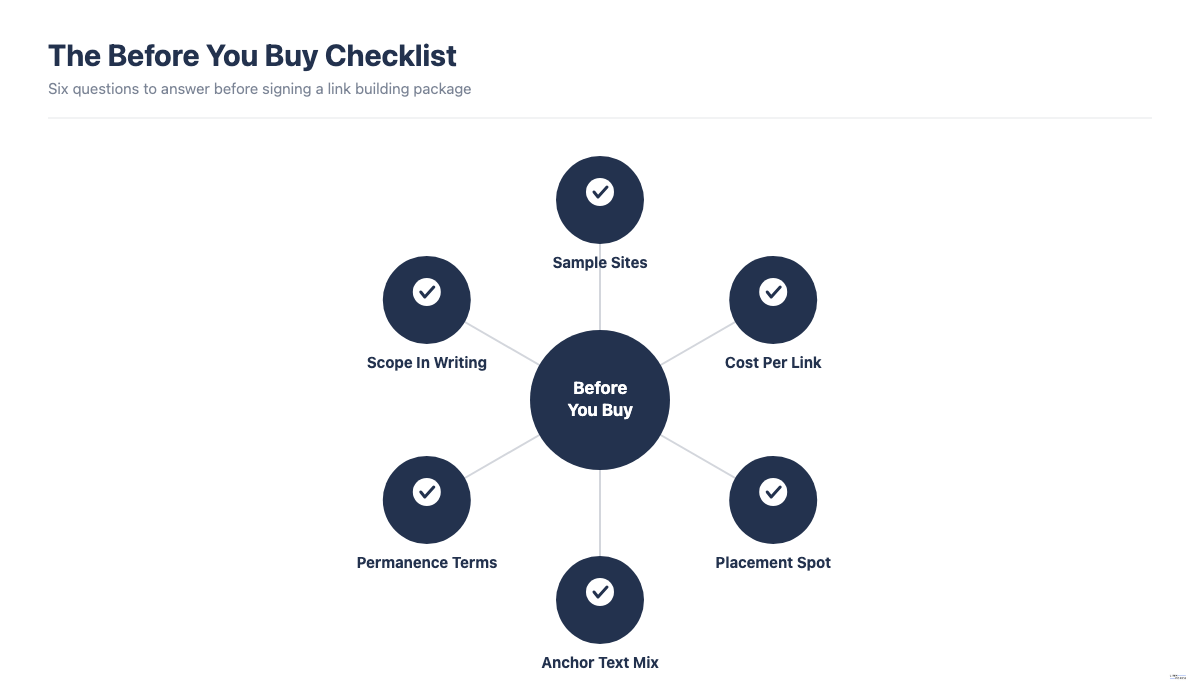
Before signing up for any link building package, work through this list. Every item here maps to a real way that a package can look strong on paper while delivering little actual value.
- Ask for sample websites, not just metrics. A domain rating of 60 means little if the site has no organic traffic or is stuffed with unrelated sponsored content. Ask to see two or three actual example placements from the past month.
- Calculate the real cost per link. Divide the total price by the link count, using the formula above, before you compare offers.
- Confirm where the link will sit. A link in the body of a relevant article carries more weight than one buried in an author bio or a sidebar widget. Ask specifically where each placement will appear.
- Ask if you get pre-approval rights. Agencies that let you review and approve the target site before publishing give you real quality control. Agencies that only report after the fact do not.
- Check the anchor text plan. A healthy link profile mixes branded, partial-match and natural anchors. A package that plans to use your exact target keyword as the anchor on every link is building a pattern that looks manipulative to search engines.
- Ask about permanence and replacement. Find out what happens if a publisher takes the article down or removes the link later. A package without a replacement or permanence guarantee leaves you paying for links that may not last.
- Sanity-check the delivery timeline. Real outreach, writing and publishing takes time. A promise of fifty links in five days is not a sign of efficiency, it's a sign the links are coming from an existing network rather than genuine placements.
- Get the scope of service in writing. Confirm explicitly what is and is not included, particularly whether any on-page or technical SEO work is part of the deal, so you're not assuming coverage that isn't there.
- Ask what the inclusion is worth beyond the link. Some packages bundle brand mentions or listicle inclusions alongside traditional backlinks. These can carry value for visibility in AI search results, but that's a separate benefit from traditional link equity, and it's worth understanding which one you're paying for.
Red Flags That Mean You Should Walk Away
Some warning signs are consistent enough across the industry that they're worth memorizing rather than relearning the hard way.
- Private blog networks (PBNs). These are groups of sites built solely to sell links, often disguised as independent publications. Search engines actively hunt for and deindex these networks, and when that happens, every link you bought from them becomes worthless overnight.
- Guaranteed rankings. No agency can guarantee a specific ranking position, because ranking depends on hundreds of factors outside any link building campaign's control. A guarantee is a sales tactic, not a technical promise anyone can keep.
- Push-button or instant bulk links. If an agency can hand you one hundred backlinks with no lead time, those links are not the product of real outreach to real publishers. That volume, delivered that fast, is a spam signal. Google's own spam policies name automated link creation and paid links built purely for ranking as violations that can get a site demoted or removed from results.
- Prices that are dramatically below the per-link range. Links priced at $20 to $50 are rarely coming from sites with meaningful traffic or editorial standards, whatever the domain rating claims.
- No willingness to share example sites before you buy. A legitimate agency has nothing to hide about where your links will appear. If they won't, that's reason enough to look elsewhere.
Frequently Asked Questions
Should I buy a link building package or pay per link?
A package makes sense if you want predictable pricing and volume, while paying per link gives you more control over individual placements but takes more of your time to manage. Most buyers running an ongoing SEO program find a package easier to budget and execute against.
How many backlinks should I expect in a typical package?
Most packages deliver three to thirty links per cycle, scaling with price: entry-level tiers run three to five links, mid-tier packages ten to twenty and enterprise tiers thirty or more. The right number for your site depends on your current link profile and how competitive your target keywords are, which is worth checking against how many backlinks you actually need to rank before you commit to a tier.
Can a link building package guarantee my site will rank higher?
No, because ranking depends on many factors beyond backlinks, including on-page content quality, technical SEO and what your competitors are doing at the same time. Any agency promising a specific ranking outcome from a link package alone is overselling what the service can control.
Are cheaper link building packages ever worth buying?
Yes, but only when the lower total price comes from fewer links rather than lower-quality ones, which is exactly why calculating cost per link matters more than comparing sticker prices directly. A cheap package built on sub-$50 links is usually cheap for a reason, not a bargain.
What's the most common mistake buyers make when choosing a package?
Comparing packages by their headline price instead of their cost per link, and skipping the step of asking for real example placements before signing, are the two most common mistakes. Both mistakes are easy to avoid once you know to check for them.
Do brand mentions or listicle inclusions count the same as a traditional backlink?
Not exactly. A traditional backlink passes direct link equity, while a brand mention or listicle inclusion without a link mainly builds visibility and can help with citations in AI search results. If a package bundles both, ask the agency to break out how many are actual links versus mentions, since they serve different purposes.