
Shopping for a cold-outreach tool means comparing at least three separate cost lines: the base subscription, the per-action credit system for enrichment data, and whatever add-ons your channel mix requires. This guide walks through all three for lemlist, as its prices stood in September 2026, so the numbers below carry a real source and date rather than a guess.
We cross-checked every figure against two of lemlist’s own pages (its marketing pricing page and its help-center plan guide) rather than relying on a single source, and we flag the handful of add-on costs that come only from third-party estimates rather than lemlist’s own published numbers. This breakdown covers every published tier, the full email-volume pricing ladder that lemlist only documents in its help center, what the credit system actually costs per action, and a worked example of what a small outreach team ends up paying once the add-ons are factored in.
How much does lemlist cost?
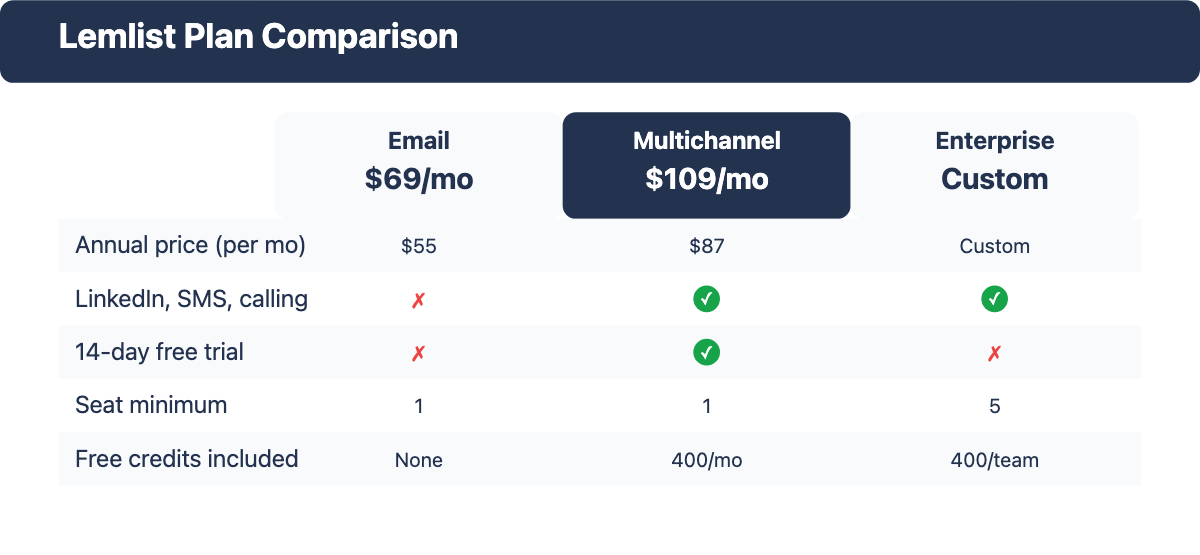
Lemlist has three plans: Email, Multichannel, and Enterprise. Email pricing starts at $69 a month for 50,000 emails and climbs to $659 a month once you’re sending a million, scaling with volume rather than headcount. Multichannel costs $109 per user per month on the standard monthly bill and adds LinkedIn, SMS, and calling on top of email, capped at 5 sending mailboxes per user. Enterprise is custom-priced with a 5-seat minimum.
| Plan | Monthly | Annual (per month) | Best for |
|---|---|---|---|
| $69/mo (50,000 emails) | $55/mo | Teams doing cold email only, unlimited users on one sending volume | |
| Multichannel | $109/user/mo | $87/user/mo | Teams running email plus LinkedIn, SMS, and calls, capped at 5 sending mailboxes per user |
| Enterprise | Custom | Custom | Teams needing 5+ seats, SSO, and a dedicated account manager |
Annual billing saves about 20% on both self-serve plans, and lemlist also offers a quarterly option at roughly 10% off the monthly rate. The Multichannel plan comes with a 14-day free trial and doesn’t require a credit card upfront, though it caps each user at 5 sending mailboxes, a limit that carries over once the trial converts to a paid subscription. The Email plan skips the trial entirely: you go straight to a paid subscription. There’s one restriction worth knowing before you commit: lemlist won’t let a single team run both the Email and Multichannel plans side by side, so you’ve got to pick one plan per team rather than mixing and matching by user. That’s a non-negotiable platform rule, not a workaround waiting to be found.
If lemlist’s $69/mo Email plan is more than your budget allows, it isn’t the cheapest self-serve cold-email tool on the market: Smartlead’s Base plan starts at $39/mo ($32.50/mo annual), and Instantly’s Growth Outreach plan starts at $47/mo ($37.60/mo annual, per our own Instantly pricing breakdown), both undercutting lemlist’s entry price. The trade-off is usually feature depth and lead-database size rather than reliability, so the cheapest option isn’t automatically the best value once you factor in what each plan actually unlocks.
Lemlist Email plan pricing by volume tier
The $69/mo figure on lemlist’s main pricing page is really just the entry point. Email plan pricing actually scales across five volume tiers based on how many emails your team sends per month, and lemlist only spells out the full ladder in its help center, not on the pricing page itself.
| Emails per month | Monthly | Quarterly (per month) | Annual (per month) |
|---|---|---|---|
| 50,000 | $69 | $62 | $55 |
| 100,000 | $89 | $80 | $71 |
| 200,000 | $159 | $143 | $127 |
| 500,000 | $359 | $323 | $287 |
| 1,000,000 | $659 | $593 | $527 |
Every tier includes unlimited users, so a five-person team sending 100,000 emails a month pays the same $89/mo (or $71/mo annual) as a solo sender working at that volume. That flat, per-tier structure is the strongest argument for the Email plan over Multichannel once a team grows past two or three people: Multichannel bills per user, while Email bills by volume tier no matter how many people are logged in. The catch is that Email plan users lose LinkedIn automation, SMS, calling, and the per-user sending-address allowance that come bundled with Multichannel.
What lemlist’s credits and add-ons cost
Both plans include access to lemlist’s lead database and enrichment tools, but pulling verified contact data or intent signals draws down a separate credit balance. Credits cost $0.01 apiece, and lemlist sells a starter bundle of 1,000 credits for $10.
| Action | Credit cost | Approximate USD cost |
|---|---|---|
| Verified email | 5 credits | $0.05 |
| Phone number | 20 credits | $0.20 |
| Company web-visit signal | 20 credits | $0.20 |
| Hiring or job-change signal | From 100 credits | $1.00+ |
| Company fundraising signal | 100 credits | $1.00 |
| LinkedIn engagement signal | From 400 credits | $4.00+ |
Multichannel plan users get 400 free enrichment credits per user every month, folded into the subscription, which covers roughly 80 verified emails or 20 phone numbers before a top-up is needed. Email plan users don’t get any included credit allowance and pay for every credit starting with the first purchase. On a 1,000-credit bundle, that works out to about 200 verified emails or 50 phone numbers for $10, so a team pulling contact data for a few hundred prospects a month should budget an extra $20 to $50 on top of the base subscription.
Extra costs lemlist doesn’t advertise on its pricing page
Lemlist’s own pricing and help-center pages don’t list per-mailbox, per-integration, or third-party verification fees. Industry pricing breakdowns, including one published by competing platform Amplemarket, estimate several add-on costs that aren’t confirmed anywhere on lemlist’s own site: extra sending mailboxes at roughly $9 per mailbox per month, a WhatsApp channel add-on around $20 per user per month, and an Aircall calling integration priced from about $30 per user per month with a 3-seat minimum. Some teams also pay a separate service like Bouncer for email verification outside lemlist’s built-in credit system, typically a few dollars per 1,000 emails.
Treat these figures as third-party estimates rather than lemlist’s own published prices, since none of them turned up on lemlist.com or help.lemlist.com during this review. If your outreach stack actually depends on WhatsApp, Aircall, or a third-party verification tool, it’s clearly worth confirming current pricing directly with lemlist or the integration partner before you budget, since add-on pricing tends to shift independently of the core plan prices above.
A rough total for a 5-person Multichannel team: the base subscription at $87/user/mo annual comes to $435/mo for five seats, plus the 400 free credits per user per month that are already baked into that price. A team that also buys an extra 2,000-credit top-up bundle each month (roughly $20) lands close to $455/mo, or a little over $5,400 a year, before any of the unconfirmed third-party add-ons above.
Which plan actually fits your team
Team size and channel mix, more than budget alone, decide which plan makes sense. A solo founder or a two-person agency sending straightforward cold email usually comes out ahead on the Email plan, since the price is locked to volume rather than headcount and nobody’s paying extra just for logging in. A revenue team juggling LinkedIn touches, calls, and SMS alongside email leans toward Multichannel instead, even though the per-seat math gets steeper as headcount climbs past five or six people, and it’s rarely worth switching back once that automation is built into the workflow. Agencies managing several client accounts under one roof tend to land on Enterprise once they cross the 5-seat threshold, mostly for the dedicated account manager and the custom contract terms rather than any extra automation feature.
Budget for credits separately from the subscription line. A lean team sending a couple hundred emails weekly can often stay inside the free Multichannel allotment, while a heavier prospecting operation pulling phone numbers and hiring signals daily will burn through a starter bundle within days and should plan on a recurring top-up.
Frequently asked questions
Is lemlist free to use?
No, it isn’t. Lemlist has no permanent free plan. The Multichannel plan includes a 14-day free trial with no credit card required, but the Email plan skips the trial entirely, so testing that plan means starting a paid subscription right away.
What’s included in the 14-day free trial?
The trial gives full access to the Multichannel plan, including LinkedIn automation, SMS, calling, and the 400 monthly enrichment credits per user. It’s not available on the Email-only plan.
Is lemlist better than Instantly on price?
Yes, if you need LinkedIn, SMS, or calling alongside email, since Instantly doesn’t natively support those channels. No, if you only need high-volume cold email, since Instantly’s Growth Outreach plan starts at $47/mo versus lemlist’s $69/mo Email plan, and its Hypergrowth tier at $97/mo bundles unlimited sending accounts into one flat price instead of lemlist’s $109/mo per-user Multichannel rate. Lemlist charges per user for Multichannel and by volume tier for Email-only; Instantly charges by product tier regardless of seat count. See our Instantly pricing breakdown for the full tier structure.
Can I switch between the Email and Multichannel plans?
You can change plans, but you can’t run both on the same team at once. Lemlist requires every user on a team to sit on the same plan, so switching means migrating the whole team rather than mixing plan types user by user.