


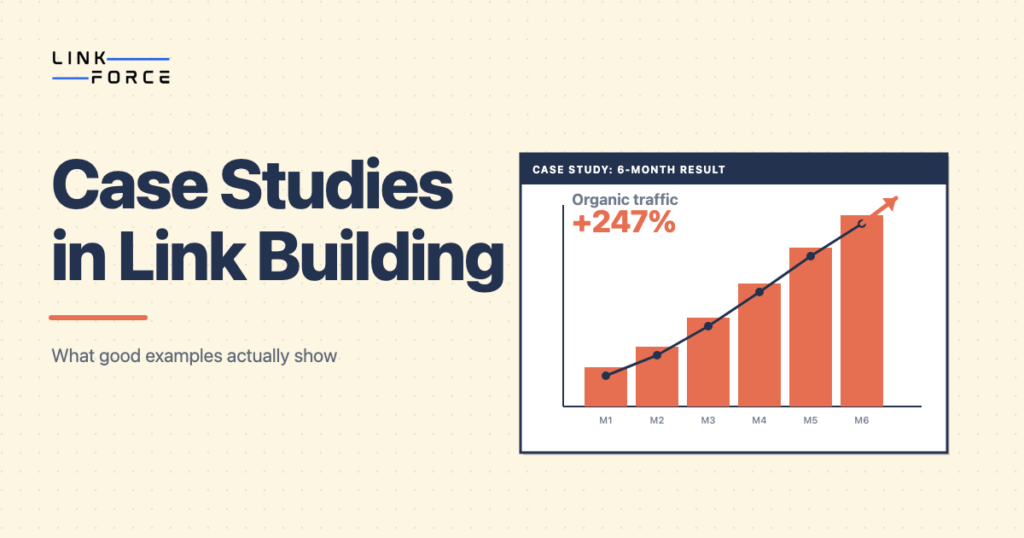
A link building case study is useful when it shows more than a big traffic chart. The reader should be able to see what page or asset got the links, which tactic was used, how long it took and whether it’s the kind of win another site could realistically repeat.
That’s where many published examples fall short. They lead with a dramatic percentage lift, then skip the page target, the time window, or the tradeoffs behind the campaign. The result may be real, but the lesson stays blurry.
If you want the broader strategy for deciding which SaaS pages deserve links first, start with our guide to link building for SaaS. This page stays narrower. It’s a guide to reading a link building case study, spotting what patterns show up in the stronger examples and using those lessons without copying another company blindly.
What should a good link building case study show?
A good link building case study should show the goal, the page or asset, the tactic, the time window and the quality of the outcome. If one of those pieces is missing, the case study gets harder to trust and even harder to reuse.
Why context matters more than the headline number
A 500% traffic lift can sound huge and still tell you very little. Moving from a tiny baseline isn’t the same as lifting an already established page in a competitive market. A case study also reads differently when the destination was a statistics page, a guest post program, a service page or a category page that could already absorb authority.
The useful question isn’t just “How much did traffic grow?” It’s “What changed, where did the links point, and why did that target deserve links in the first place?” That context helps you decide whether the lesson belongs to your site or only to that one campaign.
The best link building case study doesn’t just prove that links were built. It proves why the campaign made sense, what page benefited and how the result should be judged.
The five elements that make a case study useful
The strongest examples keep the reader oriented from the first screen. This framework separates a useful case study from a flashy one in a few seconds. If it doesn’t, something’s missing.
| Element | Why it matters | Question to ask |
|---|---|---|
| Goal | It tells you what the campaign was trying to improve. | Was the goal more links, more qualified traffic, stronger page rankings, or a mix? |
| Page or asset | The destination shapes how repeatable the result is. | Did the links point to a statistics page, guest post, category page, service page or another asset? |
| Tactic | Different tactics prove different things. | Was the win driven by outreach, content promotion, digital PR, guest posting or a linkable asset? |
| Time window | Results mean less without a timeline. | Did the outcome happen over weeks, months, or a much longer compounding period? |
| Outcome quality | A clean result is more than raw volume. | Did the case study show relevance, page fit, better rankings, stronger traffic quality or only vanity metrics? |
When those five elements are visible, the reader can judge the result instead of admiring it from a distance. When they’re missing, the case study turns into marketing copy fast.
What tactics appear most often in link building case studies?
The most common tactics in published link building case studies are guest posting, statistics page campaigns, digital PR and broken link building. Each tactic produces a different kind of case study and the signals worth checking differ for each.
Guest posting is the most commonly documented tactic. A strong guest posting case study shows how prospects were found and vetted, what the outreach conversion looked like and which sites the links came from. Outreach response rates in well-run campaigns fall between 10 and 25 percent. If a case study celebrates sending 5,000 emails without explaining how sites were selected, prospect quality wasn’t the real lever.
Statistics page campaigns build a citable page with original data or aggregated research, then pitch it to sites that write about the topic. Ahrefs documented this approach when they built a statistics page and reached the top ranking for their target query. The case study worked because the asset had a clear sourcing purpose, not just because the outreach was large.
Digital PR campaigns pitch newsworthy stories, data studies or tools to journalists and editors. The strongest case studies in this category show which publications picked up the story, what the editorial fit was and how referral and search traffic responded. That’s what makes digital PR results credible.
Broken link building finds dead links on third-party pages and offers a replacement. It appears less often in published case studies because conversion rates are modest, but when the niche is a good fit, the outreach volume’s manageable and the link quality can be high.
Which patterns show up in strong link building case studies?
Strong link building case studies fall into three patterns. Some prove that an asset’s inherently linkable. Others prove that outreach quality was the real lever. A third group proves that the destination page was strong enough to absorb authority once the links arrived.
Asset-led case studies start with something worth citing
Asset-led examples often revolve around statistics pages, original research, calculators, templates or another page publishers can cite directly. These case studies work best when the asset solves a real sourcing problem for writers, editors or researchers.
This pattern proves that the page itself carried part of the campaign. A cleaner asset can lower the outreach burden because the linker’s already got a reason to use it. Ahrefs documented this with a statistics page campaign that reached the top ranking for its target query. The asset worked because journalists and bloggers needed a citable source, not because the outreach volume was large. If a case study in this bucket never explains why the asset deserved links, it’s harder to learn from.
- best for pages that collect, simplify, or package useful information
- usually stronger when the asset gives writers something easy to cite
- less convincing when the “asset” is only a thin post with a bigger outreach push behind it
Outreach-led case studies live or die on prospect quality
Outreach-led case studies usually center on guest posting, digital PR outreach, mention reclamation or a prospecting process that turned a solid idea into placements. The tactic matters, but the real signal is prospect quality, relevance and message fit.
This pattern proves that execution discipline can carry the result even when the asset isn’t naturally link-magnet material. Respona published a guest posting case study that reached 1,000 targeted sites, generated a 20.5% response rate, and converted 55 placements in about a month. The numbers are worth noting not because they’re typical, but because the case study shows how prospect selection (sites with a genuine topical fit) drove the response rate. Big outreach volume sounds impressive until you ask how many of those sites were relevant and what page they actually linked to. That context isn’t optional.
- best for campaigns where prospect selection is the main differentiator
- stronger when the case study explains why the prospects were a fit
- weaker when it celebrates send volume more than placement quality
Page-led case studies work only when the destination page can absorb authority
Some case studies are really page-choice stories. The links matter, but the outcome happened because the campaign pointed to a page that already matched demand and could convert the extra visibility into useful traffic. That’s a different story than a weak tactic hitting a strong domain.
This pattern matters because it’s often the most transferable lesson for operators. A campaign can build real links and still underperform if the destination page is weak, thin or poorly aligned with what the searcher wants. In those cases the link building didn’t fail. The page choice did, flat-out.
- best for category, service, solution and comparison pages that can rank and convert
- stronger when the case study names the page type and why it was chosen
- weaker when it hides the destination and only shows domain-level wins
Which red flags make a link building case study less trustworthy?
The fastest red flags are missing context and vague attribution. If the case study won’t tell you what page was promoted, how long the work ran, or what changed besides link building, you’re being asked to trust the result on faith.
- the page target is hidden, so you can’t judge whether the result came from a strong destination or a weak one
- the time window is vague, which makes slow compounding growth look like a fast campaign win
- the result is framed only through traffic or referring domains, with no quality signal around relevance or business value
- the write-up never explains whether on-page work, content refreshes or broader SEO changes happened at the same time
- the case study sounds certain about the win but never mentions limits, friction or tradeoffs
- the case study frames every result as proof of a universal method. Real campaigns have conditions, whether that’s an industry where stats pages are popular with writers, a domain that already had enough authority for links to convert or a niche where guest post editors are more accessible than average
A good case study doesn’t need to reveal every private detail. It does need to give the reader enough information to understand what the campaign actually proved. The safest baseline when evaluating any case study is to ask whether the result could be reproduced by a site unlike the one in the example. If it can’t, treat the case study as inspiration, not instruction. Without question, that’s the safer default.
How should SaaS teams use link building case studies?
SaaS teams should use link building case studies to judge page fit, asset quality and reporting expectations before they copy a tactic. The goal isn’t to clone another brand’s playbook. It’s to learn which conditions made that playbook work.
Use case studies to judge page fit before outreach starts
A SaaS company rarely gets the full value of a campaign if the links point to the wrong page. Case studies are useful here because they show whether the real lift came from a research asset, an integration page, a category page or another destination that was already positioned to benefit.
If your broader question is which SaaS pages deserve links first, go back to the parent guide on link building for SaaS. This case-study page’s better used as a quality filter than as a full prioritization framework.
Adapt the lesson, don’t copy the exact tactic mix
The public example may be built around a statistics page, heavy guest posting or an outreach motion your team shouldn’t copy as-is. What’s important is the underlying lesson. Was the win driven by a linkable asset, careful prospect quality or a page that was already one good campaign away from ranking better?
| Signal from the case study | What a SaaS team should take from it | What not to assume |
|---|---|---|
| The asset attracted links because it was easy to cite | Create or improve assets that support your product story and solve a clear sourcing need. | Don’t assume any long-form content will earn links once outreach starts. |
| The outreach campaign converted because the prospect fit was tight | Invest more in relevance, targeting and page selection. | Don’t assume higher send volume will produce the same result. |
| The result came from links to a specific landing page or category page | Make sure the destination page can explain the product and absorb authority well. | Don’t assume the same links would work if pointed to a weaker page on your site. |
| The case study shows traffic growth over a long window | Treat the result as compounding work and set calmer expectations. | Don’t sell it internally as a quick campaign spike. |
Bring reporting discipline into the readout
SaaS teams also need cleaner readouts than most public case studies provide. A growth chart’s helpful, but it should sit next to the destination page, the campaign window and a note on whether the linked page helped qualified traffic or later-stage evaluation.
If your team needs a cleaner way to package that evidence, our guide to link building reporting goes deeper into how to track and explain the work. The case study tells you what to question. The reporting layer’s how you document it on your own site.
- record the destination page, not just the domain-level outcome
- track the campaign window so the result isn’t stripped from its timeline
- separate useful traffic and page-level movement from pure vanity metrics
Frequently asked questions about link building case studies
What makes a link building case study credible?
A credible link building case study names the page that was promoted, the tactic used and the time window. It shows results that go beyond raw traffic or referring domain counts. It’s also honest about the conditions or limits that shaped the outcome.
Which link building tactics appear most often in published case studies?
Guest posting, statistics page campaigns, digital PR and broken link building show up most often. Guest posting and statistics page campaigns are the most commonly documented because both tactics produce measurable outreach conversion data that can be shared publicly.
How do I apply another company’s link building case study to my own site?
Start by checking whether the conditions match. If the case study worked because of a strong linkable asset, ask whether you have a comparable asset or can build one. If it worked because of tight prospect targeting, look at how they selected sites rather than copying the tactic itself. The underlying logic transfers; the exact tactic mix often doesn’t.
Should I trust a case study that hides the client name?
A hidden client name doesn’t automatically make a case study untrustworthy. Many legitimate campaigns are covered by NDAs. What matters more is whether the case study still shows the industry, the page type, the tactic, the time window and the result quality. If all those details are hidden, there isn’t enough context to evaluate the lesson.
What results should a good link building case study report?
A good case study reports results at the page level, not just the domain level. That means showing ranking changes, organic traffic to the specific destination and ideally a note on referral traffic quality or conversion impact. Referring domain counts and domain-level traffic charts are useful context but they’re not sufficient on their own.
Once you know how to read the examples, move to the next guide that matches your question. Go to link building for SaaS if you need the parent strategy for page choice, tactic prioritization and cluster planning. Go to link building reporting if you’re looking for a cleaner way to package campaign evidence and page-level outcomes.