
Most “backlink sites” lists are the same fifteen names copied from post to post, and a few of them are wrong about basic facts. HARO is the clearest example: plenty of guides still call it dead, when Featured.com bought the brand and relaunched it in 2025. This list groups the 40 places that still work by why they work, so you can pick a starting point that matches your business instead of submitting to everything at once.
What Makes a Backlink Site Worth Your Time in 2026
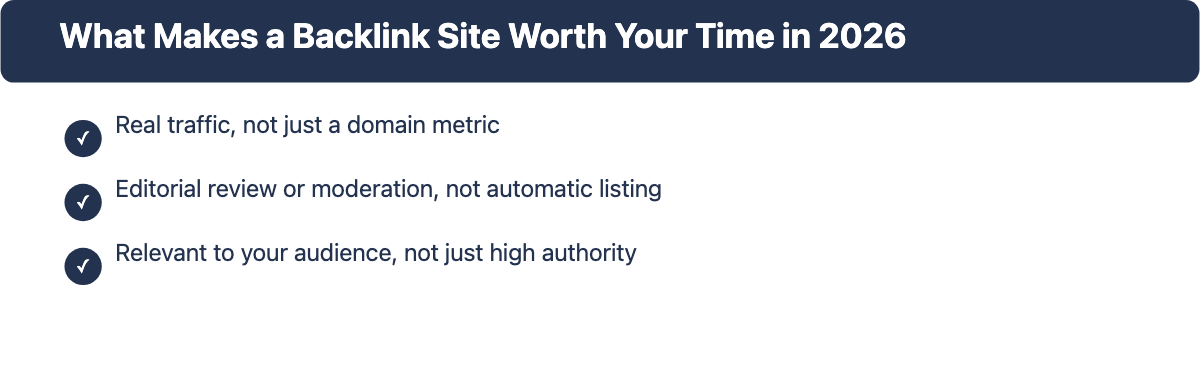
Not every site on a “free backlink” list is worth the submission form. Before you spend an afternoon signing up for directories, run each candidate against three questions:
- Does it have real traffic? A directory nobody visits gives you a link with no referral value and, in most cases, no crawl priority either.
- Is it moderated? Editorial review, even a light one, keeps the neighborhood clean. Sites that accept every submission automatically tend to carry less trust with search engines over time.
- Is it relevant to your audience? A link from a site your buyers actually use is worth more than a higher-authority link from a site with no topical connection to your business.
Dofollow status matters less than these three factors combined. A relevant, well-trafficked nofollow link from G2 or Product Hunt still sends qualified visitors and still helps your brand show up where buyers are already researching. A dofollow link from an abandoned directory does neither.
Journalist and Expert-Source Platforms
Start here if you have real expertise to offer, since these links tend to carry the most editorial weight in the entire list.
Is HARO Still Around for Backlinks?
Yes, but not in the form most guides describe. Cision, which owned HARO, rebranded it as Connectively in 2023 and shut Connectively down completely in December 2024. Featured.com then bought the HARO name and relaunched it in April 2025, close to the original format: free, no login, three curated email digests a day. If a guide tells you Connectively is the place to pitch journalists, that guide is out of date. HARO itself is the platform to use again.
- HARO: relaunched by Featured.com in 2025 in its original free, email-digest format. Reply to a relevant query and a placement typically includes an editorial link back to your site.
- Featured: the company behind the HARO relaunch also runs its own separate expert-answer marketplace (rebranded from its earlier name, Terkel), matching journalist and publisher queries with contributor responses and a link in your bio.
- Qwoted: connects journalists, reporters, and podcast producers with expert sources across finance, tech, health, and B2B. Placements come with an editorial backlink or brand mention.
- SourceBottle: an Australian-founded alternative with a similar model, covering media queries from bloggers and journalists in multiple countries.
- ProfNet: Cision’s other journalist-source connector, aimed at PR teams with an existing Cision subscription rather than solo pitching, but still a live source for expert-quote placements.
Software and B2B Review Platforms
If you sell software or a professional service, a profile on these sites earns you a backlink and puts you in front of buyers actively comparing vendors.
- G2: the largest software review marketplace. A free vendor profile includes a link to your site and appears in category comparison pages buyers use during evaluation.
- Capterra: Gartner’s software directory, organized by category with the same free-profile-plus-link model as G2.
- TrustRadius: leans B2B and enterprise, with longer-form reviews than G2 or Capterra and a similar profile link.
- GetApp: another Gartner property, useful for smaller SaaS tools that want a second review-site footprint beyond G2 and Capterra.
- Software Advice: Gartner’s third review property, focused on buyer-intent traffic through guided software recommendations.
- Clutch: built for agencies and B2B service providers rather than pure software, with verified client reviews and a company profile link.
- GoodFirms: a Clutch alternative covering software companies, agencies, and freelancers, with a similar free-listing structure.
- Slashdot: better known for tech news, but its software review section (built on the former SourceForge review data) still accepts vendor listings with a profile link.
Startup and Product Launch Directories
These sites are built for the specific moment when you have something new to announce, and the traffic they send is made up of people actively looking for new tools.
- Product Hunt: the highest-visibility launch platform for SaaS, apps, and digital tools. A launch page link plus community upvotes can also drive a real traffic spike on launch day.
- BetaList: for products still in beta, ahead of a full Product Hunt launch. Good for building an early list and a link before you are ready for a wider audience.
- AlternativeTo: a crowdsourced directory of software alternatives. Getting your product listed as an alternative to an established competitor puts you in front of buyers actively switching tools.
- SaaSHub: a smaller, SaaS-focused counterpart to AlternativeTo with the same alternative-to positioning and a free listing link.
- Crunchbase: a company profile here is standard practice for funded startups and gives you a link plus visibility to investors, press, and partnership prospects.
- F6s: a startup community and directory with company profiles, program listings, and a link back to your site.
Business and Local Directories
Most of these are nofollow, but they still matter because search engines use them for local trust signals, and a consistent name, address, and phone number (NAP) across directories is itself a ranking factor for local search.
- Google Business Profile: not a traditional backlink, but the single most important local listing you can claim, with a direct link to your site from your profile.
- Bing Places: Bing’s equivalent to Google Business Profile. Low effort, and Bing still sends meaningful search traffic in several markets.
- Better Business Bureau: a trust-signal listing more than a link-building play, useful for service businesses that rely on credibility with local buyers.
- Yelp: still the default local directory for consumer-facing businesses in the US, with a profile link even on the free tier.
- Manta: a general business directory that indexes small and mid-sized businesses, useful as one more consistent NAP citation.
- Trustpilot: primarily a review platform, but your business profile page includes a link to your site and often ranks for branded searches.
- Foursquare: less relevant for search than it once was, but still a live local directory with a business profile link worth claiming.
Web 2.0, Developer, and Design Showcase Platforms
This category covers the profile page you get automatically when you publish something real on an established platform. The link lives in your author bio, not the article body, so the per-link SEO value is smaller, but the platforms themselves carry enormous authority.
- Medium: publish under your own account and your author profile link travels with every story.
- LinkedIn Articles: publishing long-form posts on LinkedIn puts a link in front of your own professional network and anyone who finds the article through search.
- Dev.to: a developer-focused publishing platform with an active community and a profile link on every post.
- Hashnode: a similar developer blogging platform, with the added option of hosting on your own subdomain.
- Substack: built for newsletters, but every publication has a public profile page, and cross-links between Substack writers are common.
- GitHub: your profile README and any public repository link back to your site. For a technical product, a well-maintained open-source repo is itself a legitimate backlink source through the project’s own visibility.
- npm: if you publish JavaScript packages, your npm profile and each package page can link to your site.
- PyPI: the Python equivalent of npm, with the same profile and package-page linking opportunity.
- Behance: Adobe’s design portfolio platform, useful if your business does any visual or brand design work worth showcasing.
- Dribbble: a design-community showcase site with a similar profile-link setup to Behance, skewed toward UI and product design work.
Q&A, Community, and Forum Platforms
The lowest link-value tier on this list, but not a waste of time. These are nofollow almost everywhere now, and the value is referral traffic and topical authority rather than direct ranking power.
- Quora: still a high-traffic Q&A site. A profile link plus genuinely useful answers in your niche can send steady referral traffic.
- Reddit: nofollow, but a relevant subreddit answer that actually helps people can outperform a dozen directory links for referral traffic and brand recall.
- Stack Overflow: essential if your product is developer-facing. A profile link and answers that solve real technical problems put you in front of exactly the right audience.
- Niche industry forums: active, moderated forums in your specific niche still generate referral traffic and relationships that turn into real editorial backlinks later, even though the forum link itself carries a nofollow tag.
Guest Posts and Resource Pages: the Technique, Not a Fixed List
Two categories don’t belong on a static list because they are techniques, not fixed sites.
Guest posting means finding blogs in your niche that accept outside contributors and pitching them a genuinely useful piece, in exchange for an editorial link in the body or your author bio. There is no permanent list of “write for us” sites because publications open and close their guest program constantly. Search your niche plus “write for us” or “contribute” for current opportunities, and prioritize sites with real traffic over sites that exist only to sell guest post links.
Resource pages are curated lists of tools, guides, and links on a specific topic, published by universities, industry associations, and established blogs. Because they are created constantly and go stale fast, there is no fixed list of them either. Search your topic plus “resources” or “useful links” to find current pages, then reach out with a specific reason your page or tool belongs on the list.
If you want a structured, repeatable process for either technique rather than one-off searching, our guest post outreach guide and manual link building guide walk through the full workflow.
All 40 Backlink Sites at a Glance
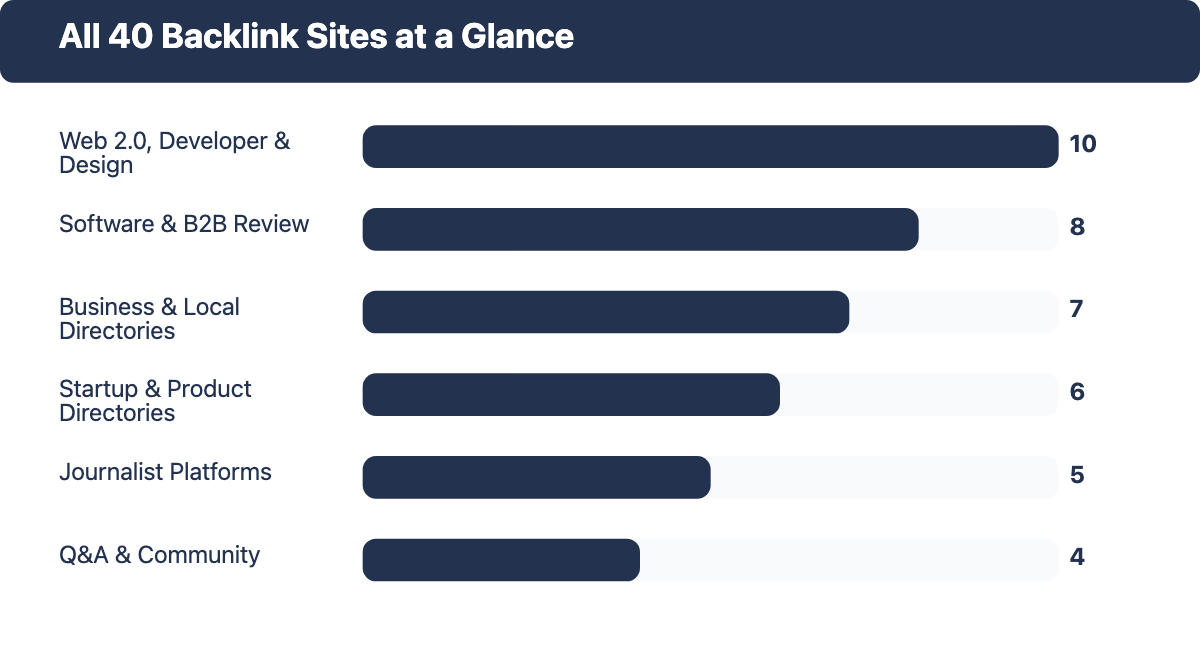
Use this table to scan the full list by category, link type, and cost before you commit an afternoon to submissions.
| Site | Category | Link Type | Cost | Best For |
|---|---|---|---|---|
| HARO | Journalist platform | Editorial, mixed | Free | Any expert source |
| Featured | Journalist platform | Editorial, mixed | Freemium | Any expert source |
| Qwoted | Journalist platform | Editorial, mixed | Freemium | Finance, tech, B2B experts |
| SourceBottle | Journalist platform | Editorial, mixed | Free | International PR |
| ProfNet | Journalist platform | Editorial | Paid | PR teams on Cision |
| G2 | Software review | Nofollow | Free | SaaS and software |
| Capterra | Software review | Nofollow | Free | SaaS and software |
| TrustRadius | Software review | Nofollow | Free | Enterprise B2B software |
| GetApp | Software review | Nofollow | Free | SaaS and software |
| Software Advice | Software review | Nofollow | Free | SaaS and software |
| Clutch | Software review | Nofollow | Free | Agencies, B2B services |
| GoodFirms | Software review | Nofollow | Free | Agencies, B2B services |
| Slashdot | Software review | Nofollow | Free | Developer tools |
| Product Hunt | Startup directory | Nofollow | Free | Product launches |
| BetaList | Startup directory | Nofollow | Free | Pre-launch beta products |
| AlternativeTo | Startup directory | Nofollow | Free | Products with an established competitor |
| SaaSHub | Startup directory | Nofollow | Free | SaaS tools |
| Crunchbase | Startup directory | Nofollow | Freemium | Funded startups |
| F6s | Startup directory | Nofollow | Free | Startup community |
| Google Business Profile | Local directory | Nofollow | Free | Local and service businesses |
| Bing Places | Local directory | Nofollow | Free | Local and service businesses |
| Better Business Bureau | Local directory | Nofollow | Freemium | Trust-focused service businesses |
| Yelp | Local directory | Nofollow | Freemium | Consumer-facing businesses |
| Manta | Local directory | Nofollow | Free | Small and mid-sized businesses |
| Trustpilot | Review directory | Nofollow | Freemium | Any customer-facing brand |
| Foursquare | Local directory | Nofollow | Free | Local businesses |
| Medium | Web 2.0 | Nofollow | Free | Content publishers |
| LinkedIn Articles | Web 2.0 | Nofollow | Free | B2B professionals |
| Dev.to | Web 2.0 | Nofollow | Free | Developers |
| Hashnode | Web 2.0 | Nofollow | Free | Developers |
| Substack | Web 2.0 | Nofollow | Freemium | Newsletter writers |
| GitHub | Developer showcase | Mixed | Free | Technical products |
| npm | Developer showcase | Mixed | Free | JavaScript packages |
| PyPI | Developer showcase | Mixed | Free | Python packages |
| Behance | Design showcase | Nofollow | Free | Design and brand work |
| Dribbble | Design showcase | Nofollow | Freemium | UI and product design |
| Quora | Q&A community | Nofollow | Free | Niche expertise |
| Q&A community | Nofollow | Free | Niche expertise | |
| Stack Overflow | Q&A community | Nofollow | Free | Developer-facing products |
| Niche industry forums | Q&A community | Nofollow | Free | Relationship-based link building |
How to Prioritize These Sites When You Have Limited Time
Forty sites is a lot to tackle at once, so weigh each category by effort versus impact instead of working straight down the list.
- Start with the sites your buyers already use. A SaaS company gets more from G2 and Product Hunt than from a general business directory. A local service business gets more from Google Business Profile and Yelp than from Product Hunt.
- Claim the free, low-effort profiles first. Business directories and developer platforms (GitHub, npm, PyPI) take minutes to set up and never expire.
- Reserve real time for the journalist platforms. HARO, Featured, and Qwoted require an actual pitch, but the editorial links they produce carry more weight than a dozen directory listings combined.
- Treat guest posts and resource pages as an ongoing habit, not a one-time list to clear. These are the two categories with no fixed endpoint and the highest long-term ceiling.
Once you have claimed the easy profiles and started pitching journalist platforms, the bottleneck shifts from “which sites exist” to “how many pitches and profiles can I realistically manage at once.” That is the point where a link building marketplace or outreach tool starts to pay for itself, by centralizing prospecting, tracking which sites you have already submitted to, and managing follow-up on guest post and resource-page pitches instead of running the whole process from a spreadsheet.
Frequently Asked Questions
Are free backlink sites actually worth using in 2026?
Some are, most aren’t. Directories and platforms with real traffic and editorial review, such as G2, Product Hunt, or Clutch, are worth the submission. Mass-submission directories with no moderation mostly earn you a nofollow tag and no referral value, and a long list of low-quality directory links can look more like a footprint than a strategy. Google’s own SpamBrain system, its AI-based spam classifier since 2018, is built specifically to spot exactly that kind of footprint: identical profiles pushed to hundreds of unmoderated sites in a short window. There is also a simpler, older problem with thin directory submissions: if the page hosting your link never gets crawled and indexed in the first place, the backlink on it does not count for anything, no matter how many directories you add to the list.
Do I need dofollow links from these sites to see any SEO benefit?
No. Most of the sites on this list are nofollow, and they still help. A nofollow link from a high-traffic, relevant platform sends real visitors, builds brand recognition among people who later search your brand name directly, and can get a new page discovered and crawled faster.
How much does it cost to get links from these sites?
Most of the list is free. A handful, like Qwoted, Featured, Crunchbase, Better Business Bureau, Yelp, Trustpilot, and Dribbble, have optional paid tiers, and ProfNet effectively requires an existing Cision subscription, but the base profile and link are free everywhere else on this list, including HARO itself. If you are seeing quotes for guaranteed backlinks that cost money per link, that is a different category entirely (paid link placements) and carries real risk if the seller cannot show you real traffic on the linking page.
What is the single best backlink site to start with?
There is no universal answer, it depends on your business. A SaaS company should start with G2 and Product Hunt. A local service business should start with Google Business Profile first, since it is the single highest-priority local listing, then Bing Places and Yelp for the same reason with a smaller audience each. A B2B agency should start with Clutch. Pick the platform your actual buyers already use before working down the rest of the list.
Is it safe to submit to all 40 sites at once?
Yes, since every site on this list is a real platform with a normal submission or profile process, not a link scheme. The only real risk with directory submissions in general is doing it through mass-automated tools that blast identical, low-quality profiles across hundreds of unmoderated sites. Submitting manually to the platforms above, with a complete and accurate profile on each one, carries no penalty risk.