
A good collaboration email states who you are, what you want to build together, and what the other side gets out of it, all inside the first three sentences. Everything after that is proof and a clear next step. If you send content partnership pitches, co-marketing invites or link and asset swaps as part of a broader partner ecosystem, the templates below are built for exactly that job, not for generic sales outreach or influencer gifting.
What a Collaboration Email Needs to Include
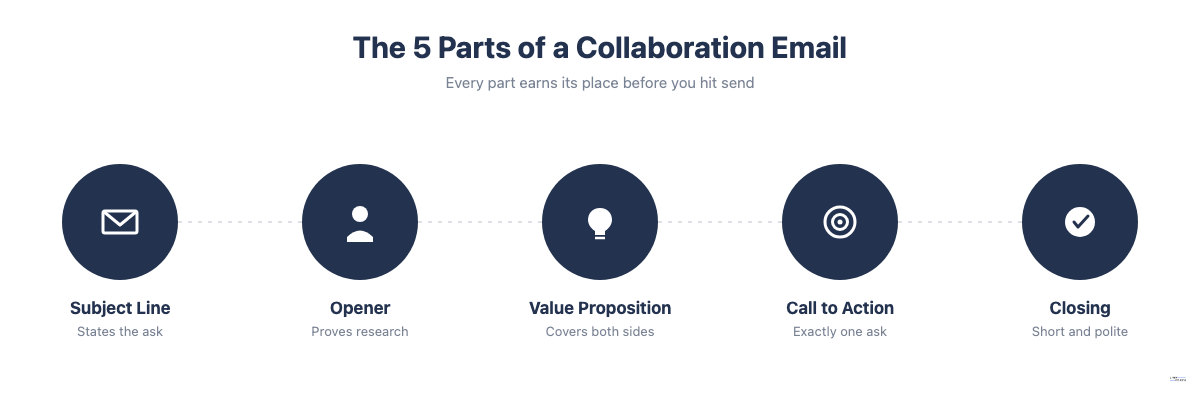
A collaboration email needs five parts: a subject line that states the ask, a personalized opener, a specific value proposition for both sides, one clear call to action, and a short, professional closing. Skip any of these and the email reads like a mail merge instead of a real proposal.
The subject line is the first filter. It should tell the recipient exactly what you want without forcing them to open the email to find out. “Partnership idea for [Their Company]” beats a curiosity-bait line like “Quick question” every time, because the recipient can triage it correctly on a busy day.
The opener has one job: prove you did your homework. Reference something specific, a recent post, a shared connection, a tool they use, before you ask for anything. A generic “I came across your site” line signals a template blast and gets deleted along with it.
The value proposition is the paragraph that decides whether you get a reply. State what you’re proposing and what’s in it for the recipient in the same breath. Readers skim for “what’s in it for me,” so put that answer early rather than burying it after three paragraphs about your own company.
The call to action should ask for exactly one thing: a reply, a 15-minute call or a yes/no on the idea. Emails that ask for a call, a content review and an introduction all at once rarely get any of the three. The diagram below breaks down all five parts.
- Subject line that states the collaboration, not a vague hook
- Opener that proves specific research, not a generic compliment
- Value proposition covering both sides, not just your ask
- One clear call to action
- A short, polite close that doesn’t overstay its welcome
8 Collaboration Email Templates for Partnership Outreach
Each scenario below covers a different stage of a partnership, from the first cold email through renewing a relationship that’s already working. Use the comparison table to find the right template fast, then copy the full example underneath it.
| Scenario | Goal | Use it when | Key line to change |
|---|---|---|---|
| Initial partnership proposal | Open a new relationship | First contact, no prior interaction | The specific mutual benefit |
| Co-marketing / cross-promotion | Share audiences | Both sides have overlapping but non-competing audiences | The exact promotion mechanic |
| Content collaboration | Trade content or assets | You want a guest post, data, or an asset swap | What each side contributes |
| Joint webinar or event | Co-host something live | You want shared reach on a launch or topic | The topic and target date |
| Warm introduction | Use a shared contact | A mutual connection can vouch for you | The name of the mutual contact |
| Follow-up after no response | Revive a stalled thread | 3-5 business days have passed with silence | The new value you’re adding |
| Post-meeting recap | Confirm what was agreed | Right after a call or meeting | The specific next step and owner |
| Renewal or check-in | Keep an active partnership warm | A partnership is working and due for a refresh | The proposed next phase |
Initial Partnership Proposal
This is the first email in a new relationship, so it carries the most weight. Keep it short, name the mutual benefit explicitly and ask for a single yes or no.
Subject: Partnership idea for [Their Company] and [Your Company]
Hi [Name],
I run content and partnerships at [Your Company], and I’ve been following [Their Company]’s work on [specific topic, post or product]. Your audience of [their audience description] overlaps closely with ours in [shared topic area].
I’d like to propose [specific collaboration idea, for example a co-authored guide, a data exchange or a shared resource page]. You’d get [specific benefit to them], and we’d bring [specific benefit you provide, such as distribution, a backlink or a case study].
Would a quick reply telling me if this is worth a 15-minute call work for you?
Best,
[Your Name]
Swap in: the specific topic reference, the exact collaboration idea and the two-sided benefit. Everything else in the structure can stay as written.
Co-Marketing / Cross-Promotion
Use this when both sides have an audience worth sharing but aren’t direct competitors. The pitch works best when you propose the exact mechanic up front instead of a vague “let’s promote each other.”
Subject: Cross-promotion idea between [Your Company] and [Their Company]
Hi [Name],
[Your Company] and [Their Company] serve a similar reader without competing directly, which makes this a natural fit. I’d like to propose a cross-promotion: we feature [Their Company] in our [newsletter, resource page or roundup], and you do the same for us in [their equivalent channel].
Both lists would see something genuinely useful instead of an ad, and neither side has to spend budget to reach a few thousand new, relevant readers.
Let me know if you’re open to it and I’ll send over the specifics.
Best,
[Your Name]
Swap in: the exact channel on both sides (newsletter, resource page, podcast) and a rough audience size if you have one, since a concrete number makes the trade easier to say yes to.
Content Collaboration (Guest Content or Asset Swap)
This template covers guest posts, data sharing, and any exchange where content or an asset changes hands. Be specific about what each side contributes so the recipient can evaluate the trade in one read.
Subject: Content collaboration idea for [Topic]
Hi [Name],
I noticed [Their Company] doesn’t have a piece covering [specific content gap] yet, and it’s a topic our team has real data and experience with. I’d like to contribute a guest piece on [specific angle], or alternatively share our [data set, survey or tool] if that’s a better fit for your editorial calendar.
In exchange, we’d ask for a byline link back to [specific page], which is standard for this kind of exchange.
Happy to send an outline first if that’s easier to evaluate than a full draft. What works best on your end?
Best,
[Your Name]
Swap in: the actual content gap you found on their site (this is the part that proves you researched them) and the specific asset you’re offering in exchange.
Joint Webinar or Event Invitation
Use this when you want to co-host something live, a webinar, a panel or a joint launch event. Anchor the pitch to a topic and a rough date so the recipient can say yes without a long back-and-forth.
Subject: Co-hosting a webinar on [Topic]?
Hi [Name],
Your team’s expertise in [their specialty] would pair well with our experience in [your specialty] for a joint session on [specific topic]. I’m picturing a 30-40 minute format split between both companies, with a Q&A at the end.
We’d handle [specific logistics you’d own, such as the platform or landing page] and promote it to our list of [audience size or description]. Would early [month] work for your team’s calendar, roughly?
Let me know and I’ll put together a one-page outline to make the yes/no decision easier.
Best,
[Your Name]
Swap in: the topic, a real target month, and which side owns which piece of logistics, since ownership questions are the most common reason joint events stall before they start.
Warm Introduction via a Mutual Connection
A shared contact is the strongest opener you can use. Name them early and let their credibility carry the first few lines of trust instead of your own.
Subject: [Mutual Connection] suggested we connect
Hi [Name],
[Mutual Connection] mentioned we should talk. I lead [your role] at [Your Company], and [Mutual Connection] thought our work on [relevant topic] might be a good fit for a collaboration with [Their Company], given [specific reason].
Would you be open to a short call to see if there’s a fit? Happy to work around your schedule.
Best,
[Your Name]
Swap in: the mutual connection’s name in the subject line and first sentence, since that’s the entire reason this template outperforms a cold pitch.
Follow-Up After No Response
Send this 3-5 business days after the original email if you haven’t heard back. Add one new piece of value instead of just repeating the original ask, which is the detail that separates a useful follow-up from a nag.
Subject: Re: Partnership idea for [Their Company]
Hi [Name],
Wanted to bump this in case it got buried. Since I last wrote, [add one new piece of value, such as a relevant result, a recent example of the collaboration type working elsewhere, or a narrower version of the original ask].
If now isn’t the right time, a quick “not right now” is genuinely useful too, so I know whether to check back later.
Best,
[Your Name]
Swap in: the new value line. A follow-up that only repeats the first email reads as pressure, not persistence.
Post-Meeting Recap
Send this within a few hours of a call while the conversation is still fresh. Restate what was agreed and name who owns the next step, so nothing gets lost between the call and the next action.
Subject: Recap: [Your Company] x [Their Company] partnership
Hi [Name],
Good talking today. Quick recap so we’re both working from the same page: we agreed to move forward with [specific collaboration], with [Your Company] handling [specific deliverable] and [Their Company] handling [specific deliverable].
Next step is [specific action] by [specific date], and I’ll own getting that to you. Let me know if I captured anything incorrectly.
Best,
[Your Name]
Swap in: the exact deliverables and owners discussed on the call. A recap with no named owner is the most common reason partnerships stall right after the meeting that was supposed to start them.
Partnership Renewal or Check-In
Use this for a partnership that’s already live and working, to propose the next phase before it quietly goes cold. Lead with a result, not just a “checking in.”
Subject: How’s our partnership working for you, and what’s next?
Hi [Name],
It’s been [timeframe] since we kicked off [specific collaboration], and [specific result, such as traffic, leads or coverage] on our end has been solid. Wanted to check how it’s landing for your team and propose [specific next phase, such as expanding the content swap or adding a second channel].
Open to a quick call to compare notes and plan the next round?
Best,
[Your Name]
Swap in: a real result number if you have one. A renewal pitch with a specific outcome attached is far easier to say yes to than a generic “just checking in.”
How to Personalize a Collaboration Email Template
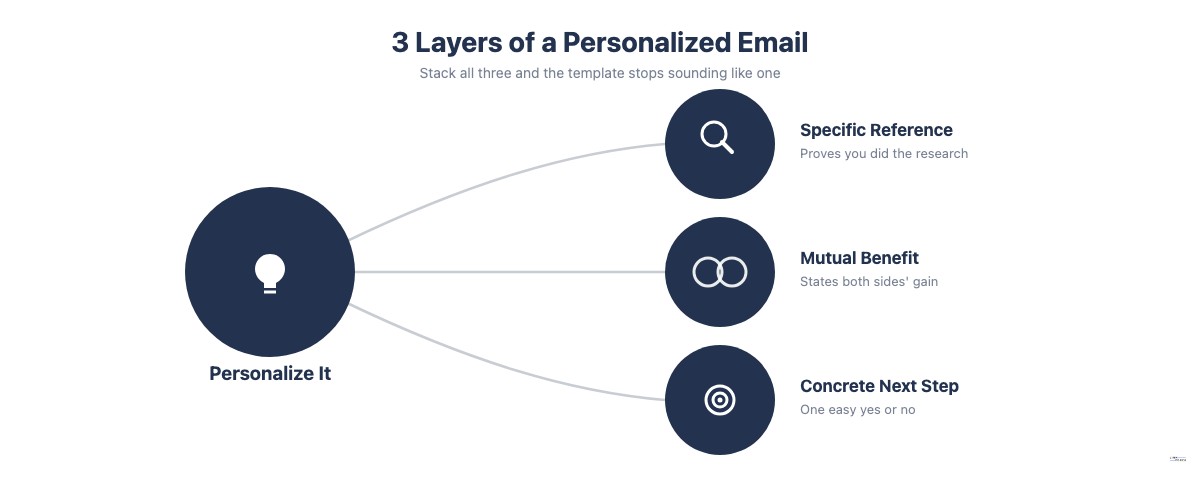
Personalizing a collaboration email template comes down to three layers: a recipient-specific reference, a mutual-benefit framing instead of a one-sided ask, and a concrete next step instead of an open-ended one. Stack all three and the email stops reading like a template, even though it started as one.
The same three layers apply whether you’re sending a one-off partnership pitch or running a full outreach email sequence, since the personalization work is what separates a reply from a delete either way.
The recipient-specific reference is the easiest layer to skip and the most important to keep. Swap “I came across your website” for “I saw your recent piece on [specific topic]” and the entire email changes tone, because it proves a real person read something specific before writing.
The mutual-benefit framing means naming what the recipient gets before or alongside what you want, not three paragraphs later. A one-sided template says “we’d like to guest post on your site.” A personalized version says “your readers get [X], and we get [Y],” which reads as a proposal instead of a request.
The concrete next step replaces “let me know your thoughts” with “does a 15-minute call next Tuesday work?” A vague close forces the recipient to do the work of deciding what happens next, and busy people default to ignoring emails that require extra decisions. The diagram below lays out all three layers together.
Before: “Hi, I found your blog and think we should collaborate. Let me know if you’re interested.”
After: “Hi [Name], your recent post on [specific topic] covers exactly the gap our readers have been asking about. I’d like to propose [specific idea], where you get [specific benefit] and we bring [specific benefit]. Would a quick call this week work to talk it through?”
Mistakes That Kill Collaboration Emails
None of these templates matter if the email never reaches the inbox in the first place, so it’s worth running your sending setup through an email deliverability checklist before a partnership campaign, and using an email finder to confirm you’re writing to the right person rather than a generic inbox.
A vague ask is the most common failure. “Let’s collaborate sometime” gives the recipient nothing to say yes to, so the email gets filed under “maybe later” and forgotten. Name the exact collaboration in the first two sentences.
No clear benefit for the recipient is a close second. If the email only explains what you want, it reads as a favor request, not a partnership. State their side of the trade as clearly as your own.
Generic template language is easy to spot and easy to ignore. Bracketed placeholders left unfilled, or a value proposition so broad it could apply to any company, both signal a mail-merge blast rather than a real proposal.
Missing or unclear calls to action leave the recipient guessing what happens next. An email that ends with “thoughts?” instead of a specific ask gets a lower reply rate than one that proposes an exact next step.
Asking for too much in the first email overloads the recipient’s decision. A first contact that requests a call, a content review and an introduction to their boss usually gets none of the three. Ask for one thing and expand the relationship after that first yes.
- Vague ask with no specific collaboration named
- No stated benefit for the recipient’s side
- Generic, unfilled template language
- Missing or unclear call to action
- Too many asks packed into the first email
Frequently Asked Questions
How long should you wait before following up on a collaboration email?
Wait 3-5 business days before sending your first follow-up. That’s long enough that the original email isn’t buried under a busy inbox day, but short enough that the context is still fresh when you send the reminder. A single follow-up can lift your reply rate by around 22%, and sending two to three total follow-ups roughly doubles overall responses compared to a single email.
What’s a good reply rate for a collaboration or partnership email?
A reply rate between 3% and 6% is a normal, healthy benchmark for cold B2B outreach in 2026, with 10% or higher considered excellent. Anything under 3% usually points to a targeting or personalization problem rather than bad luck, since the biggest lever on reply rate is how specific and relevant the pitch is to that exact recipient.
How long should a collaboration email be?
Keep the body between 50 and 125 words. Recent outreach data shows this range gets meaningfully higher reply rates than longer emails, roughly 50% higher in some studies, because a short email respects the recipient’s time and fits on one mobile screen without scrolling.
Can I use AI to draft a collaboration email?
Yes, AI can draft the structural skeleton of a collaboration email, but the personalization layer still needs a human. A useful workflow is to let a tool draft the subject line, opener, and closing structure, then have a person add the specific research, the real mutual benefit, and the exact ask before sending.
Does personalizing the subject line actually matter?
Yes, personalized subject lines get opened noticeably more often, with research from Campaign Monitor showing about a 26% lift in open rates over generic ones. A subject line that names the company or the specific collaboration idea consistently outperforms a vague, curiosity-driven line.
Should I cc anyone on the initial collaboration email?
No, keep the first email to a single recipient. Adding a manager, an assistant or a teammate on the first contact can make the ask feel like an escalation instead of a simple proposal, and it removes the option for the recipient to quietly say no without an audience. Loop in additional people only after the recipient has already responded positively.