
Domain reputation is a trust signal that determines how legitimate a domain appears to email providers, search engines, and security systems. A low reputation means emails get blocked or land in spam, search rankings suffer, and sites refuse to link to you.
The term covers two different contexts:
- In email deliverability, domain reputation determines whether messages reach the inbox or get filtered. ISPs like Gmail, Outlook, and Yahoo each calculate their own score based on complaint rates, blacklist status, authentication setup, and sending behavior.
- In SEO, domain reputation reflects how much search engines trust a domain as an authoritative source. It is shaped by backlink quality, content depth, E-E-A-T signals, and domain history.
Both contexts matter if you run a website that also sends email. This guide covers both.
Domain Reputation in SEO vs. Email: Two Contexts You Need to Know
Domain Reputation for Email (Email Deliverability)
When email marketers talk about domain reputation, they mean the score ISPs assign to your sending domain. Every mailbox provider calculates this score independently.
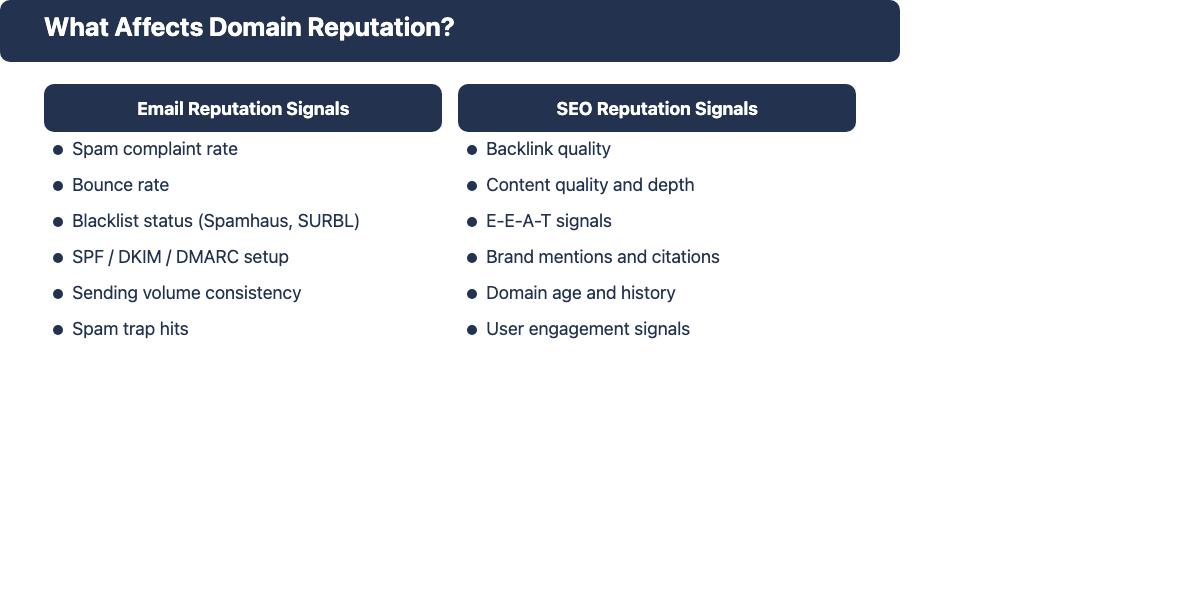
The strongest signals that affect email domain reputation:
- Spam complaint rate — the single most impactful factor; a rate above 0.1 percent triggers filtering at Gmail, and above 0.3 percent typically leads to blocks
- Bounce rate — high hard bounces signal poor list hygiene; ISPs treat this as a red flag
- Blacklist status — if your domain appears on blocklists like Spamhaus DBL, Barracuda, or SURBL, delivery is blocked immediately
- Authentication setup — domains missing SPF, DKIM, and DMARC records score lower across all ISPs
- Sending volume consistency — sudden spikes look compromised; ISPs model expected behavior over time
- Spam trap hits — sending to honeypot addresses signals an aged or poorly maintained list
A low email domain reputation means messages land in spam or get blocked, regardless of content quality.
Domain Reputation for SEO (Web Authority)
In the SEO context, domain reputation is not a single score. It is a composite of trust signals that search engines use to assess how authoritative and reliable a website is as a source.
Key signals that shape SEO domain reputation:
- Backlink quality — editorial links from relevant, authoritative domains are the strongest signal
- Content quality and topical depth — shallow content that covers topics without adding insight reduces trust over time
- E-E-A-T signals — author credentials, about pages, citations, and editorial accountability all contribute
- Brand mentions and unlinked citations — being referenced by credible publications signals entity recognition
- Domain age and history — older domains with clean histories carry accumulated trust
- User engagement signals — strong click-through rates, time on page, and low bounce rates reinforce authority
SEO domain reputation is reflected in third-party metrics like Ahrefs Domain Rating (DR), Moz Domain Authority (DA), and Semrush Authority Score. None of these are official Google metrics, but all correlate with ranking performance.
For link builders, a site’s SEO reputation is directly relevant to how much value a link from that site passes, and how likely the site is to accept an outreach pitch.
Domain Reputation vs. Domain Authority: What’s the Difference?
These two terms are often used interchangeably, but they describe different things.
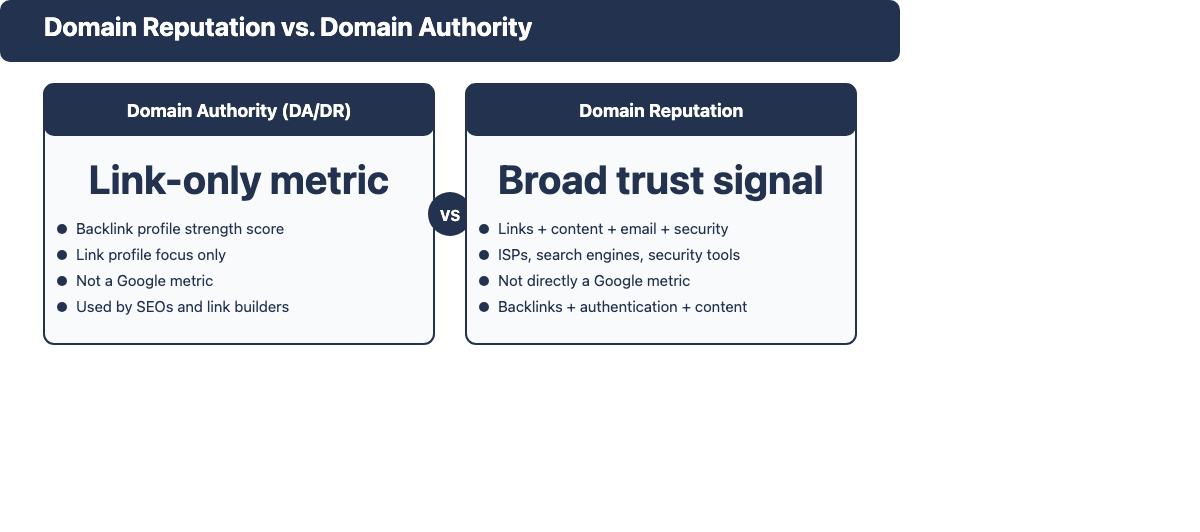
Domain authority metrics (Moz DA, Ahrefs DR, Semrush Authority Score) measure backlink profile strength on a 1 to 100 scale. They are narrow, link-focused measurements. You can read more in our full guide to domain authority.
Domain reputation is a broader concept. It includes your backlink profile, plus behavioral history, content quality, email sending behavior, and security signals.
| Domain Authority (DA/DR) | Domain Reputation | |
|---|---|---|
| Definition | Backlink profile strength score | Composite trust signal across systems |
| Scope | Link profile only | Links + behavior + content + email + security |
| Who measures it | SEOs, link builders | ISPs, search engines, security tools |
| Is it a Google metric? | No | Not directly |
| Improves by | Earning more quality backlinks | Backlinks + content + authentication + clean behavior |
The key practical implication: you can have a high Ahrefs DR built on a strong link profile, but still have weak overall domain reputation if your email practices trigger ISP flags, your content has thin E-E-A-T, or your domain has a history of abuse.
What Affects Your Domain Reputation?
SEO Reputation Factors
Backlink quality is the single strongest SEO reputation signal. Links from relevant, authoritative, editorially placed domains signal that trusted sources vouch for your content. Low-quality or purchased links harm reputation even if they temporarily inflate DA scores.
Content quality and topical depth tell search engines whether your domain is a genuine authority. Shallow articles that touch topics without adding real insight reduce trust over time.
E-E-A-T signals (Experience, Expertise, Authoritativeness, Trustworthiness) include author credentials, clear attribution, citations to primary sources, About pages, and editorial standards. These matter across all content categories, not just YMYL topics.
Brand mentions, even without links, contribute to entity recognition. When established publications reference your brand by name, search engines interpret this as a trust signal.
Domain age and history give search engines context. A recently registered domain starts with a trust deficit. Years of clean, consistent operation build accumulated trust.
User engagement signals including click-through rates, time on page, and bounce rates reinforce domain authority when users actively engage with your content.
Email Reputation Factors
Spam complaint rate is the most impactful single factor. Gmail uses feedback loop data to track how often recipients mark your emails as spam. A rate above 0.1 percent triggers filtering; above 0.3 percent typically leads to blocks.
Bounce rate signals list quality. High hard bounce rates indicate your list was purchased, scraped, or poorly maintained.
Blacklist status has an immediate delivery impact. Major blocklists like Spamhaus DBL, Barracuda, URIBL, and SURBL are checked in real time by most ISPs during message delivery.
SPF, DKIM, and DMARC authentication prove your domain authorized the email. Missing authentication leads to lower trust scores across all providers.
Sending volume consistency matters because ISPs model expected behavior. A domain that suddenly sends 10 times its normal volume looks compromised or spammy.
Spam trap hits from sending to honeypot addresses signal that your list has aged or was poorly sourced.
How to Check Your Domain Reputation
Different tools serve different contexts. Use SEO tools for web reputation and email tools for deliverability reputation.
Checking Web / SEO Reputation
- Ahrefs Website Authority Checker: Domain Rating (DR) on a 0 to 100 scale; free single-domain checks
- Moz Link Explorer: Domain Authority (DA) with spam score; free basic checks
- Semrush Authority Score checker: composite score combining backlinks, organic traffic, and spam signals
- Google Search Console: check for manual actions, indexing issues, and Core Web Vitals problems
Checking Email Reputation
| Tool | Context | What It Shows | Free? |
|---|---|---|---|
| Google Postmaster Tools | Gmail only | Domain reputation: Bad / Low / Medium / High | Yes |
| Sender Score (Validity) | Multi-ISP | Domain score 0 to 100 | Yes |
| Talos Intelligence (Cisco) | Multi-ISP | Good / Neutral / Poor | Yes |
| MXToolbox Blacklist Check | Blacklists | Domain against 100+ major blocklists | Yes |
| Barracuda Central | Barracuda network | Domain reputation lookup | Yes |
Start with Google Postmaster Tools if Gmail deliverability is your concern — it is the most direct signal from the world’s largest email provider. Use MXToolbox to check blacklist status, which causes the most immediate damage.
How to Improve Your Domain Reputation
Build a Strong Backlink Profile
Editorial links from relevant, authoritative domains are the most direct path to improving SEO domain reputation. Our link building outreach guide covers the systematic approach.
Key principles:
- Prioritize links from domains with high DR/DA and topical relevance to your niche
- Avoid buying links, participating in link schemes, or using low-quality directories
- Identify and disavow toxic links — see our SEO backlink audit guide for the process
- Build a diverse link profile with links from different referring domains
Create Authoritative, Trustworthy Content
Backlinks alone do not build SEO reputation. Search engines also evaluate content quality. Publish content that demonstrates first-hand experience and genuine expertise. Cite credible primary sources. Attribute content to real authors. Keep articles up to date. These habits build the E-E-A-T signals that underpin long-term domain reputation.
Fix Technical Signals
Technical problems can silently undermine domain reputation:
- Run on HTTPS with a valid SSL certificate
- Fix page speed issues that harm Core Web Vitals
- Resolve crawl errors in Google Search Console
- Add structured data (schema markup) to help search engines understand your domain’s entity
Set Up Email Authentication
SPF, DKIM, and DMARC are non-negotiable baseline requirements in 2026. Without them, ISPs cannot verify your domain authorized the message, which leads to lower trust scores across all providers.
Our email deliverability checklist covers the full setup process. If your emails are already going to spam, start with our guide on why emails go to spam.
Maintain Consistency Over Time
Sudden spikes trigger suspicion in both email and SEO contexts. Warm up new sending domains gradually. Build links at a natural pace. Consistency signals legitimate, long-term behavior to all reputation systems.
How Long Does It Take to Build Domain Reputation?
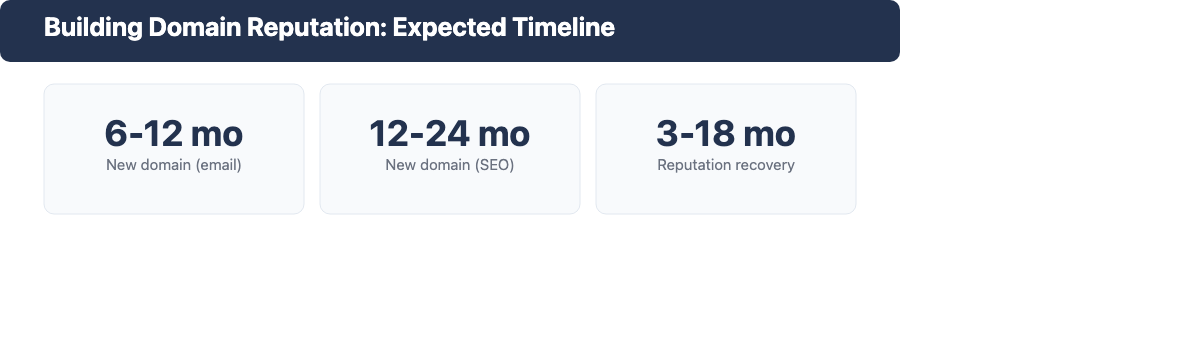
Three typical scenarios:
- New domain (email): Building a meaningful sender reputation takes 6 to 12 months of consistent, low-complaint-rate sending. New domains have zero history and face ISP skepticism until patterns are established.
- New domain (SEO): Reaching meaningful organic visibility typically takes 12 to 24 months. Domain age is a real factor in how much search engines trust a source.
- Reputation recovery: Recovering from a spam blacklisting, a Google manual action, or a history of manipulative link building can take 3 to 18 months depending on severity and how quickly root causes are addressed.
Shortcuts accelerate damage but do not accelerate legitimate reputation building. Domains that bought links or used email blasts to grow lists spend years recovering from those decisions.
Domain Reputation and AI Search
AI search systems like ChatGPT, Google Gemini, Perplexity, and Claude increasingly surface sources by trust rather than by keyword matching alone. When an AI generates an answer and cites sources, it draws on a model of which domains are trustworthy enough to reference. Domains with strong reputations get cited; low-trust domains do not.
Practical implications for 2026:
- Brand mentions on credible publications matter even without a direct link — AI models learn entity associations from unlinked text
- Verified authorship and clear editorial attribution increase the likelihood of being treated as a citable source
- E-E-A-T has evolved from a ranking signal into an entity trust filter that determines AI search visibility
- Editorial backlinks from recognized publications send trust signals that carry weight with both traditional and AI search
The reputation-building work that improves traditional search rankings — quality links, authoritative content, E-E-A-T signals — is the same work that positions your domain for AI search visibility.
Frequently Asked Questions About Domain Reputation
Is domain reputation the same as domain authority?
No. Domain authority (Moz DA, Ahrefs DR) is a specific backlink-focused metric. Domain reputation is broader — it covers behavioral signals, content quality, email sending history, and security signals in addition to backlinks. You can have a high DA score but still have weak overall reputation if other signals are negative.
Can a bad email reputation affect my SEO rankings?
Not directly. Search engines do not read ISP email scores. However, the same behaviors that damage email reputation — spammy practices, low-quality content, manipulative link building — also tend to harm SEO reputation. The two problems often share root causes.
How do I check if my domain is blacklisted?
Use the MXToolbox Blacklist Checker, which checks your domain against more than 100 major blocklists at once. Barracuda Central is also worth checking separately. If your domain is listed, each blocklist has its own delisting request process.
How do I recover from a damaged domain reputation?
For email: submit delisting requests to relevant blocklists, set up SPF/DKIM/DMARC authentication, clean your list of invalid addresses and complainers, and resume sending at low volumes while monitoring complaint rates closely.
For SEO: use Google Search Console to identify and resolve any manual actions, disavow known toxic backlinks through Google’s Disavow Tool, focus on earning new high-quality editorial links, and allow time for recovery — it is rarely immediate.
Does changing your domain reset your reputation?
For email, yes — a new domain has zero history and must rebuild sender reputation from scratch. Ramp sending volume up gradually.
For SEO, a domain migration with proper 301 redirects transfers a portion of existing link equity to the new domain. But entity recognition and trust signals still need to be re-established over time. Migration does not reset you to zero, but it does not fully preserve your existing reputation either.