

What Is Domain Authority?
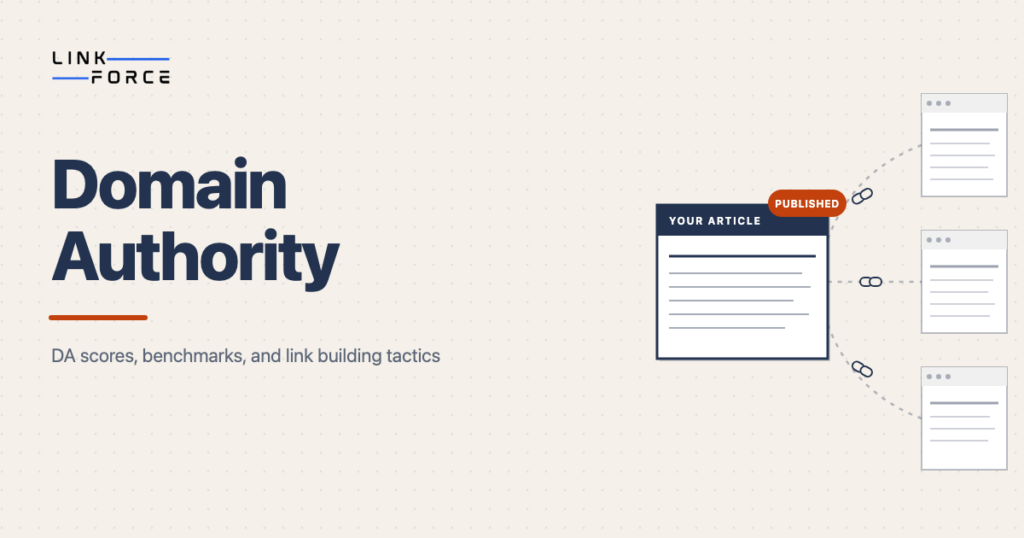
Domain Authority (DA) is a 1-to-100 score developed by Moz that predicts how likely a website is to appear in search engine rankings relative to competing sites. The higher the score, the stronger the site’s estimated ranking potential. DA is calculated using a machine learning algorithm that evaluates backlink data — specifically the number and quality of referring domains pointing to your website domain. Moz updates the score continuously as it recrawls the web. Because DA compares your site against every other indexed domain, the score is relative by nature. A DA of 40 is strong if your competitors average 25, but weak if they average 60. Domain Authority is not a Google ranking factor. Moz’s DA is a third-party metric that Google does not use in its ranking algorithm. The correlation between DA and search engine rankings exists because high-DA sites tend to have strong backlink profiles — and Google does value backlinks. But a high DA score does not cause rankings.Quick Facts About Domain Authority
- DA ranges from 1 to 100; new websites start at DA 1
- Moz owns and calculates DA using its own Link Explorer web index
- DA is not used by Google to determine search engine rankings
- Scores fluctuate as Moz recrawls the web and as other domains gain or lose links
- DA is a relative metric — compare your score to competitors in your niche, not to global brands
- The only way to improve DA is to earn more high-quality referring domains
Domain Authority vs. Domain Rating vs. Authority Score
Every major SEO platform has built its own version of this metric. Moz calls it Domain Authority, Ahrefs calls it Domain Rating (DR), and Semrush calls it Authority Score. All three measure backlink-based site strength on a 1-to-100 scale, but they use different web indexes and algorithms. Because each tool crawls the web independently, the same website domain authority score will often differ between platforms.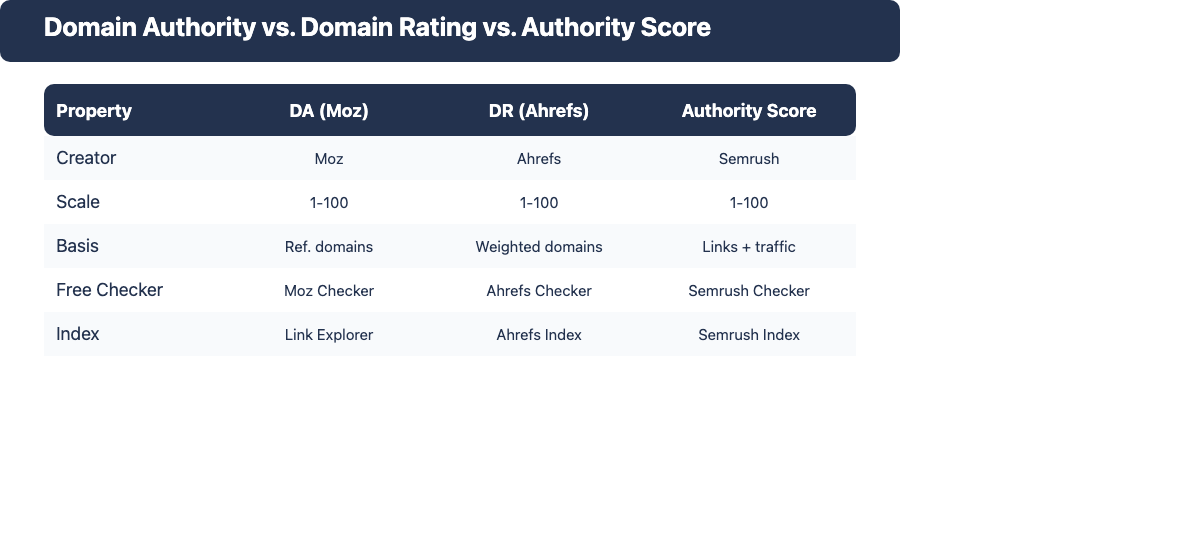
| Metric | Creator | Scale | Calculation Basis | Free Checker |
|---|---|---|---|---|
| Domain Authority (DA) | Moz | 1-100 | Moz Link Explorer index; referring domains, link quality | Moz Domain Authority Checker |
| Domain Rating (DR) | Ahrefs | 1-100 | Ahrefs index; unique referring domains weighted by their own DR | Ahrefs Website Authority Checker |
| Authority Score | Semrush | 1-100 | Semrush index; backlinks, organic traffic signals, spam detection | Semrush Authority Score Checker |
Domain Authority vs. Page Authority
Domain Authority (DA) measures the overall strength of an entire website domain. Page Authority (PA), also from Moz, measures the ranking strength of a single page. Both use a 1-to-100 scale and predict ranking likelihood in search engine results pages (SERPs). For most link-building decisions, DA is the right signal. Use DA to evaluate whether a site is worth approaching as a link source. Use PA to evaluate whether the specific page you want a link from is likely to pass strong link equity. A page from a lower-DA domain can have a high PA if it has accumulated many direct inbound links.How Domain Authority Is Calculated
Moz calculates Domain Authority using a machine learning algorithm built on data from its Link Explorer web index. The algorithm evaluates:- Number of unique referring domains: How many distinct website domains link to the target site
- Quality of those referring domains: Links from high-DA sites contribute more than links from low-DA sites
- Spam score: Domains with manipulative or toxic backlink patterns may see their DA suppressed
- Relative position: DA is normalized across all indexed domains, so score changes elsewhere affect your score even without changes to your backlink profile
What Is a Good Domain Authority Score?
There is no universally good DA score. Domain Authority is a relative metric — what matters is how your score compares to competitors in your specific niche, not against global benchmarks.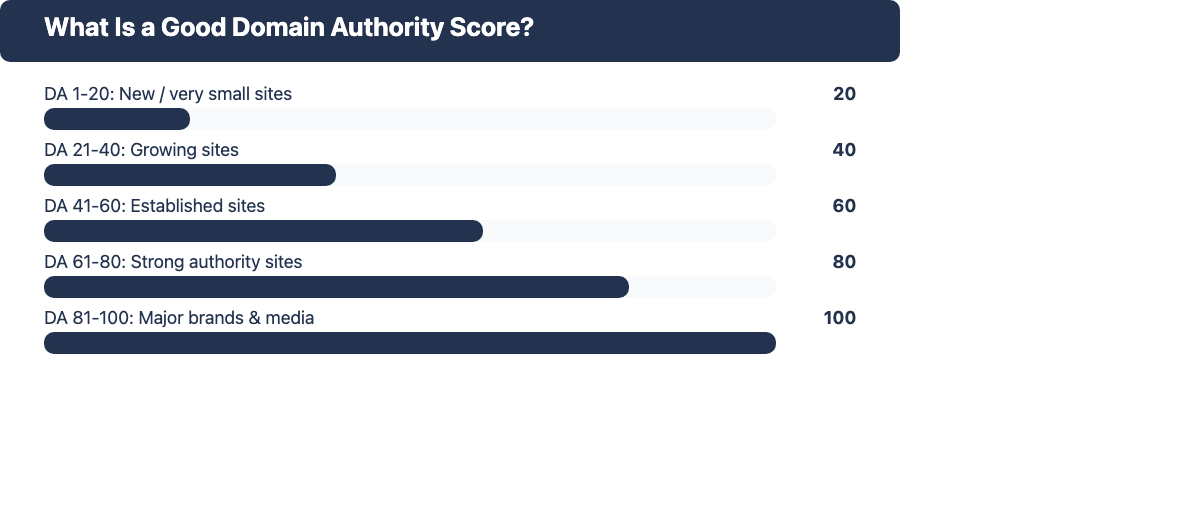
| DA Range | Typical Profile |
|---|---|
| 1-20 | New or very small sites with few referring domains |
| 21-40 | Growing sites with a developing backlink profile |
| 41-60 | Established sites with solid link presence in their category |
| 61-80 | Strong authority sites with extensive backlink profiles |
| 81-100 | Major brands, national media, high-authority platforms |
Why Domain Authority Matters for Link Building
DA is most useful as a practical signal in your link-building workflow, not as a goal in itself. Here is how practitioners use it day to day.Benchmarking Your Website Domain Against Competitors
Run a DA check on the top-ranking sites for your target keywords. If your website domain authority score is significantly lower than the sites currently ranking, closing that gap through link building should be a priority. Track your DA monthly as a lagging indicator of campaign progress — meaningful gains typically appear 3 to 6 months after earning new referring domains.Vetting Link Prospects Before You Pitch
Before spending time on a guest post pitch or outreach email, check the DA of the target website. A common minimum threshold is DA 30 for standard editorial outreach and DA 40-50 for sites where you want maximum link equity transfer. Sites below DA 20 from unknown publishers often have thin organic traffic and low-quality link profiles that pass little value. DA is not the only signal for prospect vetting — organic traffic, topical relevance, and spam score matter too. But it is a fast first filter that prevents wasted outreach effort. Many link-building teams use a DA PA checker or bulk domain tool to screen hundreds of prospects in a single pass before shortlisting outreach targets.How to Check Your Domain Authority
You can check DA for free using any of these tools:- Moz free Domain Authority checker (free with a Moz account): check any website domain, see DA, PA, and referring domain count
- MozBar browser extension: displays DA and PA for every page you visit while browsing
- Ahrefs Website Authority Checker (free, no login required): shows Domain Rating, referring domains, and organic traffic estimate
- Semrush Authority Score checker (free): shows Authority Score alongside backlink and traffic data
How to Improve Your Domain Authority

- Create linkable assets: original research, data studies, free tools, and comprehensive guides earn natural citations because other sites reference them
- Guest blogging on established sites in your niche: each published piece on a new domain adds a referring domain to your profile
- Digital PR: pitch data-led stories to journalists and bloggers; a single media placement from a high-authority outlet adds meaningful link equity
- Broken link building: find dead links on relevant pages, create a replacement resource, and notify the site owner to update the link
- Link reclamation: find brand mentions without links using Ahrefs or Semrush and ask publishers to add a link
- Journalist and media outreach: respond to media queries through services like HARO, Qwoted, or SourceBottle to earn editorial links from news sites
- Resource page outreach: get listed on curated link pages in your industry
- Writing more blog posts without a corresponding link acquisition strategy
- Improving on-page SEO, site speed, or internal linking
- Gaining social media followers or social shares
- Buying backlinks — this violates Google’s guidelines and can trigger manual penalties
Domain Authority Limitations and Common Misconceptions
Understanding what DA cannot tell you is as important as knowing how to use it. Common misconceptions about Domain Authority:- DA is not a Google ranking factor: Google does not use Moz’s Domain Authority to rank websites. Moz states explicitly: “Domain Authority is not a Google ranking factor and has no effect on the SERPs.” Google’s John Mueller has confirmed that Google has its own sitewide quality signals that map to similar concepts, but these are distinct from DA.
- DA is not the same as PageRank: Google’s PageRank and Moz’s Domain Authority are separate systems from different organizations. PageRank was a Google algorithm; DA is a Moz prediction model.
- DA is not a fixed score: DA fluctuates as Moz updates its algorithm, recrawls the web, and indexes new domains. Industry-wide index updates can shift scores across thousands of sites simultaneously, even if your own backlink profile has not changed.
- High DA does not guarantee search engine rankings: DA captures backlink strength only. Google’s algorithm also weighs on-page relevance, topical authority, content quality, and user experience signals. A site with DA 60 and thin content can underperform a DA 35 site with deep topical authority.
- DA can be artificially inflated: Link farms and private blog networks (PBNs) can temporarily inflate DA. When evaluating domains for outreach, combine DA with organic traffic data and spam score to detect manipulated profiles.
Frequently Asked Questions About Domain Authority
No. Google does not use Moz’s Domain Authority metric. DA is a proprietary score created by Moz to estimate a website’s ranking potential based on its backlink profile. Google has its own internal quality signals, which are separate and not publicly available.
There is no universal answer. DA is a relative metric — a score of 30 is strong if your competitors average 20, but weak if they average 55. Compare your DA to the sites that currently rank for your target keywords, not to unrelated high-authority sites.
After earning a meaningful number of new high-quality referring domains, expect 3 to 6 months before the DA score reflects that growth. DA updates lag behind actual link acquisition because Moz recrawls the web on its own schedule.
Not directly. DA is not a Google ranking factor. However, websites with high DA tend to rank well because they have strong backlink profiles, which Google does value. DA correlates with ranking ability — it does not cause it.
Domain Authority measures the overall strength of an entire website domain. Page Authority (PA) measures the ranking strength of a single page. Use DA to evaluate a site as a potential link source. Use PA to assess whether a specific page on that site is strong enough to pass meaningful link equity.