

Brand mentions for SEO are online references to your company, product, or service, with or without a hyperlink to your website. Search engines use these references as authority and credibility signals alongside traditional backlinks. In the AI search era, consistent brand mentions across authoritative sources also determine whether your brand appears in AI-generated answers.
Every day, people write about brands online without linking to them. A journalist names your company in an industry article. A forum user recommends your product. A blogger references your tool in a comparison. None of those references include a hyperlink, but all of them contribute to how Google and AI systems understand your brand’s credibility and relevance.
This guide covers what brand mentions are, why they affect SEO, how to track them, how to earn more, and how to convert unlinked mentions into backlinks. It also includes a 5-step audit framework and a comparison of the leading monitoring tools.
What Are Brand Mentions for SEO?
A brand mention is any online reference to your company, product, or service, whether or not it includes a link back to your website. Brand mentions appear in blog posts, news articles, forum threads, podcast transcripts, social media posts, Reddit comments, and AI-generated answers.
The core value of brand mentions is that they do not require a hyperlink to carry SEO weight. An article that names your company in a relevant context signals to search engines that your brand exists, is credible, and is relevant to your industry. Google refers to this concept as implied links: the brand appears in context, the co-occurrence creates an entity relationship, and the search engine updates its understanding of your brand’s authority even without an explicit hyperlink.
The three main types of brand mentions are:
- Linked mentions: The brand name appears alongside a hyperlink to your website. These carry link equity, referral traffic, and entity signals.
- Unlinked mentions: The brand name appears without a hyperlink. These build brand authority and AI training signals but do not pass link equity directly.
- AI mentions: The brand appears in AI-generated answers, AI Overviews, or large language model responses. This is a fast-growing category that both reflects and reinforces overall brand authority.
For most brands, unlinked mentions outnumber linked ones by a wide margin. Managing all three types is part of a complete SEO strategy in 2026.
Why Brand Mentions Matter for SEO
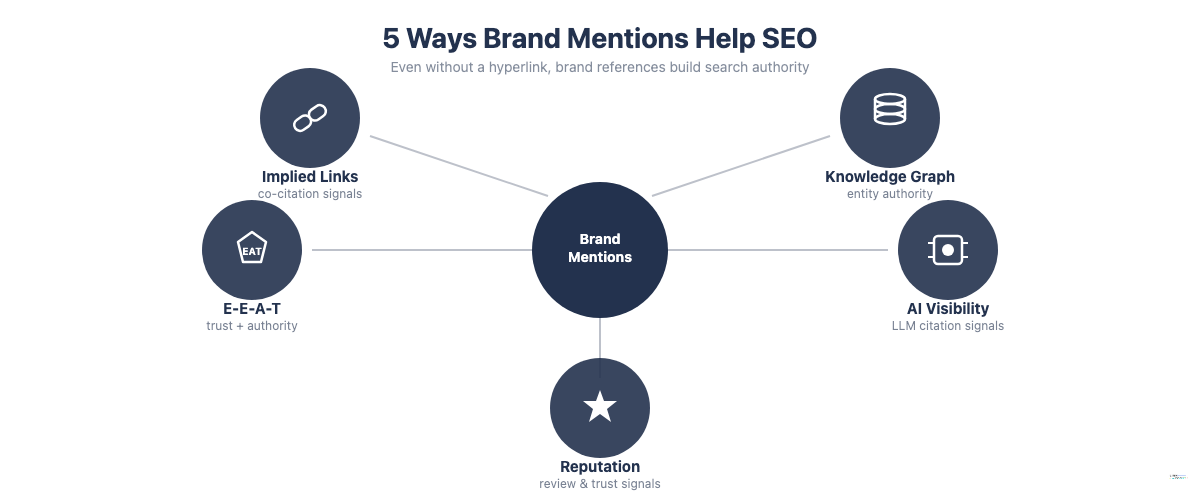
Unlinked brand mentions help SEO through several distinct mechanisms, each with a different effect on rankings and visibility.
Implied links and co-citation. Google can detect co-occurrence patterns between brand names and relevant topics even when no hyperlink is present. When authoritative sites repeatedly reference your brand alongside your industry or competitors, Google strengthens your brand’s Knowledge Graph entry. This influences rankings without requiring a direct backlink from those sources.
Knowledge Graph and entity signals. Google’s Knowledge Graph tracks real-world entities: companies, products, and people. Brand mentions from credible sources feed into how well-established your entity appears in the Knowledge Graph. A brand mentioned across news coverage, review platforms, industry publications, and social media registers as more authoritative than one that appears only on its own website.
E-E-A-T signals. Experience, Expertise, Authoritativeness, and Trustworthiness are core quality signals in Google’s ranking framework. Third-party brand mentions from credible sources directly strengthen E-E-A-T. A mention in a respected industry publication or a verified review platform contributes to your authority profile in a way that backlink acquisition alone does not.
AI system visibility. AI search products are trained on web content. Brands that appear frequently, accurately, and positively in that training data are more likely to appear in AI-generated answers. According to Ahrefs’ analysis of 9.6 million ChatGPT queries, consistent brand presence across authoritative web properties correlates with higher AI citation rates. Approximately 67 percent of ChatGPT’s most-cited sources were not actively monitored by most marketers. Brands that track only backlinks miss a significant share of the signals that determine AI visibility.
Reputation signals. Consistent positive brand mentions on review platforms such as G2, Trustpilot, Capterra, and Reddit contribute to the trust signals that affect rankings for brand-adjacent queries. A spike in negative mentions can also be an early warning of reputation issues worth addressing.
3 Types of Brand Mentions (and What Each Signals)
Understanding the distinction between mention types helps prioritize the right effort for each SEO goal.
| Type | What it is | Primary SEO signal |
|---|---|---|
| Linked mention | Brand name + hyperlink to your website | Link equity, referral traffic, authority signals |
| Unlinked mention | Brand name without a hyperlink | Co-citation, Knowledge Graph signals, AI training |
| AI mention | Brand appears in AI-generated answers | AI visibility, presence in LLM citation patterns |
Linked mentions deliver the clearest, most measurable SEO impact. A backlink from a high-DR publication passes authority and referral traffic while confirming the relationship between your brand and that source. They require more effort to earn but have the most direct ranking effect.
Unlinked mentions are more common and more scalable. At sufficient scale and from authoritative sources, they build credibility that influences rankings for branded and category-level queries over time.
AI mentions are the fastest-growing category. Appearing in AI Overviews, ChatGPT responses, or Perplexity answers drives direct visibility to high-intent users and reinforces your brand’s authority in the data AI systems draw from.
How to Track Brand Mentions
Effective brand mention tracking covers web, social, review, and AI channels. No single tool covers all surfaces.
Google Alerts (Free)
Google Alerts is the simplest starting point. Set up alerts for:
- Your exact brand name in quotes: “YourBrand”
- Your primary product names: “Product Name”
- Common misspellings of your brand name
- Your founder or CEO name if they have media visibility
- Competitor brand names, to track where they are mentioned without you
Go to google.com/alerts, enter each term, select “All results” or a daily digest, and enter a delivery email. Google Alerts covers web and news coverage but does not monitor social media, forums, podcasts, or AI-generated answers.
Weekly digest alerts in brand monitoring tools compile mentions, sentiment shifts, and reach into a single summary report. They prevent inbox overload while keeping you informed about PR, SEO, and social listening trends over time.
Dedicated Brand Monitoring Tools
For broader coverage, dedicated tools monitor social platforms, review sites, forums, and in some cases AI search outputs.
| Tool | Best for | Free option | AI monitoring | Approx. price |
|---|---|---|---|---|
| Google Alerts | Basic web and news coverage | Yes | No | Free |
| Mention | Social + web, team workflows | 250 mentions/mo trial | No | From ~$49/mo (est.) |
| Brand24 | Real-time web + social, sentiment scoring | 14-day trial | Partial | From ~$99/mo (est.) |
| Semrush | Enterprise SEO platform with monitoring | No | Partial | From ~$130/mo (est.) |
| Ahrefs Brand Radar | Web mentions, AI citation tracking | No | Yes | From ~$129/mo (est.) |
| Talkwalker | Enterprise social listening | No | Partial | Custom quote |
All prices above are approximate estimates based on published plan information and may change. Check the vendor’s pricing page before purchase.
Tracking AI Mentions
AI mention tracking is still an emerging practice. Practical approaches available now:
- Use Ahrefs Brand Radar to see where your brand appears in AI-generated results, based on Ahrefs’ analysis of ChatGPT query data.
- Test your brand name and key product terms monthly in ChatGPT, Perplexity, Gemini, and Google AI Overviews.
- Monitor your presence on pages that AI systems already cite frequently. Being on those sources increases your likelihood of appearing in AI answers.
A practical monitoring cadence: daily alerts for urgent reputation events; weekly digest summaries for trend awareness; quarterly full audits for strategic review.
How to Get More Brand Mentions
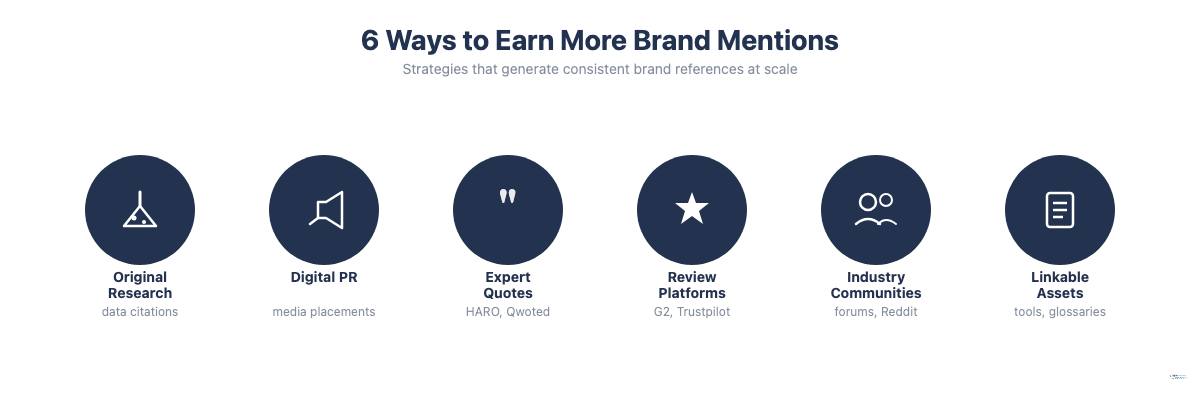
Earning brand mentions at scale requires deliberate content and outreach strategies. These six approaches produce the most consistent results.
Publish Original Research and Data
Original research is the highest-leverage way to generate brand mentions. A study, survey, benchmark report, or original dataset that answers a question your industry cares about earns citations from journalists, bloggers, and content creators for months or years. The key is answering a question no existing public data addresses. When Ahrefs publishes analysis of backlink patterns or Semrush releases traffic data, those numbers appear across hundreds of articles with brand attribution. A well-designed industry survey with 200 respondents and a clear original finding generates more citations than thousands of generic blog posts.
Run Digital PR Campaigns
Digital PR is structured outreach to journalists and publications to earn media coverage. A strong campaign identifies a newsworthy angle, builds a targeted media list, and pitches a story that journalists can publish. One successful placement on a high-authority site generates a mention (often linked) plus syndication across secondary publications. For a detailed workflow, see the guide to digital PR and PR outreach.
Contribute Expert Quotes
Journalists writing about your industry actively need expert sources. Responding to requests on platforms like HARO, Qwoted, or SourceBottle positions your brand as a credible voice. When your quote is published, your name and brand appear in context on an authoritative site. At scale, this generates dozens of brand mentions per year with modest effort per placement.
Build a Review Platform Presence
Review platforms such as G2, Trustpilot, Capterra, Clutch, and Product Hunt are high-authority sites that frequently appear in AI training data and search results. Actively managing your brand’s presence on these platforms increases mention volume on sources that carry strong authority signals. Encourage satisfied customers to leave reviews, respond to existing reviews, and keep product listings accurate.
Participate in Industry Communities
Active, useful participation in forums, Slack communities, subreddits, and LinkedIn groups generates brand mentions through discussion and shared knowledge. Answering questions and contributing data builds a mention footprint on platforms that users and AI systems both reference. This is a slower strategy but generates highly authentic signals.
Create Linkable Assets
A linkable asset is content so useful that other sites reference it without being asked. Glossaries, calculators, comparison tools, and original frameworks are common formats. Once indexed, they attract passive brand mentions as writers cite the resource. For a full breakdown of what makes an asset linkable, see the guide to linkable assets.
How to Convert Unlinked Mentions into Backlinks (Link Reclamation)
Unlinked brand mentions already exist across the web. Converting them to backlinks is one of the highest-return link acquisition tactics because the site owner has already shown willingness to reference your brand.
Find Unlinked Mentions
Use one of these methods to locate where your brand is mentioned without a link:
- Ahrefs Site Explorer: The “Highlight unlinked” feature surfaces external pages that mention your brand without linking to your site.
- Google Search: Search `”your brand name” -site:yourdomain.com` to find external pages. Check each result for a hyperlink.
- Monitoring tool exports: Most paid monitoring tools let you filter mentions by link presence.
Prioritize by Opportunity
Not every unlinked mention is worth pursuing. Prioritize based on:
- Domain Rating: Target DR 40 and above first for maximum impact.
- Editorial context: Focus on editorial articles (blog posts, guides, news) over forum comments, which are rarely edited.
- Relevance: Sites whose audience overlaps with your customers are worth more than peripheral references.
- Recency: Recently published articles are more likely to be updated than older posts.
- Mention clarity: Pursue mentions where your brand name is clearly and positively cited, not where it is incidental or critical.
Outreach Approach
Send a short, direct message to the author or editor. Keep it low-friction:
Subject: Quick note about [Article Title]
Hi [Name],
I noticed you mentioned [Brand] in your article [Title]. Thanks for the reference.
If you think a link to [specific URL] would help your readers, we’d really appreciate it. Happy to share something useful in return.
No pressure if it doesn’t fit.
[Your Name]
Well-targeted link reclamation outreach converts at roughly 10 to 30 percent. Even at 15 percent conversion on a list of 50 high-DR unlinked mentions, you earn 7 to 8 new backlinks from sources that already reference your brand. For a complete outreach workflow, see the backlink outreach guide. For assessing which mentions have the most SEO value, the backlinks analysis guide covers how to evaluate domain and page-level signals.
How to Audit Your Brand Mentions
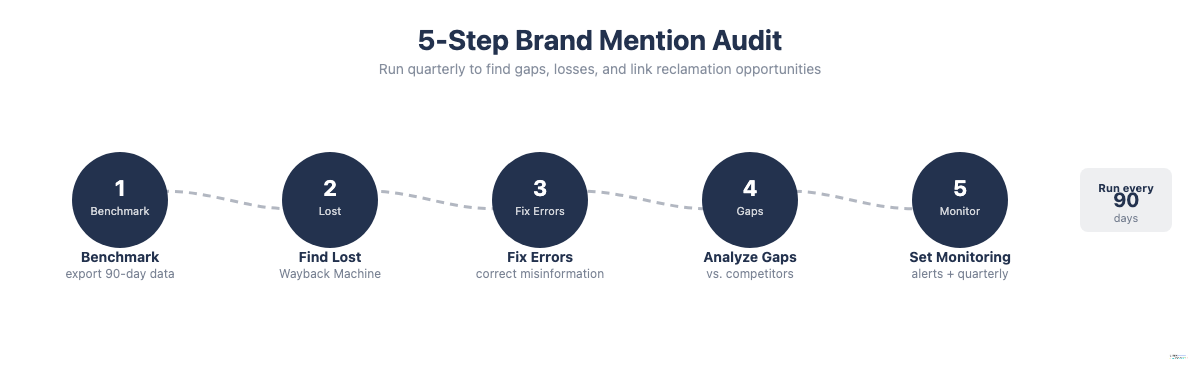
A brand mention audit is a structured review of your mention footprint. Running it quarterly helps identify gaps, losses, and opportunities before they affect rankings or AI visibility.
Step 1: Benchmark Current Mentions
Export all brand mentions from your monitoring tool for the past 90 days. Record total mention volume, the linked-to-unlinked ratio, top referring sources, and sentiment distribution. This baseline makes future campaign results measurable.
Step 2: Find Lost Mentions
Lost mentions are pages that previously referenced your brand but no longer do, because the content was updated, the page was deleted, or the mention was removed. Use the Wayback Machine (web.archive.org) to compare current page versions against archived versions where your brand appeared. If a high-authority page once mentioned you but no longer does, investigate whether an outreach opportunity exists.
Step 3: Fix Misinformation
Inaccurate brand mentions create conflicting signals in AI training data and can damage reputation. Search your brand name alongside “pricing,” “features,” “vs [competitor],” or “review” to find pages with incorrect information. Prioritize outreach to high-authority sites with factual errors. If correction is not possible, publish your own authoritative content that clearly answers the same questions and ranks for the same terms.
Step 4: Analyze Competitive Gaps
Compare your mention footprint against two or three direct competitors. Use Ahrefs’ Competing Domains feature or manually search for competitor brand mentions on high-authority sites where your brand does not appear. Publications that reference competitors but not you are direct targets for PR outreach, expert commentary, or guest content.
Step 5: Set Up Ongoing Monitoring
A one-time audit is less valuable than a continuous monitoring system. A practical setup:
- Daily or weekly digest alerts via your monitoring tool for awareness of new mentions
- Monthly manual checks in ChatGPT, Perplexity, and Google AI Overviews
- Quarterly full audit comparing current vs. prior-period baselines
- A simple stakeholder report covering mention volume, linked-to-unlinked ratio, and sentiment trend
Brand Mention Monitoring Tools
Choosing the right tool depends on your coverage needs, budget, and whether AI mention tracking is a priority.
Google Alerts suits brands with limited budgets or basic monitoring needs. It covers web and news, handles multiple search terms, and is free. Limitations: no social coverage, no sentiment scoring, no AI tracking.
Brand24 is the strongest option for growing brands that need real-time coverage with sentiment analysis. It monitors news, blogs, forums, social media, and podcasts, and offers weekly AI-powered digest summaries. Approximate pricing starts at around $99 per month (check brand24.com for current rates).
Mention fits teams that need collaborative workflows. It supports assigning mentions to team members and tracking response status. It covers social, web, and news. Approximate pricing starts at around $49 per month (verify at mention.com).
Semrush Brand Monitoring integrates mention tracking with SEO metrics like traffic and domain strength for each mention source. Most useful for teams already using Semrush as their core SEO platform.
Ahrefs Brand Radar offers the strongest AI mention tracking currently available, pulling from Ahrefs’ analysis of ChatGPT query patterns. It integrates with Ahrefs’ backlink data, making it especially useful for teams that combine mention monitoring with link reclamation workflows.
For most SEO and content teams, Google Alerts for immediate setup plus Brand24 or Ahrefs for broader coverage addresses the majority of practical monitoring needs.
Frequently Asked Questions About Brand Mentions for SEO
Do unlinked brand mentions help SEO?
Yes. Unlinked brand mentions contribute to co-citation signals and Knowledge Graph signals that Google uses alongside backlinks to assess brand credibility. While they do not pass direct link equity the way a hyperlink does, consistent unlinked mentions from authoritative sources strengthen your brand’s presence in search and in the data AI systems use. They also influence whether your brand appears in AI-generated answers.
How often should I track brand mentions?
Set up automated daily or weekly digest alerts for ongoing awareness. Conduct a deeper review monthly or quarterly to analyze trends, find lost mentions, check for misinformation, and compare your footprint against competitors.
What is the difference between a brand mention and a backlink?
A backlink is a hyperlink from another site to yours that passes link equity and creates a navigational path. A brand mention is any reference to your brand, with or without a link. All linked mentions are mentions, but most brand mentions are unlinked.
Do brand mentions affect Google rankings directly?
Not in the direct, measurable way backlinks do. Google has acknowledged the concept of implied links but does not treat them as equivalent to hyperlinks. The SEO impact of brand mentions is indirect: it comes through Knowledge Graph strengthening, co-citation patterns, and E-E-A-T signals that accumulate over time.
How long does it take to see SEO results from brand mentions?
Results from brand mention campaigns are typically slower than results from link building. A significant PR campaign generating mentions across 50 or more authoritative sources may take 3 to 6 months to produce noticeable ranking impact. The fastest measurable impact comes from converting high-DR unlinked mentions into backlinks through link reclamation, which can affect rankings within weeks of the links being indexed.
Can brand mentions help with local SEO?
Yes. Local brand mentions from regional publications, local directories, and location-specific review platforms contribute to local authority signals. For businesses targeting local queries, consistent mentions across local news outlets, regional blogs, and platforms like Yelp or Google Business strengthen local pack rankings.