


Guest blogging is one of the most direct ways to earn editorial backlinks, reach new audiences and build authority in a niche. Done right, it trades your expertise for a placement on a site your target audience already reads.
This guide covers what guest blogging is, why it still works, and a step-by-step process for finding sites, pitching editors, writing posts that get accepted and tracking the results.
What Is Guest Blogging?
Guest blogging is the practice of writing and publishing an article on another website in exchange for an author credit and a backlink to your site. The host publishes the content for free in return for something their readers want to read. You get exposure and a link.
The terms guest blogging and guest posting mean the same thing. Some publications call contributors “guest writers” or “contributing authors,” but the arrangement is identical. The deliverable is a guest blog post, a full piece of content written by an outside expert and published under that person’s name.
Both sides benefit. The host gets a piece of content without commissioning it. The guest blogger gets a byline, a backlink and access to an established audience.
Does Guest Blogging Still Work in 2026?
Guest blogging still works, but the quality bar has risen sharply. In 2014, Matt Cutts of Google warned against using guest blogging as a link-building tactic after spammers flooded publishers with thin, keyword-stuffed content written purely for links. The warning stuck, and publishers became more selective as a result.
Today, the landscape has shifted further. Many sites are actively rejecting AI-generated submissions, which have made editorial inboxes even noisier. Sites that once accepted most pitches now have explicit policies against low-quality or synthetic content.
What still works is submitting genuinely expert content to relevant, authoritative sites. Editorial links earned through quality guest blog posts continue to pass ranking signals. Sites that maintain strict editorial standards continue to reward contributors with dofollow links and real referral traffic. The channel has not died. It has raised its standards.
Benefits of Guest Blogging
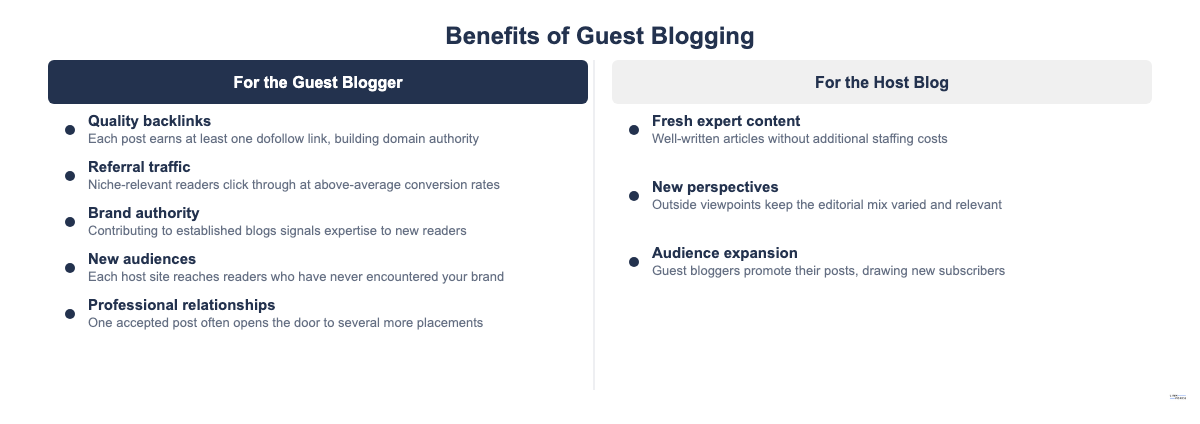
The benefits split clearly between what the guest blogger gains and what the host gets.
For the Guest Blogger
- Quality backlinks. Each published guest blog post typically includes at least one dofollow link back to your site, contributing to domain authority growth over time.
- Referral traffic. Readers who click your contextual link or author bio visit your site. Traffic from niche-relevant sources tends to convert at higher rates than untargeted traffic.
- Brand authority. Publishing on established platforms builds credibility faster than building your own audience from zero. Being named as a contributor on authoritative blogs signals expertise to new readers.
- New audiences. Each host site introduces your work to readers who have never encountered your brand before.
- Professional relationships. A well-received guest post often leads to repeat collaborations and industry connections. In link building, relationships with editors compound over time. One placement often opens the door to several more.
Compared to tactics like broken link building, guest posting requires more upfront effort per link but produces higher-authority placements and stronger editorial relationships.
For the Host Blog
- Fresh expert content. Publishers get well-written material without staffing costs. Guest blogs give teams content they might not have the in-house expertise to produce themselves.
- New perspectives. Guest contributors bring viewpoints the in-house team may not have, keeping the publication’s editorial mix varied.
- Audience expansion. When guest bloggers promote their published pieces, they draw readers from their own audience to the host site, adding new subscribers the host would not have reached otherwise.
How to Find Guest Posting Sites
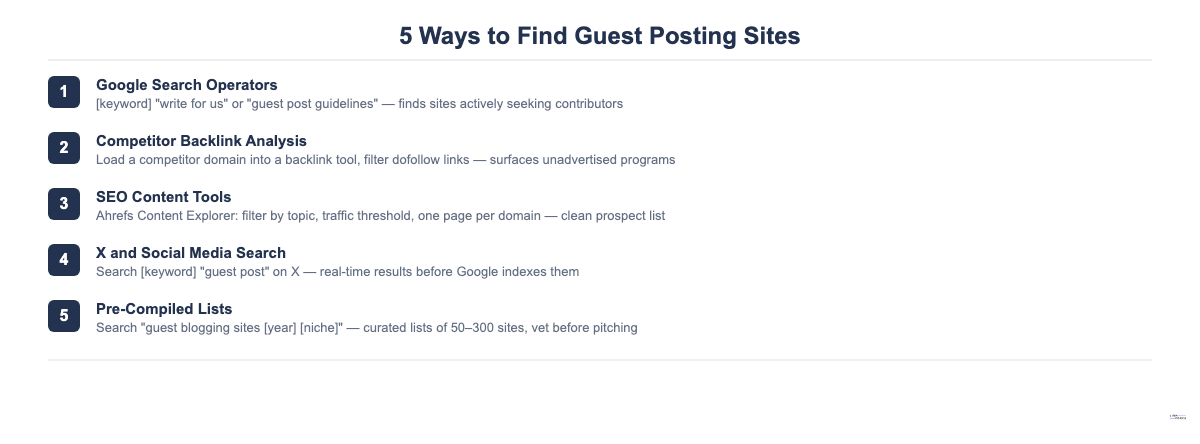
Five methods cover most of the site discovery work. You can use several in parallel to fill a prospect list faster.
Google Search Operators
Google search operators surface sites that openly accept contributions. Use these strings, replacing [keyword] with a relevant topic from your niche:
- [keyword] “write for us”
- [keyword] “guest post guidelines”
- [keyword] “contributor guidelines”
- [keyword] “submit a guest post”
- [keyword] inurl:guest-post
These strings find pages that explicitly invite submissions. Sites showing up here are actively seeking contributors, which improves acceptance rates compared to cold-pitching sites with no stated policy.
Competitor Backlink Analysis
Your competitors have already done part of the prospecting work. Load a competitor domain into a backlink tool and filter links by “dofollow” and “one link per domain.” Look for referring domains where the anchor text matches a topic, brand name or author name.
These are likely guest post placements. Each site clearly accepts contributions in your niche. They accepted your competitor, so they may accept you. This method consistently surfaces sites that do not advertise their guest post programs publicly.
SEO Content Tools
Tools like Ahrefs Content Explorer let you enter a topic, filter for pages published in the past year and set a minimum organic traffic threshold. Sites publishing content in your topic area with real traffic are worth targeting. Apply “one page per domain” to get a clean list of unique candidate sites.
Combining this with searches for resource pages in your niche adds another category of prospects worth pitching.
X and Social Media Search
X (formerly Twitter) surfaces fresh guest posting opportunities that Google hasn’t indexed yet. Search directly in X for [keyword] “guest post” or [keyword] “write for us.” Results update in near-real time. You find the same day’s opportunities before competitors do, which matters on high-DR sites where editors close submissions as soon as they hit capacity.
LinkedIn is also useful for finding editorial contributors in your niche. Search for “[job title] + guest author” to find people actively publishing guest content, then identify where they publish.
Pre-Compiled Guest Posting Lists
Curated lists of sites accepting guest posts exist across multiple SEO and content marketing blogs. Searching for “guest blogging sites [year] [niche]” surfaces lists of 50–300 sites with submission guidelines. These lists are useful starting points, though you still need to vet each site before pitching.
How to Vet a Guest Posting Site
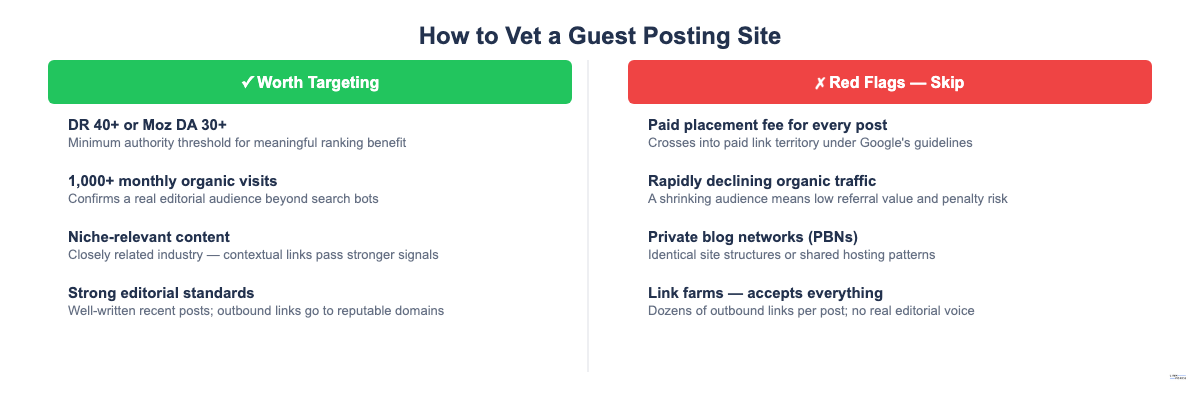
A guest posting site is worth targeting when it passes four hard criteria: niche relevance, a Domain Rating of 40+ or Moz DA of 30+, at least 1,000 monthly organic visits, and genuine editorial standards. A site that fails any one of these four is not worth the pitch.
- Niche relevance. The site must publish content closely related to your industry. A backlink from an unrelated domain passes lower SEO value and can appear manipulative to Google’s link quality filters.
- Domain authority. Target sites with a Domain Rating (DR) of 40+ or a Moz Domain Authority of 30+. Sites below these thresholds provide limited ranking benefit regardless of other signals.
- Organic traffic. The site should receive consistent or growing organic traffic, with at least 1,000+ monthly visits as a reasonable floor. A site with no organic traffic typically has no real editorial audience. Check traffic trends, not just current numbers: a declining traffic chart is a red flag even if current numbers look acceptable.
- Editorial standards. Browse five to ten recent published posts. If the writing is thin, the content looks generated, or the outbound links point to spam sites, skip it. Sites that accept anything are typically link farms, not editorial partners.
Red flags to avoid:
- Link farms with dozens of outbound links per post and no editorial voice
- Private blog networks (PBNs) with identical site structures or shared hosting patterns
- Sites with rapidly declining organic traffic over the past 12 months
- Sites charging a placement fee for every guest blog post, which crosses into paid link territory under Google’s webmaster guidelines
How to Pitch a Guest Post
Cold-pitching a stranger with a vague request rarely works. Publishers receive dozens of pitches every week, and most are generic. The ones that get accepted come from people the editor already recognizes.
Build the Relationship First
Before sending a pitch, spend a few weeks engaging with the target site. Leave thoughtful comments on their posts, share their content and connect with the editor on LinkedIn or X. This makes your pitch land with context. An editor who has already noticed your name reads your email differently than they read a cold message from someone unknown.
This step is not mandatory for every prospect, but it improves acceptance rates on higher-authority sites where competition for spots is intense.
What to Include in Your Pitch
Pitching guest blogging opportunities to editors requires showing you understand their readership, not just that you want a link. A strong pitch covers five elements:
- A specific reference to something you read on the site (shows you actually read it)
- Two or three concrete topic ideas, each with a brief rationale for the host’s audience
- Total email length under 150 words
- A link to a previously published piece as a writing sample
- No mention of backlinks in the pitch itself; that conversation happens after acceptance
For more on writing outreach emails that get replies, see the outreach emails guide. For broader campaign planning across multiple tactics, see the backlink outreach guide.
Guest Post Pitch Email Template
Hi [Name],
I’ve been following [Site Name] for a while. Your post on [Specific Article] was useful for [specific reason].
I’d love to contribute a guest post. Here are three topics I think would work well for your readers:
1. [Topic Idea 1]: [Why this fits their readers]
2. [Topic Idea 2]: [Why this fits their readers]
3. [Topic Idea 3]: [Why this fits their readers]Here’s a recent post I published on [Other Site]: [Link]
Happy to adjust the topics if something else fits better.
[Your Name]
Follow up once after 7–10 days if you hear nothing. After that, move on to the next prospect on your list.
How to Write a Guest Post That Gets Published
Getting the pitch accepted is only the first step. Execution determines whether the post goes live with the placement you need and whether the editor invites you back.
Understand the Site’s Audience
Before writing a single word, read five to ten posts on the target site. Note the vocabulary, technical depth, sentence length and typical section structure. A post written for your audience instead of theirs will come back with revision requests or get rejected. The editor knows their readers far better than you do at the start.
Pay attention to what kind of examples the site uses. A B2B SaaS blog covers the same topic in a completely different register than an ecommerce blog does. Write for where you are publishing, not for where you came from.
Include Links That Help the Host
Editors appreciate when a guest contributor includes internal links to other articles on the site. It shows care and strengthens the host’s internal linking structure. Aim for two to three links to the host’s existing content.
This small step improves the odds the post goes live without revisions. It signals that you read the site carefully and that your piece fits into their existing editorial context instead of standing as a disconnected submission.
Place Your Backlink Contextually
A link in the author bio passes some SEO value, but far less than a contextual link in the body copy. Include your backlink inside a relevant paragraph where it adds genuine value to the reader. Use anchor text that describes the linked page.
A contextual link to your outreach strategy guide would sit naturally in a paragraph about planning a link building campaign, for example. Editors accept that kind of placement because it reads as editorial, not promotional. A link that serves the reader gets kept. A link that serves only the author gets cut.
Follow Up After Publication
Once the post goes live, send a short thank-you email to the editor. Share the post on your social channels and tag the host publication. This drives traffic back to their site, which editors notice and appreciate.
A post that performs well for the host strengthens your relationship with that editor, making it easier to pitch a second or third guest blog post down the line. Building a long-term contributor relationship with three to five good publications is more valuable than one-off placements across dozens of sites you never revisit.
Dofollow vs. Nofollow Links in Guest Posts
Not all guest post backlinks carry the same SEO value. Before investing time in a pitch, check what link type the site uses.
| Dofollow | Nofollow | |
|---|---|---|
| Passes PageRank? | Yes | No |
| SEO ranking impact | Direct | Minimal to none |
| Drives referral traffic? | Yes | Yes |
| Common on | Editorial blogs, niche publications | High-traffic news sites, forums |
Dofollow links pass link equity (PageRank) from the host domain to yours. Nofollow links carry the HTML attribute rel=”nofollow” and tell Google not to pass that equity.
A nofollow link is not useless. It still drives real referral traffic and contributes to a natural-looking backlink profile. For a program focused on brand reach and audience growth, nofollow placements on high-traffic publications may be worth pursuing even without direct ranking impact.
That said, if ranking improvement is the primary goal, dofollow placements should make up the majority of your targets. Check the link type with an SEO browser extension before committing time to a pitch. Some high-traffic publications nofollow all contributor links by policy.
How to Track Guest Blogging Results
To track guest blogging results, monitor four signals: referral traffic, new backlinks, UTM-tagged conversions and keyword position changes. Guest blogging results take 3–4 months to show up in ranking data because Google needs time to index and weight each new link. The four signals below give you leading indicators while you wait.
- Referral traffic. In Google Analytics, navigate to Acquisition > All Traffic > Referrals. These visitor counts are among the fastest guest blogging results to appear, often within days of publication. Focus on time on site, bounce rate and conversion actions to determine whether the traffic is relevant, not just present.
- New backlinks. Track guest blogging results from a link equity perspective using Ahrefs, Moz or a similar tool. Confirm each link is indexed and dofollow as expected, and track the domain authority of each linking site over time.
- UTM parameters. Add UTM parameters to your guest post links so you can see exactly which placements drive traffic, clicks and sign-ups in Google Analytics. This separates attribution cleanly across multiple campaigns running in parallel.
- Keyword rankings. Track target keyword positions weekly to see whether your guest blogging strategy is moving the needle. One post rarely shifts rankings alone, but a consistent program of 2–4 placements per month builds compounding authority over time.
The right link building software can connect new link acquisitions to ranking trends in a single dashboard, making it easier to track guest blogging results across campaigns without switching between tools.
Frequently Asked Questions About Guest Blogging
Is guest blogging good or bad for SEO?
Guest blogging is good for SEO when you publish high-quality content on relevant, authoritative sites. Google’s 2014 warning from Matt Cutts was specifically about spammy link schemes that used thin, low-effort content across irrelevant sites to game rankings. Legitimate editorial contributions on niche-relevant domains remain a white-hat tactic and are recommended by most SEO practitioners.
How do I find websites that accept guest posts?
Search Google with operators like [your topic] “write for us” or [your topic] “guest post guidelines.” You can also analyze competitor backlinks to find sites that have already published guest posts in your niche, or search X for fresh real-time opportunities that have not been indexed yet.
How much does guest blogging cost?
Guest blogging is free. You provide a well-written article and receive a backlink in exchange. Some publications charge a placement fee, but these arrangements fall under Google’s paid link guidelines and require nofollow or sponsored attributes. Most quality editorial blogs cost only the time it takes to write and pitch.
How many guest posts should I publish per month?
Two to four high-quality guest posts per month on authoritative sites produces better results than publishing ten or more posts on low-quality sites. Volume without quality dilutes the effort and risks association with publishers that violate Google’s link guidelines.
What is the difference between a guest post and a sponsored post?
A guest post is an unpaid editorial contribution. You write something of genuine value and receive a backlink in exchange. A sponsored post is paid content placement. Under Google’s guidelines, paid placements must carry rel=”sponsored” or rel=”nofollow” on all links. Guest posts placed on editorial merit do not require these attributes.