
Most link building outreach fails before the first email is sent. The problem isn’t the template or the subject line — it’s that there’s no strategy behind it.
An outreach strategy gives your link building a coherent structure: clear goals, a defined prospect list, chosen tactics, and a follow-up system. Without one, you’re running campaigns on instinct — building backlinks from random DR 10 directories one month and nothing the next, with no clear way to add referring domains at a predictable rate.
This guide covers how to build a link building outreach strategy from scratch, which tactics to include, what benchmarks to expect, and why most strategies fall short. (Updated 2026.)
What Is an Outreach Strategy?
A link building outreach strategy is a planned system for acquiring backlinks through proactive contact with website owners, editors, and content creators. It defines who you target, how you reach them, what you offer, and how you track results. If you’re looking for the full breakdown of specific backlink outreach types and execution steps, that guide covers the tactical layer in detail — this article focuses on the strategic planning layer that sits above it.
The key word is “system.” A strategy is not a single email campaign. It’s a repeatable process that runs consistently and improves over time based on what works. The difference between outreach strategy and ad-hoc outreach is the same difference between a sales process and cold-calling random numbers — one scales, the other doesn’t.
A solid outreach strategy covers:
- Your link building goals (type of links, velocity, target pages)
- Your ideal prospect profile (topical relevance, DR threshold, domain type)
- Your primary tactics (guest post, link insertion, broken link, etc.)
- Your messaging approach (personalization framework, value proposition)
- Your follow-up cadence (how many emails, timing, reframe approach)
- Your tracking system (what you measure and how you act on it)
Why Having a Strategy Matters
A link building outreach strategy matters because it turns an unpredictable activity into a measurable system — one that you can scale, improve, and hold to clear benchmarks. Without one, outreach produces erratic results. You might get a few backlinks in one month and none the next, with no clear reason why.
A strategy fixes that by creating consistency. You know which sites you’re targeting and why. You know which tactics you’re using and what they’re expected to produce. When something underperforms, you can trace the cause — wrong targeting, weak messaging, no follow-up — and fix it.
Strategy also compounds. Relationships built through systematic outreach persist beyond individual campaigns. A site that rejected you once may say yes six months later if you stayed professional. Contacts who helped you once become contacts you can reach again. This only happens if you’re tracking interactions and maintaining a real prospect database, not running one-off campaigns and starting from scratch each time.
The other benefit is resource allocation. A strategy helps you decide which tactics to prioritize based on your content assets, team capacity, and goals — so you’re not spending two hours on a broken link building campaign when guest posting would generate links three times faster for your situation. If your goals extend beyond link building into influencer outreach or media partnerships, outreach marketing covers those adjacent channels.
How to Build an Outreach Strategy (Step by Step)
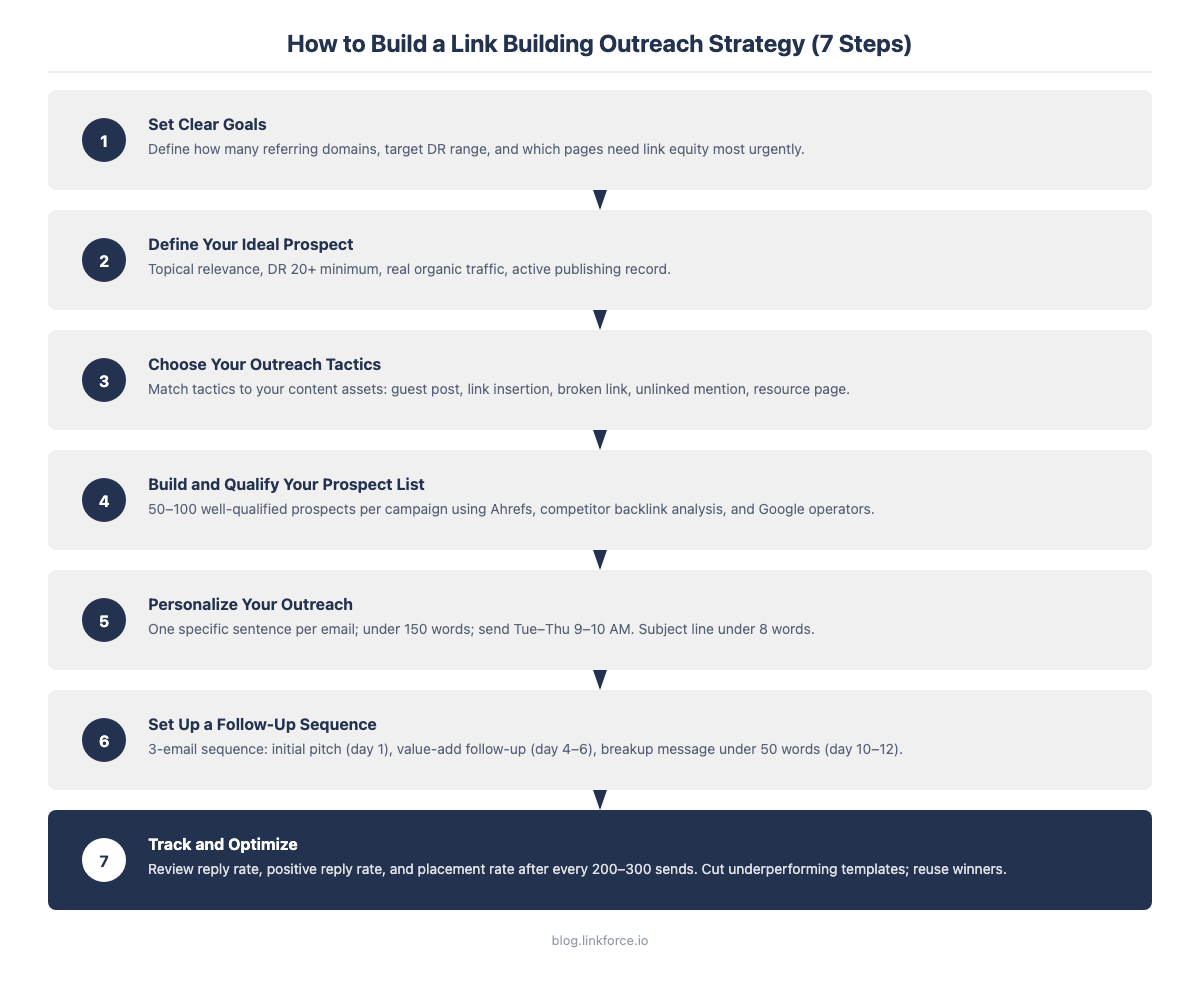
Build your link building outreach strategy in seven steps: set measurable goals, define your ideal prospect profile, choose the right tactics for your assets, build and qualify your prospect list, personalize your outreach, set up a follow-up sequence, and track results to improve over time. Here’s how each step works in practice.
Step 1: Set Clear Goals
Set a specific, measurable goal before building anything else — vague goals produce vague outreach. Define what you’re trying to achieve:
- How many new referring domains do you want to add per month?
- What DR range do you want those domains to be in?
- Which pages on your site need link equity most urgently?
- Are you focused on building topical authority or raw link count?
A specific goal might look like: “Build 10 links per month to our main product page, from DR 40+ domains in the SaaS or B2B marketing space.” That goal drives every decision downstream — which sites to target, which tactics to use, what to offer.
Step 2: Define Your Ideal Prospect
Your prospect profile is the highest-leverage decision in your strategy — it determines the quality of every link you build before you send a single email. A site that looks good in Ahrefs can still be a poor link target if it’s not topically relevant or if its editorial standards are low.
The baseline criteria for a strong prospect:
- Topical relevance: the site covers subjects related to your page
- DR 20+ as a minimum threshold (avoid link farms and thin sites)
- Organic traffic: at least some real search traffic signals the site is indexed and active
- Real audience: look at whether the site publishes regularly and has engagement signals
Red flags to filter out: private blog networks, sites that sell links openly, pages with no organic traffic, and domains that have recently expired and been re-registered.
Step 3: Choose Your Outreach Tactics
Choose tactics based on what you already have, not what sounds best in theory. A strong existing guide is a different asset than original data or a free tool, and the right tactic depends on the asset. Use this decision table to match your content to the right approach:
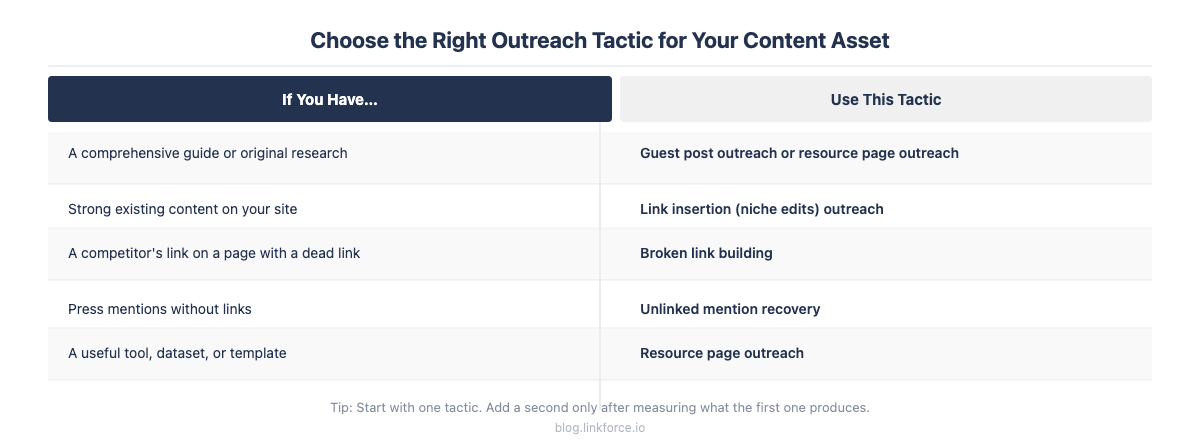
| If you have… | Use this tactic |
|---|---|
| A comprehensive guide or original research | Guest post outreach or resource page outreach |
| Strong existing content on your site | Link insertion (niche edits) outreach |
| A competitor’s link on a page with a dead link | Broken link building |
| Press mentions without links | Unlinked mention recovery |
| A useful tool, dataset, or template | Resource page outreach |
Most strategies use two to three tactics in parallel. Starting with just one makes it easier to measure what’s working before adding complexity.
Step 4: Build and Qualify Your Prospect List
A targeted list of 100 qualified prospects outperforms a spray-and-pray list of 1,000. Use these methods to build your list:
- Ahrefs Content Explorer: filter by topic, DR range, and organic traffic
- Competitor backlink analysis: find sites already linking to similar content
- Google operators: “write for us” + your topic, “guest post guidelines” + your niche
- Unlinked mention monitoring: Ahrefs Alerts or Google Alerts for your brand
Once you have candidates, filter them manually. Check topical relevance, traffic, and whether the site accepts contributed content or links to external resources. This step takes time but it’s the highest-leverage part of the process — a better list means better results from every subsequent step.
Aim for 50–100 well-qualified prospects per campaign before you start sending.
Step 5: Personalize Your Outreach
Personalized outreach consistently outperforms generic templates — including one specific sentence about the recipient’s site is often enough to double response rates compared to identical pitches sent to hundreds of contacts.
Personalization doesn’t mean writing a novel for each recipient. It means including one specific detail that proves you read their site: a reference to a recent article they published, a topic gap you noticed in their coverage, or a specific audience overlap you can point to.
Keep emails short — under 150 words. State who you are, what you’re offering, and why it’s relevant to them. Make the ask clear. A good subject line is under eight words and makes the topic obvious without being salesy. For in-depth templates, subject line testing data, and deliverability guidance, see the complete outreach emails guide.
On timing: Tuesday through Thursday between 9–10 AM local time to the recipient produces the highest open rates for cold outreach. Avoid Monday mornings (inbox clearing) and Friday afternoons (low attention).
Step 6: Set Up a Follow-Up Sequence
Most placements don’t come from the first email. Roughly 66% of replies come from follow-up messages, not initial pitches — which means if you’re not following up, you’re leaving the majority of your potential placements unreached.
A three-email sequence works well:
- Initial pitch (day 1)
- First follow-up that adds context or reframes the offer (day 4–6)
- Brief breakup message that closes the loop (day 10–12)
Each follow-up should add something, not just re-send the original. The second email is a chance to address a common objection or mention a specific article on their site where your link would fit. The third should be under 50 words — a genuine breakup message that uses closing language (“I’ll take this as a no and won’t follow up again”) and gives them an easy, low-friction way to decline or respond.
Step 7: Track and Optimize
A strategy you can’t measure is a strategy you can’t improve. Track these metrics for every campaign:
- Emails sent
- Reply rate (replies / emails sent)
- Positive reply rate (interested replies / emails sent)
- Placement rate (links secured / emails sent)
- Average DR of placed links
Review these after every 200–300 sends. If your reply rate is below 5%, the problem is usually targeting or messaging — not the quantity of emails. If positive reply rate is healthy but placement rate is low, the issue is likely in your follow-through or negotiation.
Cut templates that underperform. Reuse the ones that work. This is how an outreach strategy improves over time.
The Main Outreach Tactics (and When to Use Each)
The five tactics most worth building into a link building outreach strategy are guest post outreach, link insertion, broken link building, unlinked mention recovery, and resource page outreach. Each serves a different asset type and works best in different contexts — here’s when to use each.
Guest Post Outreach
Guest posting means pitching a contributed article to a target site and earning a link back to your content within it. It builds topical authority alongside the link and works well when the target site actively publishes contributed content.
Best for: earning links from sites with editorial standards, building author relationships, and establishing topic credibility in a niche. More effort per placement than other tactics, but the links tend to be editorially placed and durable.
Look for sites with an active “write for us” or “contributors” page and a clear topic overlap with your content.
Link Insertion Outreach
Link insertion (sometimes called niche edits) means contacting a site that already has a relevant article published and suggesting your link as a natural addition to that existing content.
Best for: faster placement cycles than guest posting, since you’re not asking the site to publish new content. Works best when you have strong content that genuinely improves what they’ve already written. Typically produces higher conversion rates per email sent than guest post pitches.
Broken Link Building
You find a link on a target page that points to a dead resource, prepare a replacement, and pitch the site owner to swap in your link. More research-intensive upfront but results in high-quality placements when it works.
Best for: sites with resource sections or in-depth guides that tend to accumulate outdated links over time. Ahrefs Site Explorer or Check My Links can identify broken link candidates quickly.
Unlinked Mention Recovery
You find instances where a site has mentioned your brand, product, or content without linking to it, and pitch a simple ask to add the link.
Best for: brands with existing press, case studies, or research that gets cited without attribution. The pitch is easy because you’re not asking for a new favor — you’re just converting existing goodwill into a link. Search for your brand name in Ahrefs Alerts or Google Alerts.
Resource Page Outreach
Resource pages are curated link lists that point to useful tools, guides, or services in a given niche. If you have a strong linkable asset — a free template, a data study, a comprehensive guide — resource page outreach is one of the most efficient tactics available.
Best for: linkable assets that serve a specific audience. Find resource pages with Google operators: “best resources for” + your topic, “useful links” + your niche.
Why Most Outreach Strategies Fail
Most link building outreach campaigns underperform for five predictable reasons — and each one is fixable before you send your next email. Knowing what to avoid saves weeks of low-yield effort.
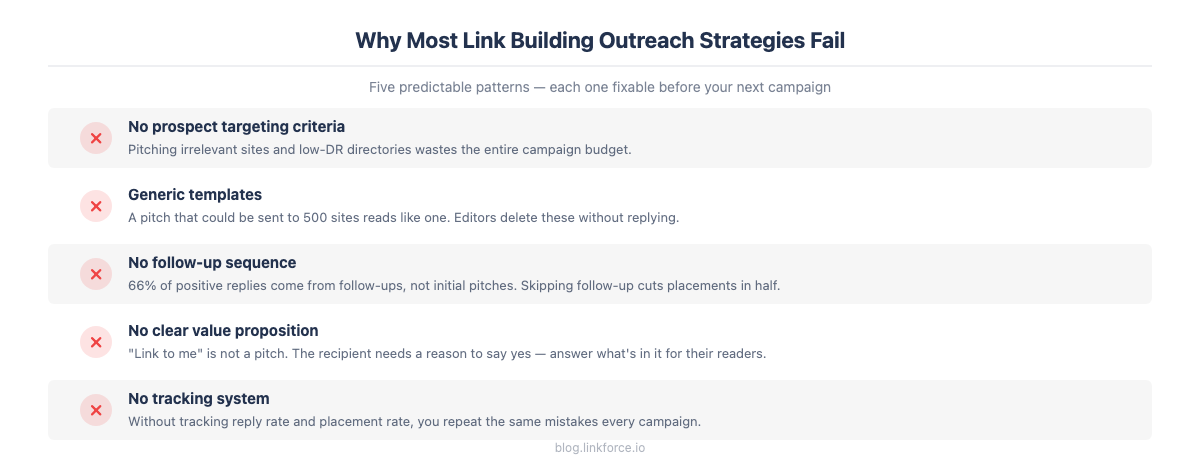
No prospect targeting criteria. Sending outreach to any site that shows up in a keyword search wastes time on sites that will never link. Without qualification criteria, you’ll pitch irrelevant sites, low-DR directories, and pages that haven’t published anything new in two years.
Generic templates. A template that can be sent to 500 different sites reads like one. Editors and webmasters see dozens of these every week. Personalization — even a single specific sentence — makes the difference between being read and being deleted.
No follow-up. If you’re only sending one email per contact, you’re skipping the majority of your potential placements. A three-email sequence isn’t aggressive — it’s expected.
No value proposition. “Link to me” isn’t a pitch. The recipient needs a reason to say yes. What does linking to your content do for their readers? Why is your resource better than what they’re currently linking to? Answer those questions in the pitch.
No tracking. If you don’t track what happens after each email, you can’t improve. You’ll keep sending the same messages to the same type of sites with the same results, month after month.
What to Expect: Outreach Strategy Benchmarks
A well-run link building outreach strategy produces 8–15% reply rates on a qualified list and converts approximately 1–2% of contacted prospects to placed backlinks. At 500 emails per month, that’s 5–10 new referring domains — but only if your targeting and messaging are solid. Here’s how each metric breaks down:
Reply rate: A healthy outreach campaign produces 8–15% reply rates on a targeted, qualified list. If you’re below 5%, the problem is usually targeting (wrong sites, wrong contacts) or messaging (too generic, no clear value proposition).
Positive reply rate: Of all replies, 30–50% should express genuine interest. If most replies are rejections or non-responses, the value proposition or relevance is off.
Prospect-to-placement conversion: In well-run outreach campaigns, approximately 1–2% of contacted prospects turn into placed backlinks. At 1,000 emails per month, that’s 10–20 links.
Follow-up impact: Roughly 66% of positive replies come from follow-up emails, not the initial pitch. Skipping follow-ups cuts your placement count roughly in half.
Single-email response rate: If you only send one email with no follow-up, expect around 8.5% response rates at best. A three-email sequence lifts that substantially.
Time to first placement: Most outreach campaigns take 4–8 weeks to see the first link go live. Editorial processes, content queues, and publication schedules all add time between approval and going live.
These benchmarks assume a qualified prospect list and personalized messaging. Results on unqualified lists or with generic templates will be lower.
FAQ
What is the difference between an outreach strategy and outreach tactics?
Tactics are the specific methods you use to get links — guest posting, broken link building, link insertion. Strategy is the overall plan that determines which tactics you use, who you target, how you message, and how you track results. Tactics are the how; strategy is the why and the structure around it.
How many outreach emails should you send per week?
This depends on your team size and capacity for personalization. A solo practitioner doing personalized outreach might send 30–50 emails per week. A team with a dedicated outreach specialist can scale to 150–300 per week while maintaining quality. Volume without quality produces low reply rates — prioritize targeted, personalized sends over raw numbers.
How long does it take to see results from link building outreach?
Expect your first placements within 4–8 weeks of starting a campaign. Building consistent monthly velocity takes 2–3 months. Factor in editorial timelines: some sites schedule guest posts weeks in advance, and link insertions can take time to implement even after approval.
What is a good reply rate for link building outreach?
8–15% on a targeted, personalized campaign is healthy. If you’re consistently below 5%, audit your prospect list quality and your email copy. If you’re above 20%, you may be undershooting on site quality — higher reply rates from low-DR sites are common but don’t always translate to valuable placements.
Do you need outreach tools or can you manage in a spreadsheet?
A spreadsheet works at low volume (fewer than 50 sends per week). Beyond that, an outreach CRM like Pitchbox, BuzzStream, or a structured Notion database makes tracking easier. The most important thing is that you track every contact, every interaction, and every outcome — the tool is secondary to the discipline of tracking.