

A guest post service costs $295 on average when you buy directly from a site, or $461 when you go through a vendor, according to a 2026 analysis of more than 257,000 guest-post sites by BuzzStream. A basic placement on a DR 20-30 site typically runs $200-$300. A genuinely high-authority site with real traffic (DR 70 and up) can run $3,000-$6,000 or more. That price only buys a safe backlink if the site passes a handful of checks first, because the same dataset found that the average Domain Rating across the whole guest-post marketplace is only 24, and fewer than 2% of sites for sale qualify as genuinely high quality. This guide covers what a guest post service actually is, what it should cost at each tier, which quality signals separate a safe placement from a wasted one, and the specific red flags that predict a bad outcome before you pay.
What Is a Guest Post Service?
A guest post service is a vendor that places an article containing a backlink to your site on someone else's website, in exchange for payment. The vendor either owns the publishing site directly, or brokers access to a network of sites it doesn't own. That second model is what most people mean by a guest post marketplace: a self-serve platform where you browse a catalog of publishers and pick one yourself, rather than handing the whole job to an agency that selects the site for you.
The marketplace and managed-service models both end in the same place, a link inside an article on a third-party domain, but they're different enough in practice that the buying process changes how you should vet the seller. On a self-serve marketplace, you'll see the publisher's own metrics before you commit, so the vetting work happens upfront. With a managed service, an account manager picks the site for you after you brief them on your niche and budget, which is faster but shifts the vetting work onto someone whose incentive is to close the sale. Neither model is automatically safer; both inherit whatever quality problems exist in the underlying site inventory.
If you want to compare specific marketplace platforms side by side, see our guest post marketplace guide. This page focuses on the part that matters regardless of which model you use: what a fair price looks like and how to tell a safe placement from a wasted one.
How Much Does a Guest Post Service Cost?
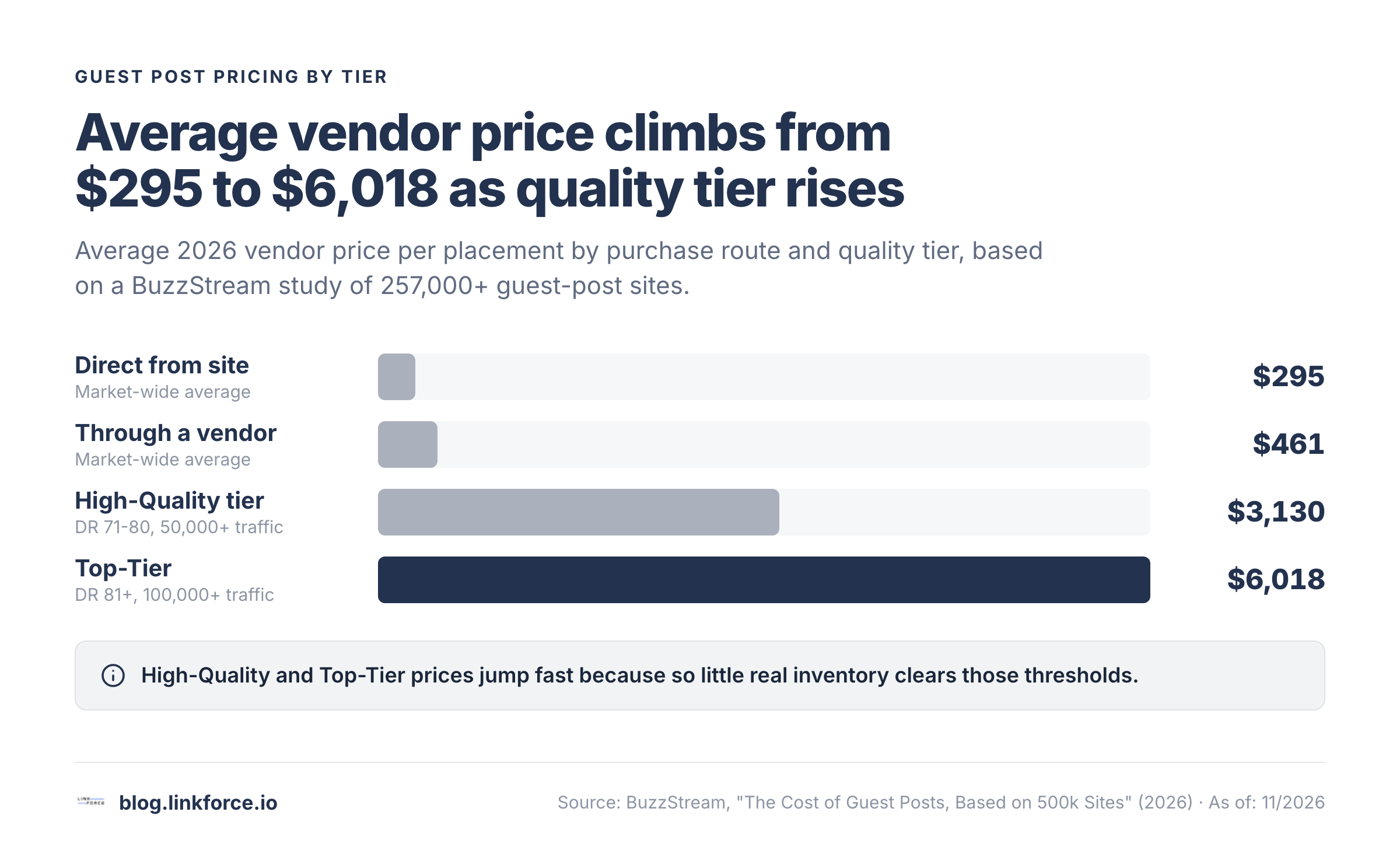
A guest post costs $295 on average bought directly from a site, and $461 on average bought through a vendor, based on BuzzStream's 2026 study of 257,000+ guest-post sites with reliable Ahrefs data. Price scales mainly with two things: Domain Rating and real organic traffic, and traffic is the better predictor of the two because it's harder to fake.
| Domain Rating | Typical vendor price | Monthly organic traffic | Typical vendor price |
|---|---|---|---|
| 0-9 | around $200 | under 100 visits | around $229 |
| 10-39 | roughly $220-$300 | 100-10,000 visits | roughly $300-$800 |
| 40-69 | roughly $400-$1,000+ | 10,000-100,000 visits | roughly $800-$2,000+ |
| 70-80+ | up to $3,000 | 100,000+ visits | up to $3,210 |
Prices don't climb in a straight line, either; they jump once a site clears BuzzStream's quality thresholds. A High-Quality placement (DR 71-80 with 50,000+ monthly traffic) averages $3,130 through a vendor, and a Top-Tier placement (DR 81+ with 100,000+ traffic) averages $6,018. Industry matters too: sites in the sports niche averaged the highest price per post at $572, while gambling sites averaged just $238, not because gambling links are a bargain, but because roughly 70% of the gambling inventory in the dataset carried zero organic traffic. A cheap price in an expensive niche isn't a discount, it's a quality signal.
Treat these figures as a 2026 market snapshot rather than a fixed rate card. Vendor pricing shifts as the underlying site inventory changes, so re-check current numbers before you budget a large campaign around them.
What Quality Signals Actually Matter?
Real organic traffic matters more than the Domain Rating number on its own, because DR can be inflated with a short burst of low-quality links, and it doesn't take much volume to move it, while traffic is much harder to fake convincingly. BuzzStream's dataset found the average DR across the entire guest-post marketplace is just 24, well below what most pitches imply, and that 78% of guest-post sites see under 1,000 organic visitors a month. Combining DR and traffic into a single quality tier, only 1.37% of sites in the dataset qualify as High-Quality or Top-Tier.
Before you pay for a placement, check:
- Organic traffic trend, not just the DR snapshot. A site with real readers won't show a flat line, it'll show a traffic history with normal weekly and seasonal variation.
- A named author with a real history, ideally one you can find outside the site itself, through a byline search or a professional profile.
- A visible editorial process, meaning the site has rejected or revised content before, not just a form that accepts whatever is submitted.
- A sane publishing cadence, a handful of posts a week from a small, identifiable team rather than a dozen or more a day from an anonymous operation.
A site that passes these checks also tends to help beyond classic SEO. A handful of vendors now market guest posts as a way to get cited by AI answer engines like ChatGPT and Perplexity, and the logic holds up: a real, indexed article on a site those models already trust is far more likely to earn a citation than a link on a site that doesn't have any readers or editorial history to begin with.
Paste any domain into the free Domain Rating Checker by LinkForce.
Red Flags That Predict a Wasted Guest Post
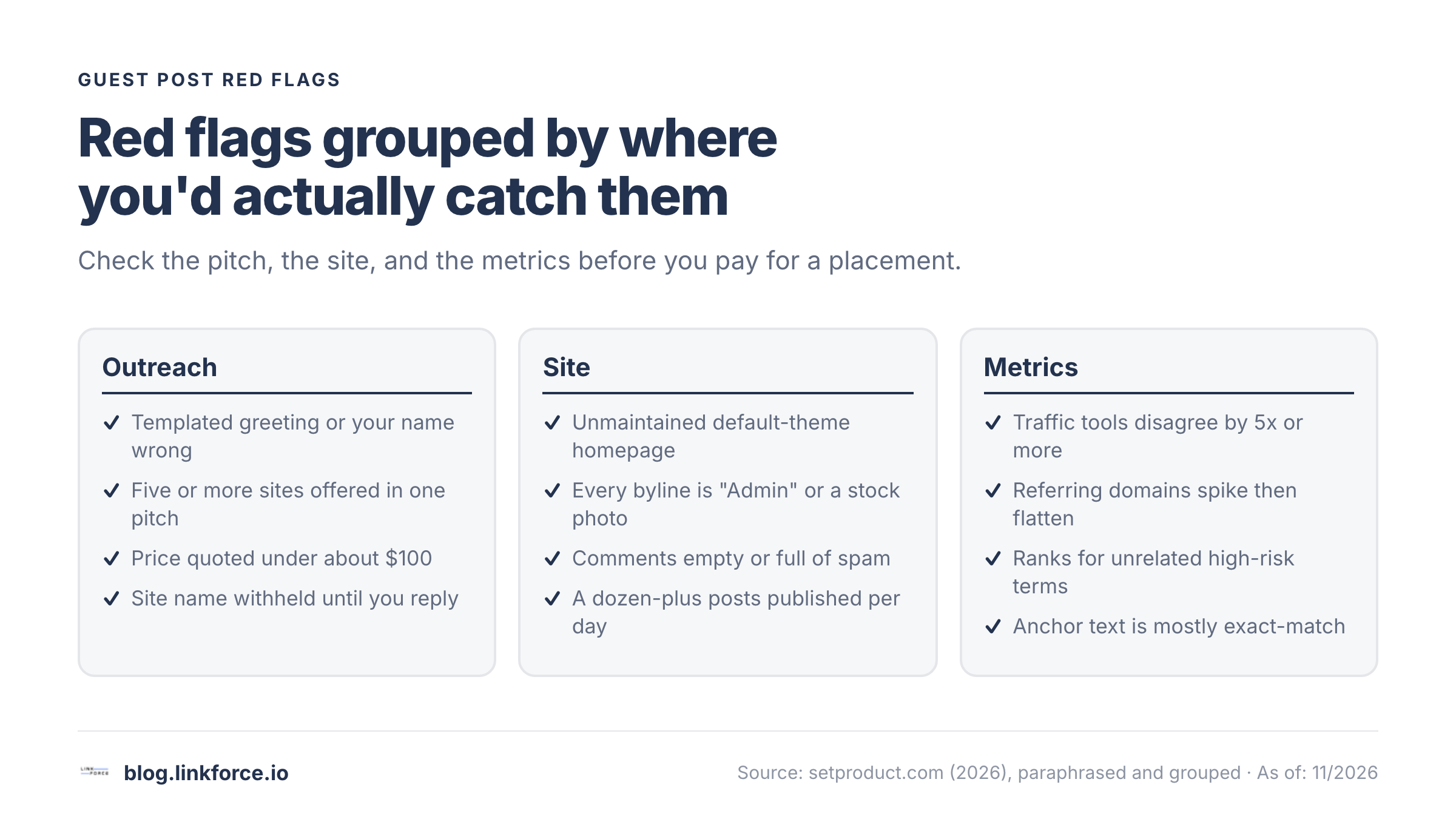
A frequently cited 2026 case involved a buyer who paid $450 for a placement on a DR 55 marketing blog, backed by an Ahrefs screenshot showing 38,000 monthly visits. The post went live within 48 hours with a do-follow link. Three months later, the entire site had been deindexed by Google, and the backlink disappeared along with it. Every signal that predicted the outcome was visible before the buyer replied to the first outreach email, according to setproduct.com's breakdown of the case. Frankly, most of these signals take less than a minute to check once you know where to look. They fall into three groups, depending on where you'd actually catch them.
Outreach Red Flags
- A templated greeting, a misspelled name, or an email addressed to someone who hasn't worked at your company in years.
- A single pitch offering five or more unrelated sites at once. That's a reseller, and a reseller owns none of the inventory it's selling.
- A quoted price under roughly $100 for a placement. Real editorial review, writing, and publishing cost more than that to produce, so a sub-$100 offer usually means no human review happened at all.
- A site name withheld until after you reply. A publisher who's proud of their own site leads with the URL.
Site Red Flags
- A homepage that still looks like an unmaintained default WordPress theme, with a stock hero image and no real identity behind it.
- Every byline reading "Admin," "Editorial Team," or a name attached to an obvious stock-photo headshot with no history you can verify elsewhere.
- A comment section that's either empty after years of publishing or full of unmoderated spam links. Either way, the site has no real readership behind the metrics a seller might show you.
- A publishing pace of a dozen or more posts a day. No small editorial team reviews that volume; it's the signature of a content mill selling placements at scale.
Metrics Red Flags
The most technical group, and clearly the one worth checking in a tool rather than taking on faith, since metrics are the easiest thing for a seller to fake convincingly:
- Traffic estimates that differ by 5x or more between Ahrefs, SimilarWeb, and Semrush. The three tools use different models and rarely agree exactly, but a gap that large usually means one number is manipulated.
- A referring-domains growth chart that jumps from a couple hundred to several thousand within months, then flattens. That shape is the signature of a paid link burst built to inflate Domain Rating before selling placements, not organic growth.
- A site that ranks for a wide spread of unrelated high-value terms, like casino offers or payday loans, alongside its stated niche. That's cross-vertical link-farm behavior, and your post will sit next to it.
- An anchor-text profile dominated by exact-match commercial phrases instead of brand names or generic anchors, a pattern that tends to concentrate around paid placements rather than organic mentions.
- A gap in the site's archive.org history that lines up with a WhoIs ownership change. A domain that sat untouched for months and then came back under new ownership with a burst of commercial guest posts is a classic repurposed or expired-domain pattern, not organic growth.
- Several "different" guest-post sites sharing the same hosting IP address. The domains might look unrelated on the surface, but one operator running a cluster of sites from the same server is a private blog network signature regardless.
How to Vet a Guest Post Service Before You Pay
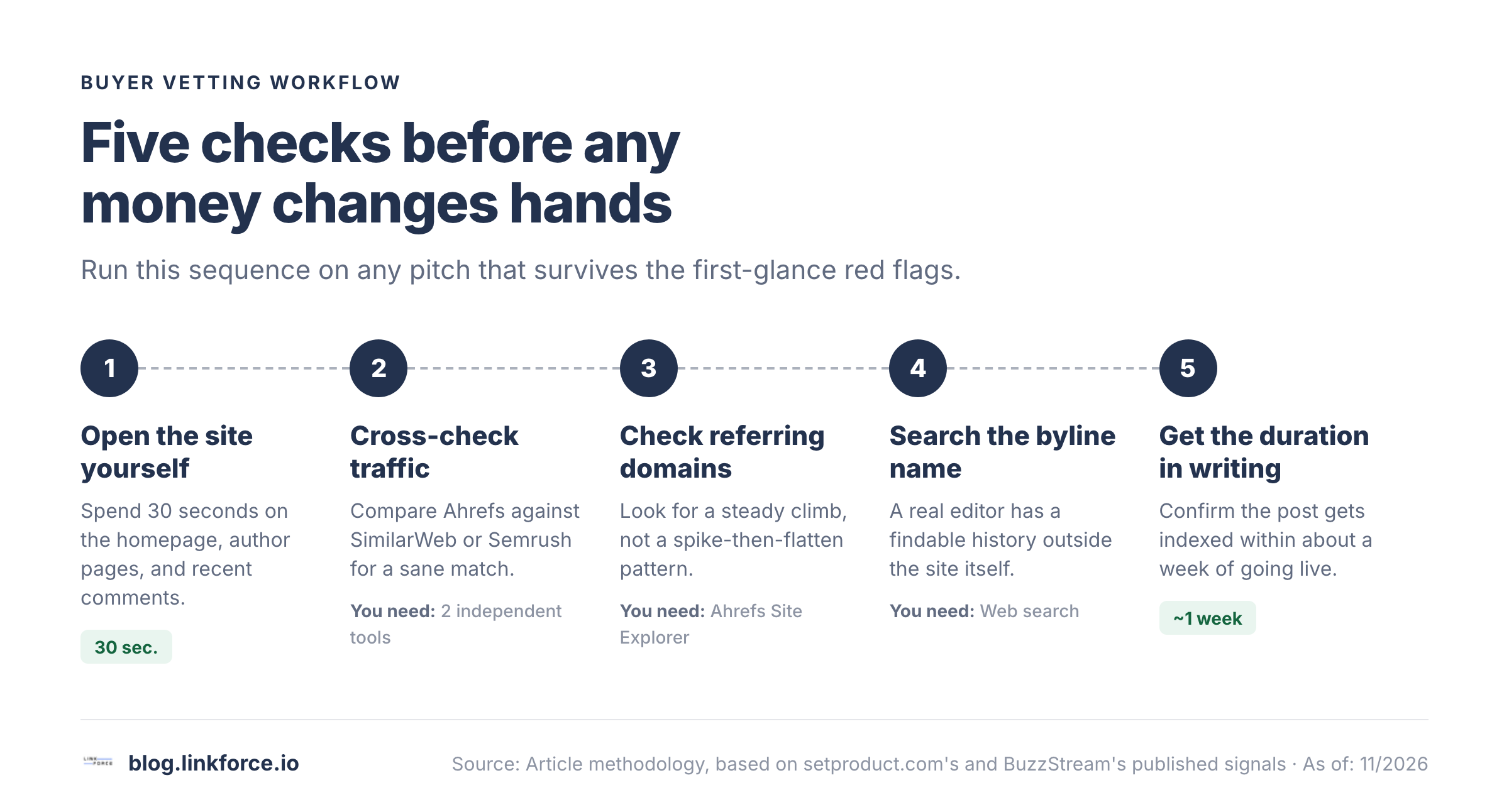
- Open the site yourself before replying to any pitch. Thirty seconds on the homepage, the author pages, and a few recent comment sections tells you more than any metrics screenshot a seller sends.
- Cross-check traffic in a second tool. Pull the domain in Ahrefs and in SimilarWeb or Semrush, and confirm the estimates are in the same range rather than miles apart.
- Check the referring-domains growth chart in Ahrefs Site Explorer. A steady climb is normal; a sudden spike followed by a plateau is not.
- Run a quick archive.org and WhoIs check on domains you don't already recognize. A lapse in the site's history followed by a change in registered ownership is a strong sign the domain was bought and repurposed rather than built up organically.
- Search the byline name outside the site itself. A real editor or writer usually has a findable history; a fabricated one doesn't, and that's the whole point of checking.
- Get the link-duration commitment in writing before you pay, and confirm the published post actually gets indexed by Google within about a week of going live.
On a larger order, put the whole agreement in writing rather than relying on a chat exchange, since that's what gives you something to point to if the link disappears or the site swaps the URL a few months later. For a single placement under a few hundred dollars, a saved email confirming the price, the live URL, and the agreed link duration is usually enough. For a recurring monthly program, ask whether the vendor monitors placements after publication and will replace or refund one that gets pulled, and get that commitment in the same written agreement rather than a verbal promise during the sales call.

800+ SaaS marketers swap partner, integration and content links. Free plan, no credit card.
Legitimate Guest Posting vs. a Link Scheme
Guest posting itself isn't against Google's rules. What crosses into a link scheme is paying specifically to pass ranking credit through a link that isn't disclosed as paid. Google's own spam policies list it directly: "advertorials or native advertising where payment is received for articles that include links that pass ranking credit, or links with optimized anchor text in articles, guest posts, or press releases distributed on other sites" is classed as link spam.
Google is explicit that this doesn't make paid links themselves against the rules. Buying and selling links is, in Google's words, "a normal part of the economy of the web for advertising and sponsorship purposes," and it isn't a policy violation as long as the link is qualified with a rel="nofollow" or rel="sponsored" attribute. In practice, that means the question to ask any vendor isn't whether they sell links, it's whether they'll tell you how the link is tagged. A vendor that markets a "pure do-follow, no disclosure" placement as the main selling point is asking you to carry their compliance risk, not sharing a benefit with you.
Frequently Asked Questions
Is buying guest posts against Google's rules?
No, guest posting itself is not banned. What Google's link spam policy targets is paying for a placement specifically to pass ranking credit without qualifying the link as rel="nofollow" or rel="sponsored", not the act of contributing an article to another site.
How much should a DR 30 guest post cost?
A DR 30 guest post typically costs somewhere between $220 and $300 through a vendor, based on BuzzStream's 2026 pricing data, though real organic traffic on that specific site matters as much as the DR number itself.
Why do some guest post services charge under $50?
A sub-$50 price usually means no real editorial review happened, either because the content is unedited or AI-generated, or because the site is a private blog network built only to hold links rather than attract readers.
Does a guest post link need to be disclosed?
Yes, if payment is involved and the link is meant to pass ranking credit, Google's policy requires the link to carry a rel="nofollow" or rel="sponsored" attribute, separate from whatever on-page wording a site uses to describe sponsored content.
How long does it take to see results from a guest post?
Most buyers can confirm whether a guest post has any value within about a week, since that's enough time to check whether the page was indexed by Google at all. Any ranking or traffic impact from the link itself typically takes longer and depends on the rest of the site's link profile.
Can I negotiate guest post pricing?
Yes, most guest post vendors quote a list price that leaves room to negotiate, especially on bulk orders of five or more placements or on a recurring monthly program. A site with genuinely scarce high-quality inventory, the DR 70+ tier BuzzStream's data puts at $3,000 and up, negotiates less because demand already outstrips the limited supply of real sites at that tier.
Should I use a guest post marketplace or a managed service?
A self-serve marketplace works better if you want to pick the exact site yourself and compare inventory directly; a managed service works better if you'd rather hand the vetting work to someone else. Either way, the pricing and red-flag checks on this page apply the same way. See our guest post marketplace comparison for specific platforms.