Understanding the different types of links is foundational for anyone doing SEO, link building, or site architecture. Links range from internal links and backlinks to dofollow, nofollow, sponsored, and ugc types. The anchor text, HTML format, and acquisition method of each link determines how much SEO value it carries. But most guides list link types without explaining how they relate to each other. This article organizes every major link type into a unified four-axis framework: by structural origin, rel attribute, acquisition method, and HTML format so you can see at a glance which links matter most and why. Whether you are auditing a backlink profile, planning a link building campaign, or troubleshooting a crawlability issue, the right classification system will tell you exactly what you are looking at.
How Links Are Classified: Four Axes
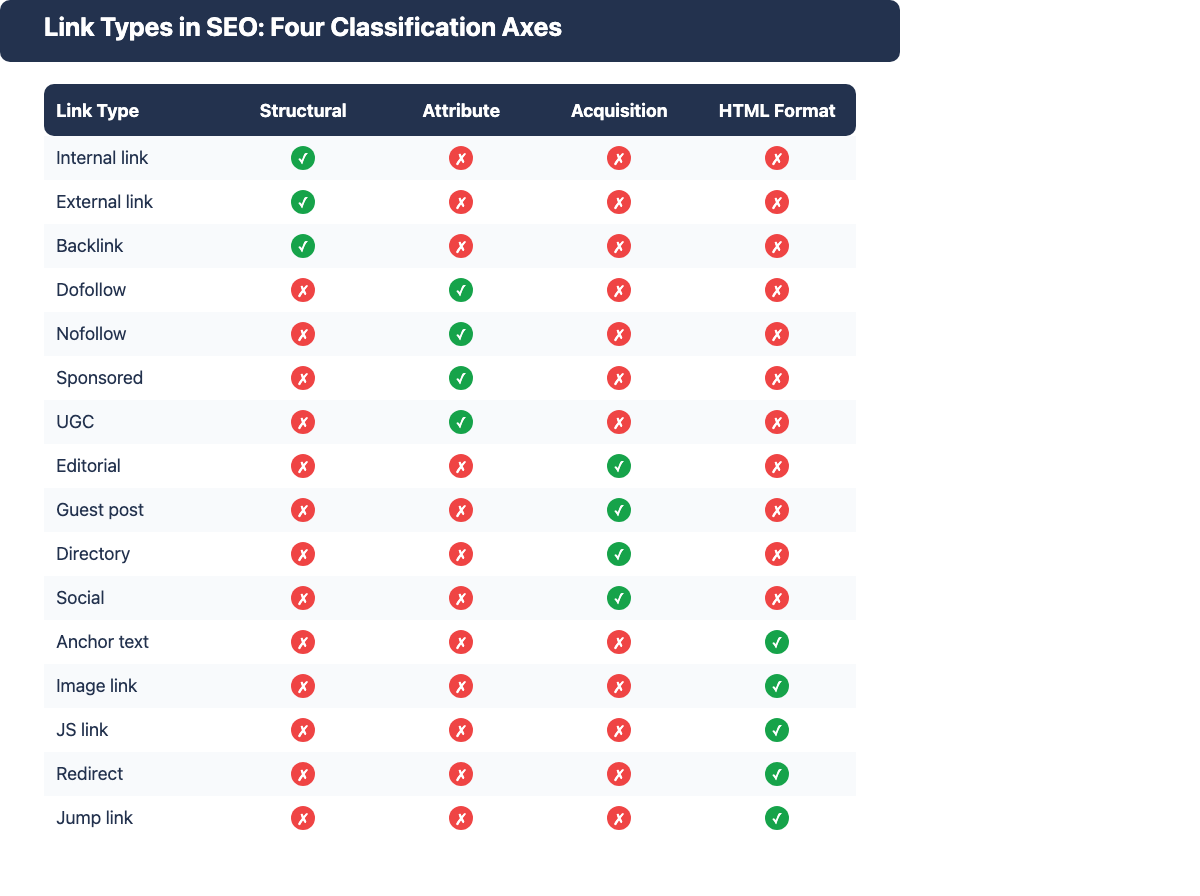
Links in SEO can be classified along four independent axes. Each axis answers a different question about the link.
The first axis is structural origin: where does the link go? The three structural types are internal links, external links, and backlinks. The second axis is the rel attribute: what instruction does the link send to crawlers? The attribute types are dofollow, nofollow, sponsored, and ugc. The third axis is acquisition: how was the link obtained? Acquisition types include editorial, guest post, directory, social, and user-generated. The fourth axis is HTML format: how is the link implemented in code? Format types include anchor text, image, JavaScript, redirect, and jump links.
Most discussions of link types address only one or two of these axes. A link can be internal (structural) and dofollow (attribute) and editorial (acquisition) and text-based (format) all at once. Keeping the four axes separate prevents confusion when a source uses „types of links“ to mean something different from what you expect.
Quick reference overview:
- Structural types: internal link, external link, backlink (inbound)
- Attribute types: dofollow, nofollow (rel=nofollow), sponsored (rel=sponsored), ugc (rel=ugc)
- Acquisition types: editorial (organic), guest post, directory, social, user-generated
- HTML format types: anchor text link, image link, JavaScript link, redirect link, jump link (fragment)
Structural Link Types
Structural type describes where a link originates relative to the site it points to. This is the most fundamental classification because it determines the basic relationship between pages.
Internal Links
An internal link connects two pages within the same domain. When a blog post links to a category page on the same website, that is an internal link.
Internal links serve three SEO functions. First, they distribute PageRank (link equity) across the site; pages with more internal links pointing to them are treated as more important. Second, they define crawl paths: Googlebot discovers new pages by following links, and a page with no internal links pointing to it is effectively invisible to crawlers. Third, they help users navigate, which reduces bounce rate and increases time on site.
Best practices for internal links: use descriptive anchor text that matches the target page topic; link to important pages (pillar pages, high-value pages) from multiple other pages; avoid orphan pages; every indexable page should have at least one internal link pointing to it; keep navigation links separate from in-content links, since Google weights in-content links more heavily.
External Links (Outbound)
An external link goes from your site to a page on a different domain. When you cite a study by linking to the original source, that is an external link.
External links have a nuanced reputation in SEO. Linking to high-quality, relevant sources signals that your content is well-researched and authoritative. Google has confirmed that outbound links to trusted sources are a positive signal. However, each external link also passes some of your page’s link equity to the target, which is why some SEO practitioners use rel=nofollow on external links they do not want to fully endorse.
The practical rule: link out when the resource genuinely helps the reader. Do not apply nofollow to every external link by default. Reserve nofollow for links you cannot vouch for or that are required by affiliate terms of service.
Backlinks (Inbound Links)
A backlink is a link from another domain pointing to your site. Backlinks are the primary currency of off-page SEO. Google’s PageRank algorithm, still the foundation of its ranking system, was built on the principle that a link from another site is a vote of confidence.
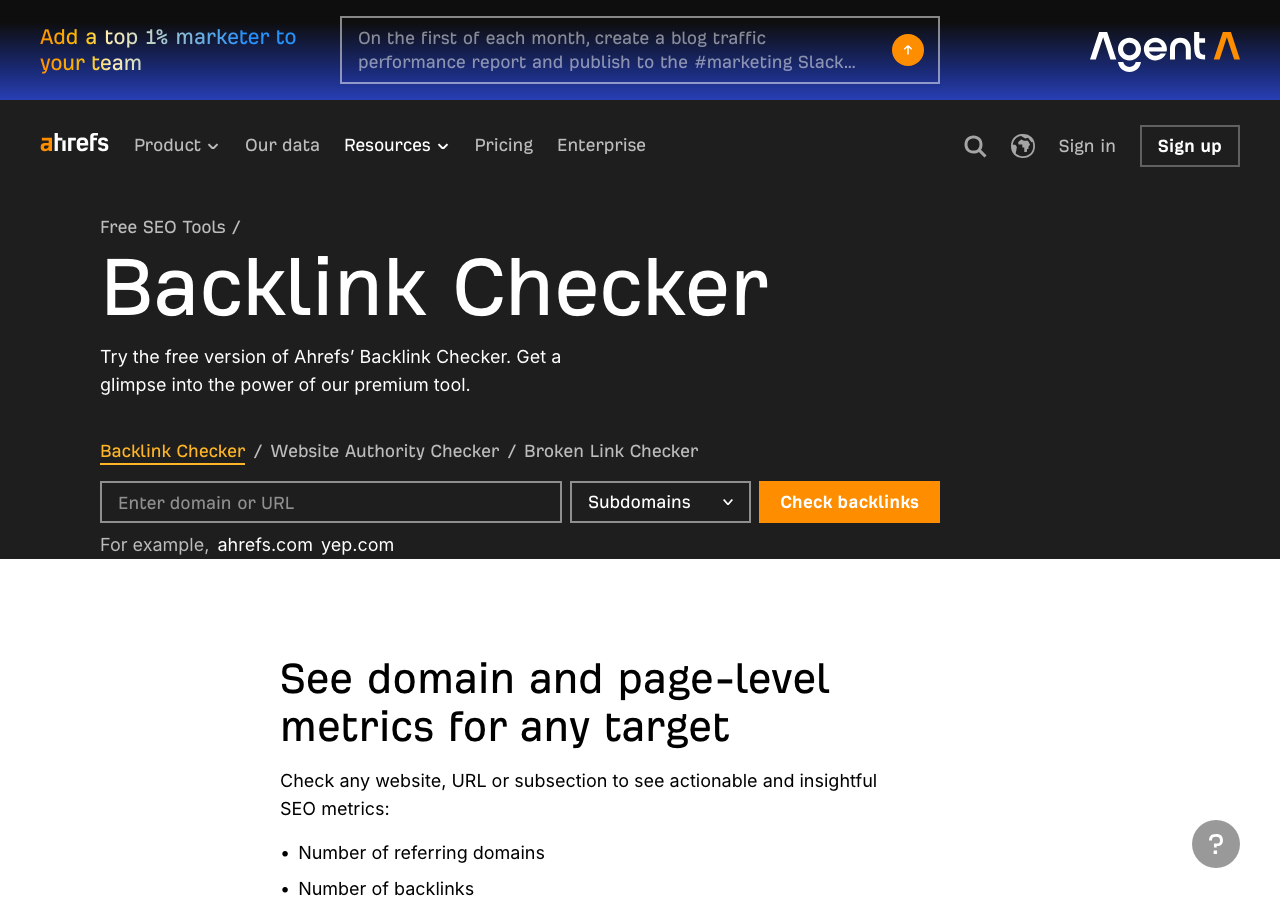
Not all backlinks are equal. A backlink from a high-authority, topically relevant site passes far more equity than one from a low-authority, unrelated domain. The quality signals that matter: the linking domain’s authority (Domain Rating in Ahrefs), the topical relevance of the linking page, the placement of the link on the page (in-content vs. sidebar or footer), and whether the link carries a dofollow attribute.
For link building, backlinks are the target. For site auditing, your backlink profile is the evidence base that determines how much authority your pages can leverage.
Link Attribute Types (Rel Values)
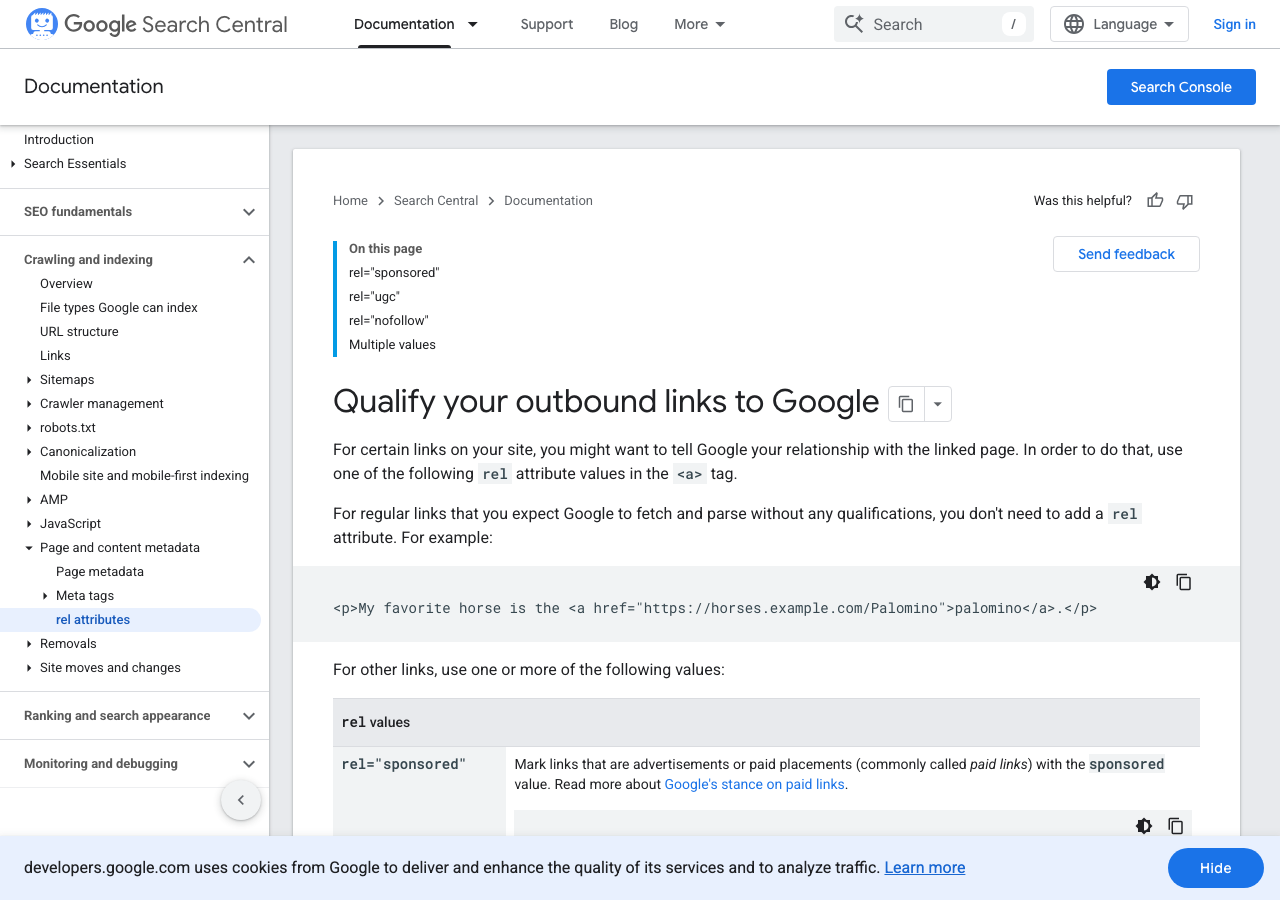
The rel attribute in an anchor tag tells search engines how to treat the link. This classification determines whether a link passes PageRank and what kind of relationship it signals.
Dofollow Links
A dofollow link has no restricting rel attribute. (For a deeper comparison, see our guide to dofollow vs. nofollow links.) The browser default for any anchor tag is to follow the link. The term „dofollow“ is technically a misnomer: there is no rel=dofollow attribute. It simply means the link carries no nofollow, sponsored, or ugc restriction.
Dofollow links pass PageRank from the linking page to the linked page. They are the primary goal of any link building campaign because they directly contribute to a page’s ranking ability. When SEOs talk about „link equity“ or „link juice,“ they are describing the value transferred through dofollow links.
Nofollow Links
A nofollow link carries the attribute rel=nofollow. Google introduced nofollow in 2005 to combat comment spam. The original intent: do not follow this link, do not pass PageRank through it.
In 2019, Google changed nofollow from a directive to a hint. Google now says it may choose to crawl and index nofollow links and may count them for ranking purposes, but is not required to. In practice, nofollow links still provide significantly less direct PageRank benefit than dofollow links. They do, however, contribute to a natural-looking link profile and can drive referral traffic.
Publishers commonly apply nofollow to: all links in comment sections; links in sponsored content (when rel=sponsored is not used); links they cannot vouch for; links in paid placements where they choose not to use the sponsored attribute.
Sponsored Links (rel=sponsored)
Google introduced rel=sponsored in September 2019 to identify paid placements specifically. (See our full guide to sponsored links.) A sponsored link exists because of a commercial arrangement: an affiliate link, a paid guest post placement, an ad unit.
Using rel=sponsored is Google’s preferred signal for paid links. It tells Google the link is there because of a financial relationship, not editorial merit. Failing to mark paid links correctly with either rel=sponsored or rel=nofollow violates Google’s link spam guidelines and can result in a manual action or algorithmic penalty.
In practice: any link you have paid for, exchanged for free product, or placed as part of a commercial partnership should carry rel=sponsored.
UGC Links (rel=ugc)
Also introduced in 2019, rel=ugc (user-generated content) marks links placed by users in comment sections, forum posts, or other user-contributed areas of a site. It replaced the informal practice of applying rel=nofollow to all user-generated links.
Search engines treat ugc links similarly to nofollow: they may or may not pass equity. For site owners, using rel=ugc signals to Google that the link was placed by a user rather than by the editorial team. This reduces the risk of being penalized for spam links in comment sections that are outside the publisher’s control.
Link Acquisition Types
Acquisition type describes how a link was obtained. This classification matters most for link building because it correlates strongly with link quality, longevity, and risk.
Editorial Links (Organic)
An editorial link is one a publisher placed because they genuinely found your content valuable without you asking for it. A journalist citing your original research, a blogger linking to your in-depth guide, or an industry publication recommending your tool are all editorial links.
Editorial links are the gold standard. They tend to come from topically relevant pages, use natural anchor text, and last longer because the publisher placed them on their own initiative. Earning editorial links requires content worth linking to: original research, definitive guides, unique data, or insights not available elsewhere.
Guest Post Links
A guest post link is placed within content you wrote and contributed to another site. You pitch an article, the publisher accepts, and you include a link back to your site within the content or author bio.
Guest posting is a Google-accepted tactic when done legitimately: you contribute genuine value to the host publication, the content is relevant to their audience, and the link is natural within the piece. Guest posting at scale purely for links, with no regard for content quality, is a pattern Google’s spam systems target.
Best practices: target publications with genuine audience overlap with yours; write content their readers need; use varied, natural anchor text; avoid exact-match keyword anchors in every guest post link.
Directory Links
A directory link comes from a listing in a business directory, industry resource page, or niche portal. Crunchbase, industry association directories, and local business listings are examples.
SEO value varies enormously. Links from curated, authoritative directories (industry associations, trusted niche portals) carry genuine equity. Links from low-quality general directories that exist primarily to sell placements provide little to no value and can be a negative signal in large volumes.
Legitimate use: directory links for local SEO and for industry presence in relevant trade directories. Mass directory submission purely for link volume is a spam pattern.
Social Links
Social links come from social media platforms: Twitter/X, LinkedIn, Facebook, Reddit, and similar. Nearly all social platform links carry the nofollow or ugc rel attribute, meaning they do not pass direct PageRank. Twitter/X, for example, applies rel=nofollow to all outbound links automatically. LinkedIn and Reddit apply ugc or nofollow depending on context.
Social links matter for SEO indirectly. They drive referral traffic, which can lead to genuine editorial links from readers who discover your content. They also contribute to brand signals that Google uses to assess entity authority. Build social links as part of a content distribution strategy, not as a substitute for link building.
User-Generated Links
User-generated links are placed by third parties in forums, Q&A sites, blog comments, or community platforms. Quora answers, Reddit posts, and blog comments are examples.
Like social links, UGC links rarely pass direct equity. Their value is in traffic, brand exposure, and occasionally triggering editorial links from engaged community members. Building links by posting in forums at scale is a spam pattern with no sustainable SEO return.
Technical / HTML Link Types
Technical type describes how the link is implemented in code. This classification matters most for site auditing and technical SEO because not all link implementations are crawled or followed reliably.
Anchor Text Links
The standard link: an anchor tag with href pointing to a URL, with clickable text between the tags. The clickable text is the anchor text, which serves as a relevance signal for the linked page. The href value can be an absolute URL (https://example.com/page), a relative link (/page within the same domain), or a root-relative link (/path from the domain root).
Anchor text types by SEO impact:
- Exact match: the anchor text is the exact target keyword. Strongest signal but appears unnatural at scale.
- Partial match: contains the keyword with other words. More natural than exact match.
- Branded: anchor text is the brand name. Natural, low-risk, expected from branded mentions.
- Naked URL: the URL itself is the anchor text. Neutral keyword signal.
- Generic: „click here,“ „read more.“ Minimal keyword signal.
A natural link profile contains a mix of all types. Over-representation of exact-match anchors, especially from external links, is a red flag for over-optimization.
Image Links
An image link wraps an image in an anchor tag. The alt attribute of the image functions as the anchor text for SEO purposes.
Image links are fully crawled and counted by Google. The key consideration is the alt attribute: a missing or generic alt text („image,“ „photo“) provides no keyword signal. A descriptive alt text that matches the topic of the linked page passes relevant anchor text context.
Best practice: always write descriptive alt text for linked images. Logo images linking to the homepage should carry the brand name as alt text.
JavaScript Links
JavaScript links exist in the page’s JavaScript code rather than in the HTML source. They may be rendered via onclick handlers, client-side routing, or dynamic injection.
Google can render JavaScript; Googlebot uses a delayed rendering pipeline. However, JavaScript links are less reliably crawled than plain HTML links. There is often a lag between first crawl and JavaScript rendering, meaning JS-only links may not be discovered or followed on the first crawl cycle. For large sites with crawl budget constraints, this lag can mean important pages stay undiscovered.
Practical guidance: use plain HTML anchor links for any navigation or links that matter for SEO. JavaScript links are fine for UI interactions that do not need to be crawled. If your site’s navigation is JavaScript-rendered, use server-side rendering or ensure a plain HTML fallback.
Redirect Links (301 vs. 302)
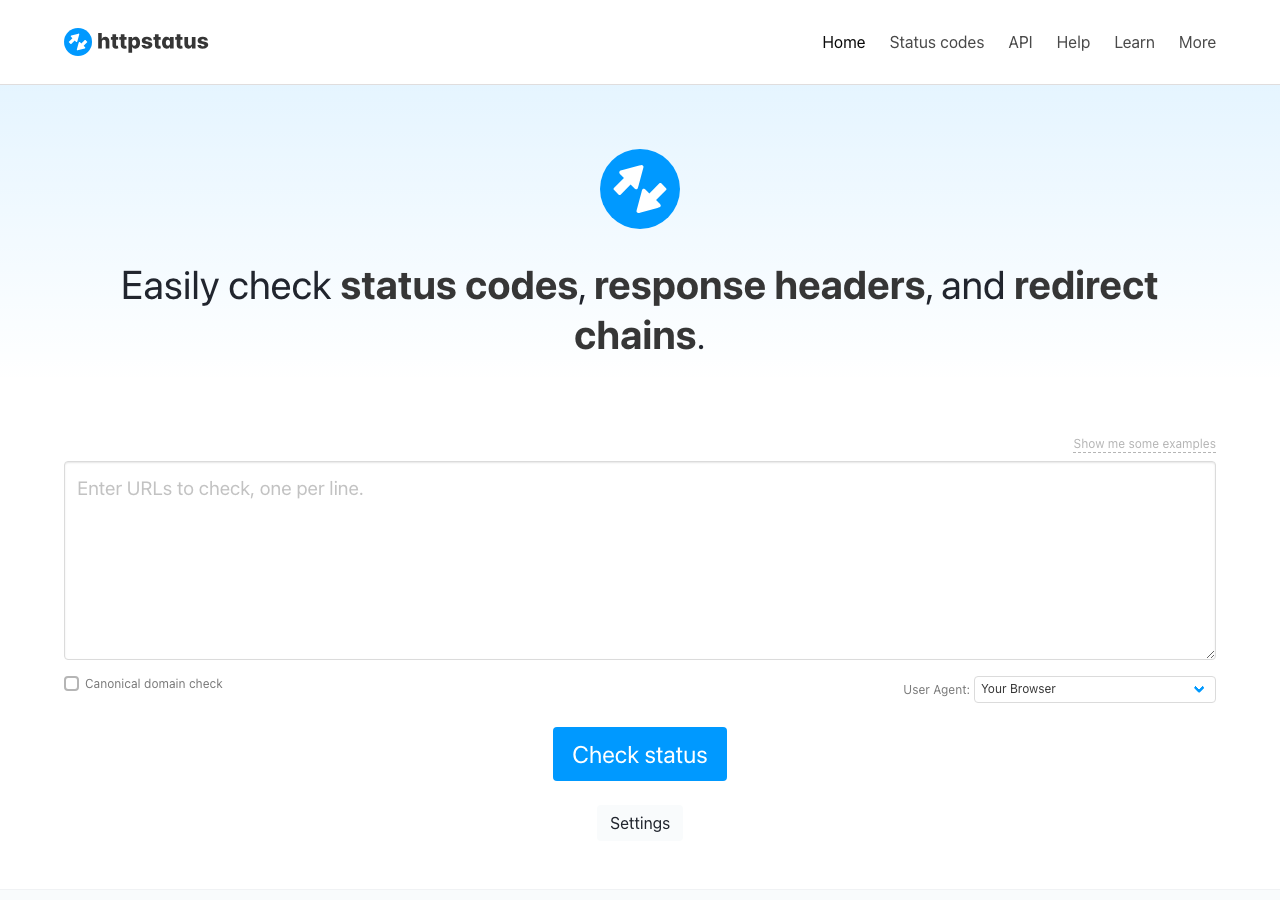
URL redirects are HTTP status codes that automatically send users and search engines to a different web address. A redirect link routes through an intermediate redirect before reaching the final URL. The two primary types, 301 and 302, differ in how long the redirect will last and how search engines handle link equity.
A 301 redirect is permanent. Google treats 301s as a full equity pass; link equity flows through to the final destination URL. If you acquire a backlink that 301-redirects to your page, you receive the equity.
A 302 redirect is temporary. Google does not reliably pass full link equity through 302 redirects. A backlink landing on a 302 redirect chain may not provide the benefit you expect.
Implication for link building: always verify the redirect chain of links you acquire. Use Ahrefs or a redirect checker to confirm the final destination receives a 301 redirect from the acquired link URL. A link through a 302 chain may provide little or no direct equity.
Jump Links (Fragment / Anchor Links)
A jump link uses a URL fragment to point to a specific section within a page. When clicked, it lands the user directly at the marked heading or div.
For SEO purposes, jump links are not separate crawl targets. Google treats a URL with a fragment as the same document as the URL without the fragment. The fragment is used by the browser for in-page navigation but is not treated by search engines as a distinct URL to rank separately.
Jump links are valuable for UX: they improve navigation on long-form content, reduce friction, and can influence featured snippet formatting when Google identifies strong in-page heading anchors. They do not pass PageRank to a sub-section independently from the overall page.
Which Link Types Pass the Most SEO Value?
Not all links are equal. The table below summarizes direct PageRank transfer potential and link building priority for each major type.
| Link Type | Passes PageRank? | Typically Dofollow? | Priority |
|---|---|---|---|
| Editorial backlink (organic) | Yes | Yes | Highest |
| Guest post backlink | Yes | Usually | High |
| Niche directory backlink | Yes | Varies | Medium |
| General directory backlink | Minimal | Often nofollow | Low |
| Social link | No | No | Indirect only |
| UGC / forum link | No | No | Indirect only |
| Sponsored link (rel=sponsored) | No | No | Compliance only |
| Internal link | Within site only | Yes | Essential for architecture |
| External outbound link | To target site | Yes | Citation / relationship |
The practical takeaway: prioritize earning editorial dofollow backlinks from topically relevant, high-authority domains. Guest posts on quality publications are a reliable second tier. Directory links are worth pursuing for local and niche relevance but rarely move the needle on competitive keywords alone.
How to Analyze Your Link Profile by Link Type
Knowing link types is most useful when you apply the framework to your actual backlink data. Here is a step-by-step process using Ahrefs.
Step 1: Open Ahrefs Site Explorer and enter your domain. (See also: how to search backlinks.) Navigate to the Backlinks report in the left sidebar.
Step 2: Apply the Link type filter. Filter by Dofollow to see what share of your links pass equity directly. A healthy backlink profile for most content sites runs approximately 60 to 70 percent dofollow links. If your dofollow ratio is significantly lower, you likely have a high volume of social, comment, or forum links diluting the profile.
Step 3: Use the Platform filter to see the acquisition type distribution: blogs, forums, news sites, directories. An unusual spike in forum or directory links may indicate a past spam campaign or an ongoing automated link injection that needs attention.
Step 4: Check the Anchors report under the Backlinks section. Look at your anchor text distribution. If one keyword phrase makes up more than 20 to 25 percent of your anchor profile, you may be over-optimized. Branded and natural anchor text should dominate a healthy profile.
Step 5: Audit redirect chains. Export your backlink list and run any suspicious links through a redirect checker. Confirm that links pointing to old URLs are 301-redirected to current canonical destinations. Links routing through 302 redirects are not passing full equity.
Red flags worth investigating: a sudden spike in nofollow or ugc-tagged links from low-quality domains; a high proportion of exact-match anchors from external sources; sponsored placements missing rel=sponsored; links routing through 302 redirect chains to your site.
After identifying issues, use Google’s Disavow Tool for harmful links that cannot be removed through outreach. For gaps, model the acquisition types your strongest competitors have earned and build a targeting strategy from there.
Frequently Asked Questions
What is the most valuable type of link for SEO?
An editorial dofollow backlink from a topically relevant, high-authority domain is the most valuable type of link. It is earned organically, carries no rel restrictions, and comes from a publisher who chose to link without any commercial arrangement. These are the links PageRank was designed to reward.
Does nofollow still matter for SEO in 2026?
Yes, but not as a direct PageRank driver. Since Google’s 2019 update, nofollow is treated as a hint rather than a hard directive. Google may count some nofollow links for ranking. Beyond that, nofollow links from high-traffic pages drive referral traffic and brand visibility, which indirectly supports SEO. A natural mix of dofollow and nofollow links is expected and healthy.
What is the difference between a backlink and an external link?
The direction. An external link (outbound) goes from your site to another domain. A backlink (inbound) comes from another domain to yours. Both cross domain boundaries; they are inverse perspectives on the same relationship. What is an external link from your side is a backlink from the recipient’s side.
How many types of links are there?
It depends on which classification axis you use. By structural origin: three types (internal, external, backlink). By rel attribute: four types (dofollow, nofollow, sponsored, ugc). By acquisition method: five main types. By HTML format: five types. Across all four axes, there are roughly 15 to 20 distinct link types that matter for SEO, though many overlap in practice.
Can image links help SEO?
Yes. Image links are fully crawled and counted as backlinks. The key is the alt attribute, which functions as the anchor text for the link. A descriptive, keyword-relevant alt text provides meaningful signal; a blank or generic alt text does not. Use image links freely; just ensure the alt text is always descriptive and relevant to the linked page.