

Most PR teams are busy. They pitch journalists, write press releases, go to industry events. But busy and strategic are not the same thing, and without a documented PR strategy, those activities rarely add up to anything measurable.
This guide covers what a real PR strategy looks like, how to build one step by step, and where digital PR strategy parts ways with the traditional approach. There is a practical checklist at the end you can use right away.
What Is a PR Strategy?
A PR strategy is a long-term, structured plan designed to shape public perception, build credibility and manage an organization’s reputation. Think of it as a roadmap. Its job is to make sure all communications and media efforts point in the same direction toward specific business goals.
That roadmap covers four things: who you are talking to, what you want them to think, which channels you will use to reach them, and how you will measure whether any of it worked.
A solid PR strategy rests on three pillars of media. Earned media is coverage you earn through relationships and newsworthiness. Owned media is content you publish directly: a blog, newsroom or newsletter. Paid media is sponsored placement and paid amplification. Each plays a different role. The mistake is treating them as alternatives rather than a coordinated system.
A PR strategy is not a list of tactics. Press releases, journalist outreach, social media posting: those are tactics. The strategy is the logic above them. Without it, tactics are just activity.
PR Strategy vs PR Plan
The confusion between these two is understandable, but the distinction matters.
A PR strategy answers: why are we doing this, and for whom? It defines the insight, the goal and the direction.
A PR plan answers: what are we doing, and when? That is the calendar, the deliverables and the budget.
You need both. But a plan without a strategy behind it is just a schedule. And a schedule without a clear goal is, at best, organised busyness.
Why You Need a Documented PR Strategy
Look at how most PR teams spend their time. A story breaks and they respond. A product launches and they write a release. A competitor earns coverage and they pitch the same outlets.
Reactive. The work feels productive. It rarely is.
Without a documented strategy, there is no shared standard for deciding which activities deserve attention. Every request looks urgent. Effort spreads thin across things that have no clear connection to business results.
A documented strategy changes that in concrete ways:
- It ties PR activity to business goals, so every campaign has a purpose you can point to
- It gives you a defensible reason to decline low-value work
- It creates a shared framework your team can use to evaluate new opportunities
- It makes reporting straightforward because the metrics were agreed before anyone started
- It gives you the data you need to protect budget when questioned
The document does not need to be long. One page covering goals, audiences, messages and measurement is enough to create real alignment.
How to Build a PR Strategy: 7 Steps
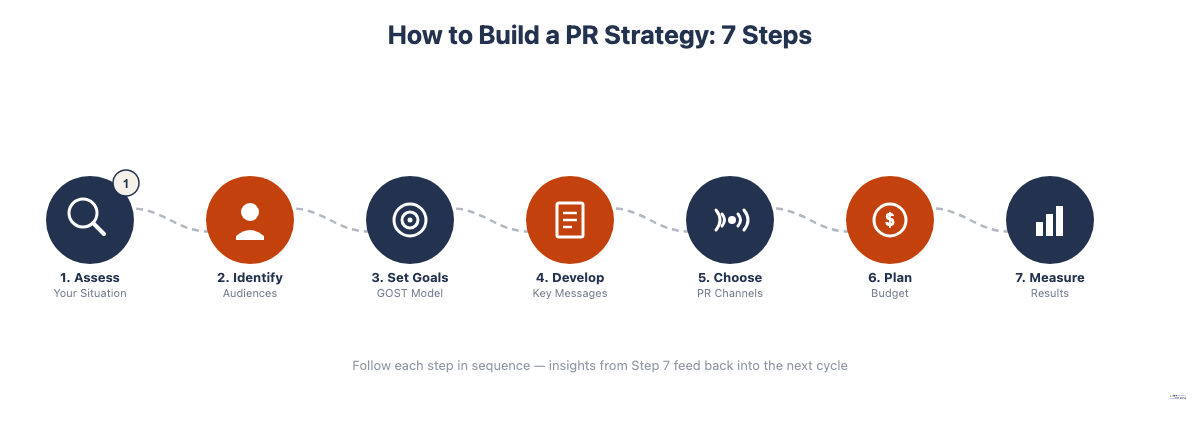
Step 1: Assess Your Situation
Start by understanding where you are before planning where you want to go. That requires an honest audit of your current position.
What does your coverage look like today? Are you earning placements in outlets your audience reads, or mostly trade press they ignore? What do journalists and customers actually say about the brand right now? Where do competitors hold stronger share of voice, and what drives it?
Pull together: recent media coverage, a competitor share-of-voice snapshot, any brand perception research you already have, and a look at your organic search footprint. If journalists do not recognize your brand when you pitch, note that. It is data.
The output of this step is not a lengthy report. It is a clear summary of your starting position, precise enough to make every subsequent decision easier.
Step 2: Identify Your Target Audiences
Sending your message to everyone is the same as sending it to no one.
Every effective PR strategy works from a small number of audience segments defined with enough precision to guide message development and channel choice. Two types matter for most organizations.
The primary audience: the people whose behavior you want to change. For a B2B SaaS company, that might mean marketing directors at mid-size businesses. For a consumer brand, parents with young children.
The influencer audience: journalists, analysts, bloggers and sector experts who shape how your primary audience perceives you. They are not your customers, but they control access to the coverage that reaches your customers.
For each segment, document who they are, which publications they trust, what problems they are trying to solve and what would make them stop to pay attention to you.
Step 3: Set Goals and Objectives (GOST Model)
One of the most common PR strategy failures is treating goals and objectives as interchangeable. The GOST model gives you a structure that keeps them separate.
| Level | Definition | Example |
|---|---|---|
| Goal | The broad business outcome PR contributes to | Become the recognized category leader in DACH markets |
| Objective | A specific, measurable result that supports the goal | Earn 20 pieces of Tier 1 business media coverage by Q4 |
| Strategy | The approach you take to reach the objective | Position the CEO as a thought leader on AI adoption in SMEs |
| Tactics | The specific activities that execute the strategy | Media interviews, bylined articles, conference speaking |
Objectives need to pass the SMART test: Specific, Measurable, Achievable, Relevant and Time-bound. “Increase brand awareness” is not an objective. “Earn coverage in five Tier 1 trade publications by the end of Q3” is.
That specificity is what makes reporting possible. It is also what makes the strategy worth having in the first place.
Step 4: Develop Your Key Messages
Key messages are the three to five things you want your audience to believe about the brand after every piece of content, every press release, every media interaction. Not taglines. Not positioning statements. The substance of what you want to be known for.
Effective key messages do four things. They are specific enough to stick but general enough to apply across contexts. They are grounded in something true: a real capability, a real result or a genuine point of difference. They are relevant to the audience, not just to internal teams who love the product. And they are written in language a journalist would actually use.
Once documented, every campaign and pitch should map back to at least one of them. If it cannot, the activity probably does not belong in the strategy.
Step 5: Choose Your PR Channels (PESO Model)
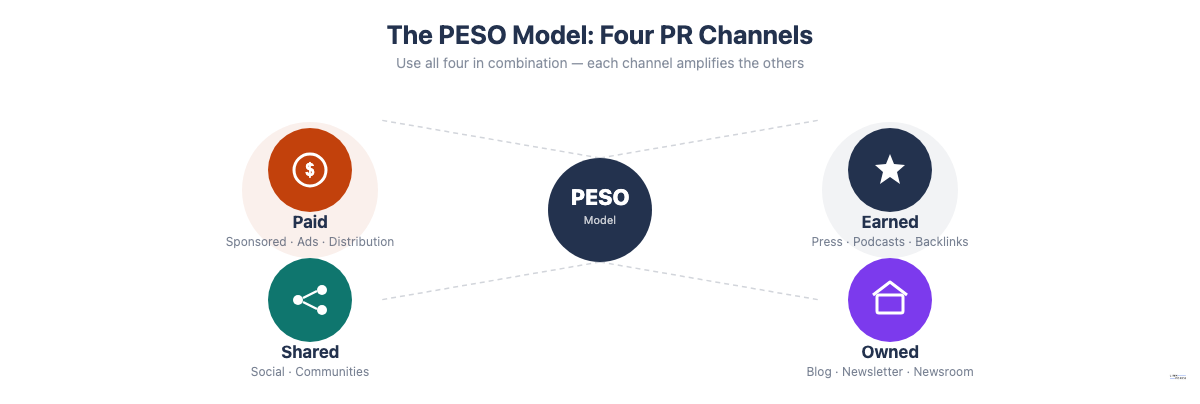
The PESO model (Paid, Earned, Shared, Owned) gives you a structured way to decide where your messages travel.
Earned media is coverage you earn through journalist relationships, newsworthiness and quality pitching. It includes press coverage, analyst mentions, podcast appearances and editorial links. Earned carries the most credibility because it comes from independent third parties.
Owned media is content you publish directly: your newsroom, blog, white papers and email newsletter. You control the message entirely, but the audience has to seek it out.
Shared media means social platforms where you distribute content and interact with audiences in real time. Low cost, high volume, short shelf life.
Paid media covers sponsored content, paid distribution and amplification. Useful for extending reach on specific campaigns, but it cannot substitute for the credibility earned media carries.
The best PR strategies do not pick one. A bylined article earned in a relevant publication gets shared on LinkedIn, linked from the newsroom and amplified to a targeted audience through paid channels. Each pillar strengthens the others.
Step 6: Plan Your Budget
PR budget decisions go wrong when teams start with a number and work forward to activities. The more useful direction is backwards: start from your objectives and calculate what it takes to reach them.
What level of agency or freelance support will you need? Which tools for monitoring, distribution and analytics are required? Are there events, production or travel costs associated with the planned campaigns?
Common budget lines worth documenting:
- Media monitoring and analytics tools
- Newswire distribution, where relevant
- Agency and freelance fees
- Content production: photography, video, writing
- Events and sponsorships
- PR software and CRM
Record your budget assumptions alongside your objectives. When budget gets cut, you can show exactly which objectives become unreachable. That is a more effective argument than any general case for PR spending.
Step 7: Measure and Report Results
Measurement is where PR strategies most frequently collapse. Not because measuring PR is impossible, but because the metrics were never agreed before the work started.
Build these into your strategy from day one:
- Volume and quality of media coverage (Tier 1, trade, niche)
- Share of voice relative to key competitors
- Backlinks and referring domains earned through PR activity (track these alongside coverage in your link building reporting)
- Organic traffic growth attributable to earned coverage
- Website referral traffic from PR-driven mentions and PR links
- Social engagement on covered content
- Sentiment of coverage: positive, neutral or negative
- How often spokespeople are mentioned by name in earned coverage
The Barcelona Principles, developed by AMEC and now in version 3.0, set the standard for how PR measurement should work: based on outcomes and impact, not just outputs. AVEs (advertising value equivalents) are explicitly excluded as a valid metric under these principles.
Agree the measurement framework with stakeholders before the first campaign launches. Changing the metrics after disappointing results destroys your credibility far more than the disappointing results themselves.
Key Components of an Effective PR Strategy
A complete PR strategy document should cover the following. Any gap here is a gap in the strategy:
- Business goals: the link between PR activity and organizational outcomes made explicit
- Audience definitions: segments defined precisely enough to guide message and channel decisions
- Key messages: three to five core beliefs you want audiences to hold about the brand
- Competitive positioning: where you stand relative to competitors on share of voice and perception
- PR channels: your specific mix of earned, owned, shared and paid
- Media list: named publications, journalists and platforms you will target
- Content calendar: a scheduled plan of campaigns, releases and content activities
- Budget: allocated by line item to specific activities
- Measurement framework: KPIs with baselines and agreed targets
- Spokesperson plan: who speaks on which topics, and how they have been prepared
The last item is consistently missing from published PR strategy frameworks. It matters because media coverage often depends as much on who is talking as what they say. A well-prepared spokesperson, briefed and clearly scoped, improves both pitch success rates and message accuracy in the resulting coverage.
Digital PR Strategy vs Traditional PR Strategy
A digital PR strategy blends traditional public relations with content marketing and SEO to build online visibility, brand authority and search rankings. Where traditional PR focuses on coverage volume and reputation, digital PR adds a third objective: earning high-quality backlinks that improve search performance.
That difference in objectives drives every other difference between them.
| Dimension | Traditional PR | Digital PR |
|---|---|---|
| Primary goal | Brand awareness and reputation | Brand awareness, reputation and organic search visibility |
| Main channels | Print, broadcast, trade press | Online publications, news sites, blogs, podcasts |
| Primary output | Media coverage | Media coverage plus backlinks to your website |
| SEO impact | Minimal | Direct: every link from a high-authority site builds domain authority |
| Measurement | Coverage volume, sentiment | Coverage, backlinks, referral traffic, organic ranking improvements |
| Audience targeting | Broad demographic segments | Search-intent-driven audience segments |
| Campaign lifecycle | Campaign-by-campaign | Continuous (content assets earn links over time) |
The backlink is the key structural difference. When a high-authority publication covers your brand and links to your website, that link signals trust to search engines and builds domain authority. Unlike traditional PR, digital PR outcomes are directly measurable and they compound over time in a way that broadcast coverage does not.
A digital PR strategy requires deliberate attention to five things traditional PR largely skips:
- Data-driven content: original research, surveys or studies that journalists cite and link to (see: linkable assets)
- High-authority backlinks: targeting publications by domain authority, not just circulation
- Targeted outreach: pitches tailored to specific journalists based on their beat and readership
- Newsjacking: connecting your brand to breaking news or trending topics while the coverage window is open
- Repurposing coverage: amplifying each win across owned and shared channels to extend its reach and link value
The strategic objective here is different from traditional PR. SEO outcomes, specifically domain authority and organic rankings, are first-class goals rather than side effects of reputation work.
PR Strategy Examples That Worked
Example 1: BBC Training and Development
The BBC faced a cultural problem. In a creative industry, being sent on training is a signal that you are not already talented enough. The organisation needed its people to develop new skills as broadcasting changed fast, but the stigma around formal learning was suppressing participation.
The insight: when high-profile employees are visibly engaged in development, they signal to the whole organisation that learning is what ambitious people do.
The strategy repositioned training as something top performers choose, not something struggling ones are assigned. It centred on profiling prominent BBC staff who were actively developing their skills, turning the act of learning into something culturally aspirational rather than remedial.
Over three years, staff training participation increased by 23%. That outcome had direct business value well beyond any media coverage the campaign earned.
Example 2: Persil’s “Dirt Is Good”

The PR strategy behind this campaign is more instructive than the campaign itself.
Persil’s challenge was straightforward: parents associate getting dirty with mess, damage and extra laundry. All negatives. A detergent brand that profits from dirty clothes faces an obvious conflict if it tries to position itself as a champion of cleanliness.
The insight inverted that logic entirely. Getting dirty is a sign of active, creative, developmentally healthy play. Persil does not fight against mess. It makes mess acceptable, which is exactly what gives children permission to explore.
The strategy built a complete narrative around celebrating dirt as evidence of childhood development. It commissioned research on the role of outdoor play, partnered with child psychologists and supported outdoor classroom programmes to give the insight third-party credibility. Earned media followed because the story was genuinely interesting, not because it promoted detergent.
More than 20 years later, the campaign is still active. That longevity is the clearest possible evidence of a strategy grounded in something true and deeply resonant.
Example 3: Original Research as a Digital PR Asset
A B2B software company commissions a research study on email response rates by industry sector. The methodology is credible. The data is genuinely useful to the journalists who cover business communication.
The company releases the study with a personalised pitch to relevant journalists at publications with strong domain authority. Coverage follows. Each article that references the research and links to the landing page builds domain rating. The landing page earns organic rankings for benchmark-related queries. The sales team uses the data in conversations. Eighteen months after release, inbound links to the page are still arriving as new articles cite the figures.
This is the defining characteristic of a digital PR strategy: assets designed to earn both coverage and backlinks, with SEO performance tracked alongside brand metrics from the beginning.
PR Strategy Mistakes to Avoid
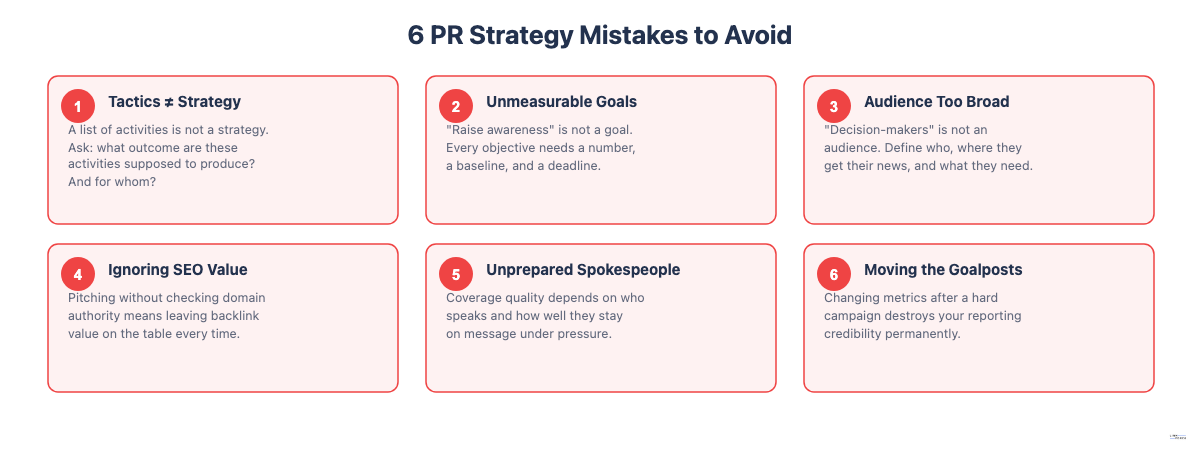
- Confusing tactics with strategy. A media list, a release schedule and a LinkedIn posting plan are tactics. If your strategy document is a list of activities, go back a level: what outcome are those activities supposed to produce, and for whom?
- Setting goals you cannot measure. “Raise brand awareness” tells you nothing about whether you succeeded. Every objective needs a number, a baseline and a deadline attached to it.
- Defining the audience too broadly. “Decision-makers” is not an audience. Neither is “anyone who might buy the product.” The more precisely you define who you are talking to, the easier every downstream decision becomes, from message development to media targeting.
- Running earned media and digital PR as separate workstreams. Pitching journalists without checking whether the outlet provides a followed link means leaving SEO value on the table every single time.
- Leaving spokespeople unprepared. Coverage quality depends heavily on who speaks and how well they can stay on message. A strategy that does not identify and prepare spokespeople will underperform even when the pitching is good.
- Changing the metrics after a difficult campaign. Agreeing to measure share of voice and then switching to “quality of relationships built” when the numbers disappoint makes future reporting worthless. Agree the framework before work begins, then hold to it.
PR Strategy Checklist
Work through this before finalising any PR strategy. Every item should have a documented, specific answer.
Situation and Positioning
- Share of voice benchmarked against main competitors
- Last 12 months of coverage reviewed for perception signals
- Competitor PR activity assessed
Audiences
- Primary audience defined with specific demographic and behavioural characteristics
- Influencer audience mapped: journalists, analysts, bloggers, sector experts
- Audience media consumption habits documented by segment
Goals and Objectives
- Business goals that PR supports named explicitly
- SMART objectives set for each major campaign or quarter
- GOST model populated: Goals, Objectives, Strategies, Tactics
Messages and Positioning
- Key messages documented, maximum five
- Each key message validated: is it true, and does the audience care?
- Spokesperson identified and briefed for each message area
Channels
- PESO model applied: Paid, Earned, Shared, Owned mix defined
- Target media list built with named journalists and publications
- Digital PR plan identifies high-authority domains as priority targets
Budget and Resources
- Budget allocated by line item
- Agency or freelance scope defined
- Tools and platforms included in budget
Measurement
- Baseline metrics captured before any campaign launches
- KPIs agreed with stakeholders before work begins
- Reporting cadence documented
- Measurement approach based on outcomes and impact, not AVE