

Silence after a first email almost never means “no.” It usually means the message got buried, the recipient meant to reply and forgot, or the ask required more thought than they had time for in that moment. A well-timed follow-up gives them a low-friction second chance to respond, and it works often enough that skipping it costs you replies you would otherwise have gotten. Below is a simple cadence rule for when to send it, eight ready-to-use samples for the most common situations, the mistakes that make follow-ups backfire, and quick answers to the questions people ask most.
Key takeaways
- A lack of reply is usually inbox overload or forgetfulness, not rejection.
- Wait 2 to 3 business days before the first follow-up on routine emails, and stop after 3 attempts total.
- Keep every follow-up shorter than your original message, ideally 50 to 125 words.
- Reference the original topic in the subject line instead of using a vague phrase like “quick question.”
- Always end with one specific, actionable next step.
Why Didn’t They Reply? (And Why a Follow-Up Still Works)
A lack of reply almost always comes down to one of three causes: an overloaded inbox, a task the recipient keeps meaning to get back to, or a request that quietly asks for more effort than they can give right away. None of these is a rejection, which is exactly why a follow-up still has a real chance of getting an answer.
- Inbox overload: your message got buried under dozens of others, or the recipient skimmed it on a phone and meant to reply from a laptop later.
- Cognitive load: the request involves a decision, some research, or coordinating with someone else, so it gets pushed to “later” and later never comes.
- Vague framing: a subject line or opening that does not signal urgency or a clear ask is easy to deprioritize.
A follow-up fixes all three problems at once. It resurfaces the message, restates the ask more clearly, and gives the recipient a fast, easy way to close the loop. That is why one well-placed follow-up regularly gets replies that the original email never did, especially when it stays short and specific instead of repeating the whole original pitch.
How Long Should You Wait Before Following Up? (The Follow-Up Cadence Rule)
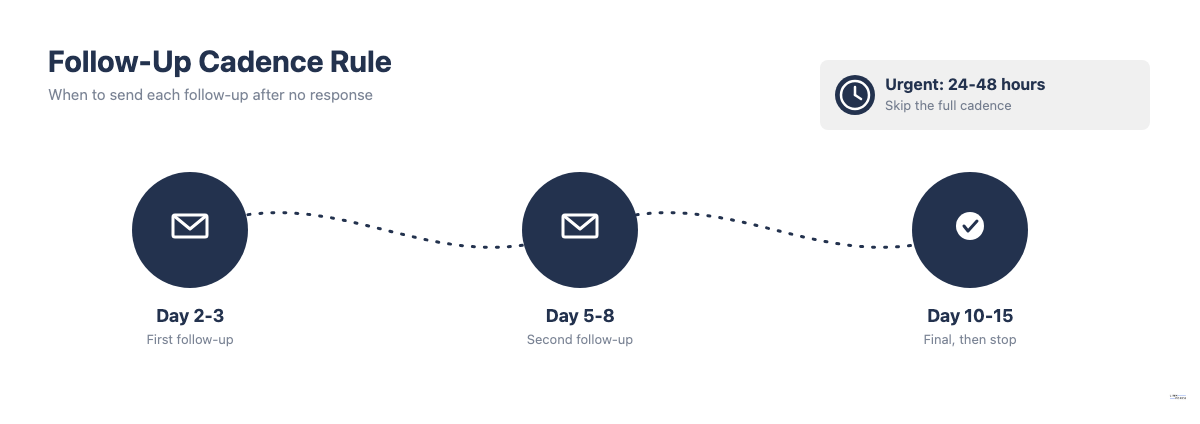
As a general rule, wait 2 to 3 business days before your first follow-up on a routine professional email. That is enough time for the message to have been seen without feeling like you’re crowding someone’s inbox. For the cold outreach case specifically, our guide to cold email covers when a follow-up helps and when it starts working against you.
The exact interval should shift with context:
- First follow-up: 2 to 3 business days after the original email, for most routine business correspondence.
- Second follow-up: wait 3 to 5 business days after the first if you still haven’t heard back.
- Third and final follow-up: stop here. Wait 5 to 7 business days after the second, then let it go. More than three attempts rarely helps.
- Urgent requests: 24 to 48 hours. Waiting the full cadence would defeat the purpose.
Exception: Faster Timelines for Interviews and Job Offers
Job-search follow-ups move faster than general business ones. Send a thank-you note within 24 hours of an interview. After that, wait until 1 to 2 days past whatever timeline the hiring manager gave you before checking in again. If no timeline was given, 5 to 7 business days is a reasonable point to send a polite status check.
Follow-Up Email Samples for Every Situation
Each sample below is written to be copied, personalized with your own details in brackets, and sent as-is. Keep the subject line specific to the original conversation instead of generic, and keep the body shorter than your first email, not longer.
Cold Outreach Follow-Up
Subject: Quick follow-up on [Topic]
Hi [Name],
I sent a note last week about [Topic] and wanted to check whether it landed at a busy moment. If it’s still relevant, I’d be glad to send over [specific resource, e.g. a case study or a short demo] so you can see whether it’s worth a closer look.
If now isn’t the right time, no problem at all, just let me know and I’ll follow up later in the year instead.
Best,
[Your Name]
Sales Prospect Follow-Up
Subject: Following up on [Product/Service] for [Company Name]
Hi [Name],
Wanted to circle back on the note I sent about [Product/Service]. A few teams similar to yours have used it to [specific outcome, e.g. cut onboarding time by a third], and I think there’s a good chance it could help with [specific pain point you mentioned or inferred].
Would it make sense to grab 15 minutes this week to see if it’s a fit? Happy to work around your schedule.
Thanks,
[Your Name]
Networking Follow-Up
Subject: Great connecting at [Event/Context]
Hi [Name],
It was great meeting you at [event or context] and hearing about [specific topic you discussed]. I mentioned I’d send over [resource, article, or intro you promised], so it’s attached here.
Would love to stay in touch, and I’ll send a LinkedIn request separately so we have an easy way to keep the conversation going.
Best,
[Your Name]
Meeting Recap Follow-Up
Subject: Recap and next steps from our [Date] call
Hi [Name],
Thanks for the time on [date]. Quick recap of what we agreed on:
- [Action item 1] (owner: [Name], due [date])
- [Action item 2] (owner: [Name], due [date])
Let me know if I’ve missed anything, and I’ll check back in once the first item is done.
Best,
[Your Name]
Job Application Follow-Up
Subject: Following up on my application for [Job Title]
Hi [Name],
I applied for the [Job Title] role on [date] and wanted to follow up to confirm it was received and check on the timeline for next steps. I remain very interested in the position and would welcome the chance to talk through how my experience with [relevant skill] fits the team’s needs.
Thank you for your time, and I look forward to hearing from you.
Best regards,
[Your Name]
Post-Interview Follow-Up
Subject: Thank you, following up on [Job Title]
Hi [Name],
Thank you again for the conversation on [date] about the [Job Title] role. I enjoyed hearing more about [specific detail from the interview] and wanted to check in on the timeline you mentioned for next steps.
I’m still very enthusiastic about the opportunity and happy to provide anything else that would help with your decision.
Best,
[Your Name]
Invoice or Payment Reminder Follow-Up
Subject: Invoice [#]: friendly reminder
Hi [Name],
Just a quick reminder that invoice [#] for [amount], sent on [date], is now [X] days past due. I’ve attached a copy in case the original was misplaced, along with the payment link: [link].
Please let me know if there’s anything blocking payment on your end, and I’m glad to help sort it out.
Thanks,
[Your Name]
Partnership or Collaboration Follow-Up
Subject: Checking in on the [Partnership/Collaboration] idea
Hi [Name],
Wanted to follow up on the idea we discussed about [specific partnership or collaboration concept]. I still think there’s a strong fit between what [Your Company] and [Their Company] do, particularly around [specific shared audience or benefit].
Would you be open to a short call to talk through what this could look like in practice?
Best,
[Your Name]
How to Tell If Your Follow-Up Strategy Is Working
Track two numbers over your next handful of sends: how many get opened, and how many get a reply. If opens are healthy but replies stay flat, the problem is usually the ask or the call to action, not the timing. If opens themselves are low, the subject line is the first thing to fix. As a rough benchmark, a single well-timed follow-up typically lifts your overall reply rate compared to relying on the first email alone, so if a full cadence of three follow-ups produces no measurable change, that is a signal to rewrite the template rather than keep sending it as-is.
Common Mistakes to Avoid When Following Up
- Opening with “just following up”: it adds nothing new and puts the entire burden of remembering context back on the recipient. Lead with the specific update or reason instead.
- Sounding pushy or demanding: phrases like “please respond ASAP” or “I’ll assume no answer means no” read as pressure and often reduce the odds of a reply instead of improving them.
- Writing too long: a follow-up should run shorter than your original message, ideally in the 50 to 125 word range. If it needs more than that, you’re probably re-explaining instead of nudging.
- Using a vague subject line: “quick question” or “checking in” gets buried just as easily as the first email. Reference the original topic directly.
- Skipping the call to action: every follow-up should end with one clear, specific next step, not an open-ended “let me know your thoughts.”
- Following up too often: more than three attempts on the same email usually signals pressure rather than persistence, and can damage the relationship instead of rescuing it.
- Emailing the wrong contact: double-check that the person you’re following up with is still the right point of contact before sending, especially for older threads.
Frequently Asked Questions
How many follow-up emails should I send?
Two to three is the practical limit for most situations. After that, response rates drop sharply and further attempts tend to read as pressure rather than persistence.
Is it rude to send a follow-up email?
No, as long as you space it out appropriately and keep the tone respectful. A single well-timed, concise follow-up is standard professional practice, not an imposition.
What is the best subject line for a follow-up email?
Reference the original topic directly, such as “Following up on [Topic]” or “Quick check-in on [Project Name].” A vague phrase like “quick question” gives no context and gets skipped just as easily.
How soon is too soon to follow up?
Following up less than 24 hours after a routine business email is generally too soon, except for genuinely urgent or time-sensitive requests where a same-day check-in is appropriate.