
Hiring a link building company can waste your budget or grow your organic traffic for years, and it depends entirely on who you hire. Link building companies range from solo freelancers to full agencies, and the category is crowded with providers that all call themselves “white hat,” which makes the label almost useless as a filter. This guide skips the vendor rankings you’ll find everywhere else. Instead, it gives you a framework for judging any link building services provider on your own: what a link building company does, what it should cost, how to compare engagement models, and the red flags that mean you’re about to get burned.
What a Link Building Company Actually Does
A link building company acquires backlinks to your site from other websites, as part of a broader SEO strategy, usually through guest posts, digital PR placements, link insertions into existing articles, or some mix of the three. The goal is external signals search engines use to judge authority and relevance, without you running outreach campaigns yourself.
Good providers combine outreach with editorial judgment. They pitch relevant sites, write or commission content those sites want to publish, and track whether the links stay live and indexed. Weak providers skip most of that and just pay for placements wherever they can get one, and that’s where quality problems start.
How to Evaluate a Link Building Company: The Criteria That Actually Matter
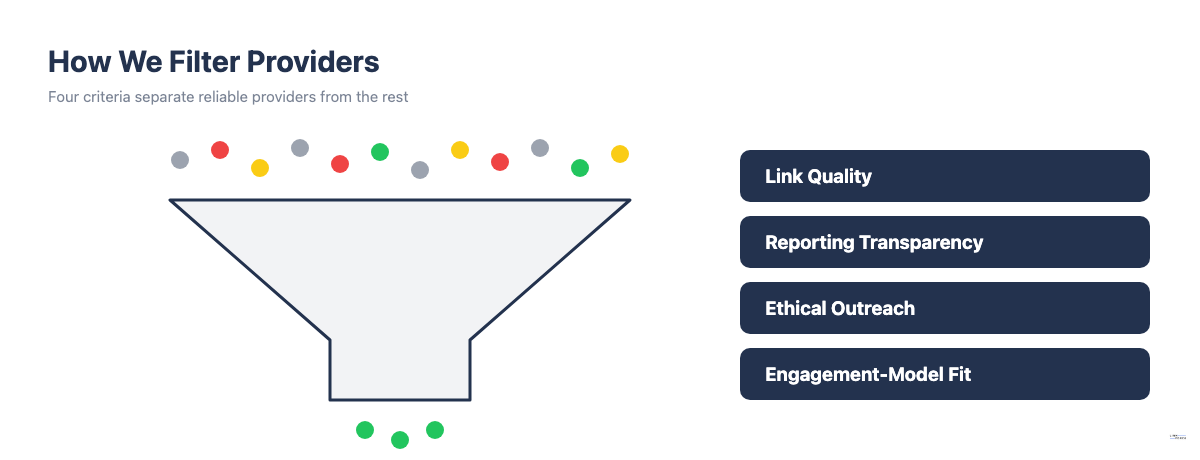
Before you compare pricing or read a testimonial, judge any provider against four criteria. These hold regardless of your budget or industry.
- Link quality and relevance. Ask where links typically come from: real editorial sites in your niche or a rotating list of guest-post farms. Request 5 to 10 recent, live examples and check them yourself rather than trust a case study screenshot.
- Reporting transparency. You should get a live, named list of placements as they go up, not a vague monthly summary. If a provider won’t show specific URLs until the contract ends, that’s a warning sign on its own.
- Ethical outreach practices. The provider should describe its outreach process in plain language: who they contact, what they offer, and how they steer clear of schemes like private blog networks (PBNs) or link farms. A vague or evasive answer means assume the worst.
- Fit with your engagement model. A provider built for one-off guest posts isn’t necessarily good at a long-term authority-building retainer, and the reverse is also true. Match the provider’s specialty to what you’re actually trying to achieve, not just their overall reputation.
Providers that score well on all four tend to cost more than providers that don’t, and that’s a legitimate reason prices vary as widely as they do.
How Much Do Link Building Companies Charge?
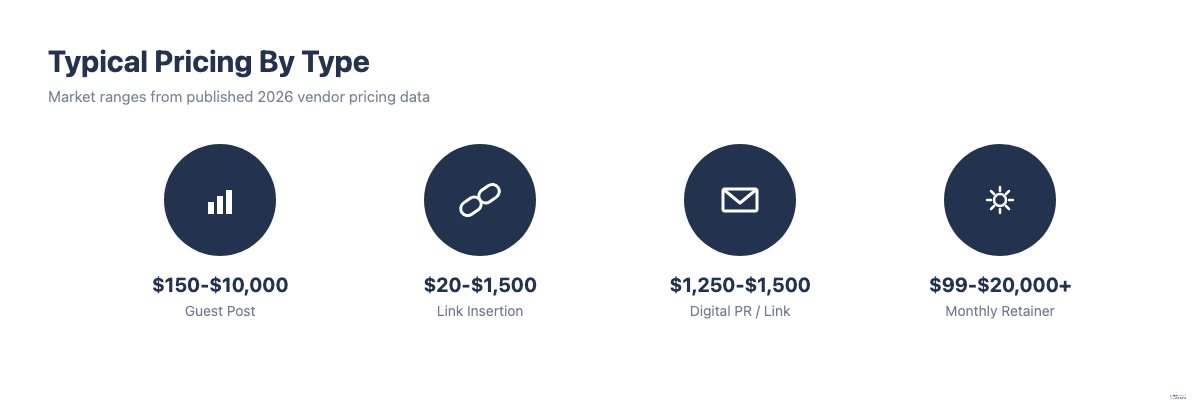
Expect to pay roughly $150 to $10,000 for a single guest post, $20 to $1,500 for a link insertion into an existing article, and $1,250 to $1,500 per unique link for digital PR. These are market-level benchmark ranges pulled from published vendor pricing data, not official fixed list prices, since most providers quote custom rates once they see your site. The spread comes almost entirely from the authority and traffic of the site you’re getting placed on. Monthly retainers for ongoing programs typically run $1,000 to $20,000 or more, depending on volume and whether content creation is bundled in, similar to the tiered structure you’ll see in most link building packages.
Guest Posts and Link Insertions
Guest posts average around $295 to $461 as a benchmark when sourced through a vendor rather than negotiated directly, though high-authority publications can charge into the thousands. Link insertions add your link to an already-published article instead of a brand-new post, and they average closer to $179, with placements on sites carrying strong domain authority and six-figure monthly traffic running closer to $780.
Digital PR
Digital PR campaigns earn links by pitching original data, surveys, or newsworthy angles to journalists instead of paying directly for placement. Expect $1,250 to $1,500 per unique link this way, or $5,000 to $10,000 a month for a retainer that typically yields six to seven unique linking domains. It’s slower and more effort, but the resulting links tend to carry more editorial weight than a paid guest post.
Monthly Retainers
Full-service retainers span an enormous range because they bundle different things together. Tool-assisted or lighter-touch monthly link building services can start around $99 a month, while premium agencies running integrated content and outreach programs can charge $5,000 to $20,000 or more. As a rough rule, budget at least $1,500 per high-quality, non-syndicated, dofollow link, and treat anything dramatically cheaper as a reason to look closer at where those links actually come from.
In-House, Freelancer, Agency, or Marketplace: Comparing Your Options
Every link building engagement falls into one of four models, and each trades off cost, control, and how much of your own time it demands.
| Model | Typical monthly cost | Your control | Your time investment | Scalability |
|---|---|---|---|---|
| In-house team | $4,000-$8,000+ (fully loaded salary, no per-link fee) | High | High (hiring, managing, training) | Low, capped by headcount |
| Freelancer | $500-$3,000 | Medium-high | Medium (still requires briefing and QA) | Low-medium |
| Agency retainer | $1,000-$20,000+ | Medium (you set strategy, they execute) | Low-medium (mostly review and reporting) | High, scales with budget |
| Link marketplace | $99-$1,500 per placement | Low (limited to available inventory) | Low | Medium, bounded by inventory quality |
An in-house team gives you the most control and the deepest institutional knowledge of your niche, but it’s slow to build and expensive relative to the volume of links you’ll get in the early months. A skilled freelancer can be the most cost-efficient option if your volume is modest and you’re willing to manage the relationship yourself. Agencies make sense once you need consistent monthly volume without hiring, while marketplaces work best as a supplement for filling specific gaps, not as your entire strategy.
Red Flags That Mean You’re About to Get Burned
The single biggest red flag is a provider that can’t show you specific, live, indexed placements before you sign a long-term contract. Everything else on this list is a variation of the same problem, which is paying for something you can’t verify.
- Private blog networks (PBNs) or link farms. Networks of low-quality sites built solely to host paid links. They violate search engine guidelines and can get your site penalized, not just the linking site.
- Guaranteed rankings. No legitimate provider can guarantee a specific ranking position, because rankings depend on far more than backlinks. Treat this promise as an immediate disqualifier.
- Exact-match anchor text spam. A natural link profile has varied anchor text. A provider that builds every link with the same exact-match keyword phrase is optimizing for a pattern search engines specifically watch for.
- Undisclosed paid placements. Paid links are supposed to carry a `rel=”sponsored”` attribute. A provider that never mentions this, or actively avoids it, is cutting a corner that can come back on you.
- “Quantity over quality” pricing. Extremely cheap link building usually means links on irrelevant, low-authority, or AI-generated content farms. One widely cited industry pricing analysis found that only a small fraction of the vendor sites in its database met basic quality standards, which matches what most experienced buyers eventually learn the hard way.
How to Verify a Placement Is Real
Before you accept a provider’s report as proof of work, check every reported link yourself. Run through this short list for each new placement:
1. Open the live URL and confirm your link is on the page, not just in an old cached version.
2. Search Google for the exact page URL to confirm it’s indexed, not just published.
3. Read the surrounding content to confirm it’s topically relevant to your site, not a random paragraph bolted onto an unrelated article.
4. View the page source and confirm the link isn’t marked `rel=”nofollow”` or `rel=”sponsored”` if you were promised a dofollow link, since a mismatch here is a common way providers pad their reported numbers.
5. Revisit the same URL a month later, since links from disposable placements sometimes disappear once a provider stops paying its own hosting bill.
Questions to Ask Before You Sign a Contract
A short list of direct questions will surface most bad providers before you’ve spent a dollar.
- Can you show me five to ten live, recent placements for a client in a comparable niche?
- What happens if a placement goes down or gets deindexed? Is it replaced at no extra cost?
- Do you use private blog networks, link networks, or any paid link scheme that isn’t disclosed to search engines?
- How is anchor text chosen, and can I review or approve it before publication?
- What reporting will I get, and how often? Ask to see a sample report from an existing client.
- What’s your average time to first live placement, and to a reportable batch of links?
If a provider hesitates on any of these, especially the request for live examples, that hesitation is your answer.
Frequently Asked Questions
How much should I budget for link building?
For most small to mid-sized sites, a reasonable starting budget is $1,000 to $5,000 a month, and that typically buys a handful of high-quality placements rather than a large volume of cheap ones. Larger sites competing in harder niches often budget well beyond that, since digital PR and premium guest post placements cost more per link.
How long does link building take to show results?
Most providers and independent case studies converge on the same answer: 3 to 6 months before a measurable ranking impact. Links need time to get indexed, and search engines don’t instantly re-trust a domain just because a new link appeared. Anyone promising faster, guaranteed results is a red flag on its own.
Is cheap link building ever worth it?
Rarely. Extremely low-cost links tend to come from low-authority, irrelevant, or purpose-built sites that search engines are increasingly good at discounting or penalizing. Fewer well-placed, relevant links from real editorial sites beat a large volume of cheap ones almost every time.
How many links do I actually need?
There’s no fixed number, and what matters more than link count is consistent placement on relevant, reasonably authoritative sites over time, matched to how competitive your target keywords are. A handful of strong, relevant links regularly outperforms a large batch of weak ones acquired all at once.