

Organic link building is the process of earning backlinks naturally – without direct agreements, paid placements, or link exchanges. When another site links to your content because it is genuinely useful, that is an organic link. It happens because someone found your resource, guide, data, or tool valuable enough to reference, not because you arranged the placement in advance.
This guide explains what organic link building is, why it produces better long-term results than transactional methods, the specific tactics that generate natural links at scale, and how to build an editorial environment that keeps earning links over time.
What Is Organic Link Building?
Organic link building – also called natural link building – is earning backlinks through content quality and visibility rather than outreach deals or paid placements. The linking site made an independent editorial decision that your content was worth referencing. No negotiation happened. No fee changed hands. The link appeared because your content solved a problem or answered a question better than alternatives.
The term sits in contrast to manual outreach link building (where you actively solicit links), paid link building (where you buy placements), and link exchanges (where you trade links with other sites). All of those involve prior arrangement. Organic links do not.
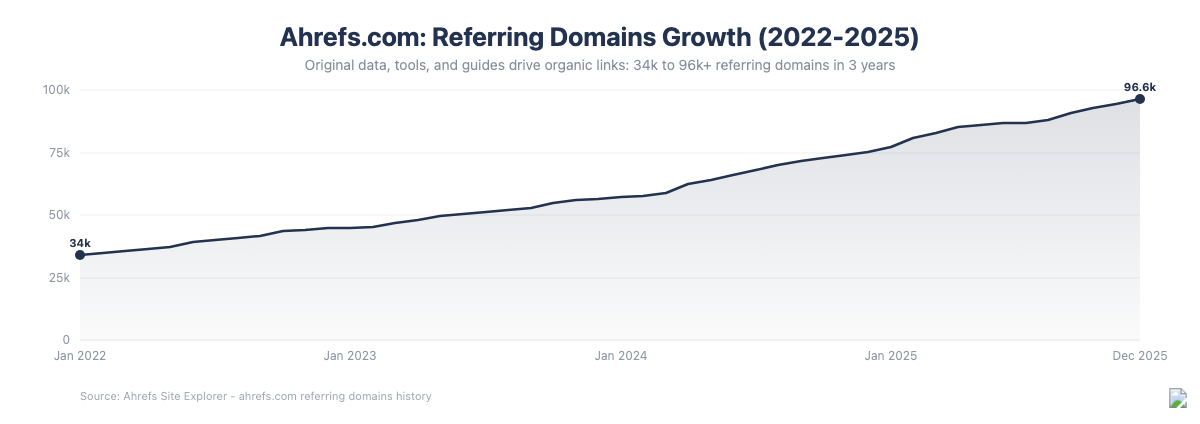
The chart below illustrates what long-term organic link building looks like at scale. Ahrefs grew from 34k to 96k+ referring domains in three years by consistently publishing original data, tools, and comprehensive guides – the exact formats that earn organic links.
What Are NOT Organic Backlinks?
Understanding the category boundaries matters for building a clean link profile:
- Paid placements. Paying a site owner to include your link, regardless of content quality, is not organic. These are sponsored links and should carry the
rel="sponsored"attribute under Google’s guidelines. - Link exchanges. “I link to you, you link to me” arrangements are transactional, not editorial.
- PBN links. Links from private blog networks set up specifically to pass link equity are entirely artificial.
- Guest posts on low-editorial sites. Guest posts on sites that accept any submission without real editorial review are closer to paid placements than organic links, regardless of what you call them.
- Comment and forum spam. Links dropped into comment fields or forums without adding value are the opposite of organic.
Why Organic Links Matter More Than Ever
Google’s link evaluation systems are better at detecting artificial patterns than they were five years ago. Links earned through genuine editorial endorsement are harder to simulate at scale, which makes them harder to devalue. A link from a relevant domain that chose to reference your content based on merit carries more weight than five links from sites that accepted payment.
The other factor is sustainability. Paid link campaigns can generate fast spikes. They also create fragile profiles – when a paid network gets detected or a sponsored post gets deindexed, those links vanish. Organic links, earned because your content is the best reference on a topic, tend to stick. New articles cite the same high-quality sources repeatedly. That compounding effect is what organic link building produces over 12-24 months of consistent execution.
Benefits of Organic Link Building
Higher Search Rankings
Organic links from relevant, authoritative domains are the most direct input into Google’s PageRank-derived ranking systems. Each organic link passes both authority and topical relevance signals. A page that accumulates organic links from industry publications, educational sites, and specialist blogs builds the kind of profile that ranking algorithms treat as genuine endorsement.
Sustainable Results
Content that earns organic links keeps earning them. A well-researched guide or original data study continues to attract citations for months and years after publication. Each new article that references your research adds another link without additional effort. That compounding behavior is the core advantage of organic over transactional methods.
Lower Investment Over Time
The upfront cost of creating link-earning content is higher than sending a batch of outreach emails. But the cost per link decreases as the content asset accumulates citations. A single original research post that earns 50 organic links over two years has a much lower cost per link than a paid link campaign at the same scale. The investment model inverts: you spend more upfront, less per incremental link over time.
AI Search Visibility
AI answer engines – Google’s AI Overviews, Perplexity, ChatGPT – draw heavily from content that is already well-cited and authoritative. Pages with strong organic link profiles are more likely to be included in AI-generated answers and cited as sources. Organic links from credible domains are one of the strongest signals that an AI system can trust a page as a reference. Building organic links improves traditional search rankings and AI search presence simultaneously.
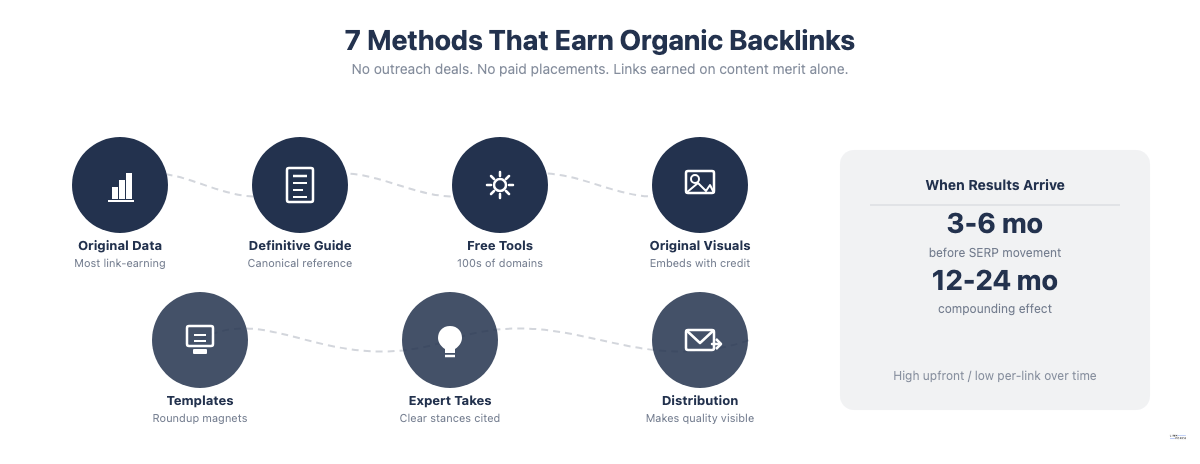
How to Build Organic Backlinks: 7 Proven Methods
Organic links do not arrive without effort. You have to create content worth linking to, make it discoverable, and distribute it to the people most likely to reference it. Here are seven methods that consistently generate natural backlinks.
1. Original Research and Data Studies
Original data is the single most link-earning content format in most industries. When you publish a study no one else has done, journalists, bloggers, and content creators who cover related topics need a source for that data. Your research becomes the primary citation. Every piece of content citing your findings is a natural link.
What makes research link-worthy: unique methodology, a large enough sample to be statistically meaningful, clear visual presentation of findings, and relevance to a topic people in your industry actively discuss. Annual or recurring research compounds faster: each new edition generates fresh coverage while old editions continue to accumulate citations.
2. Comprehensive Guides and Definitive Resources
The most-linked pages in most niches are comprehensive guides that serve as the canonical reference for a topic. When someone writes about “link building” and wants to reference a definition or concept, they link to the best available explainer. If your guide is the most thorough, the most clearly structured, and the most regularly updated, it becomes the default citation.
What makes a guide linkable: depth that exceeds competing references, original frameworks or categorizations that make the topic easier to understand, clear section structure for easy reference, and regular updates that keep it accurate. Thin guides with surface-level coverage do not earn organic links – they compete with dozens of similar pages and win nothing.
3. Free Tools and Calculators
Free tools earn organic links from multiple channels simultaneously. People who use the tool share it. Bloggers covering the tool’s topic recommend it. Resource pages list it. Review sites include it in comparisons. A single useful free tool can accumulate links from hundreds of domains over years. Ahrefs’ free backlink checker, for example, has earned links from thousands of domains simply by being the best free version of that tool.
The key is genuine utility. A tool that produces a useful output for its user will be shared. A thin tool built only for link earning will not. Calculator formats, graders, generators, and lookup tools all work when they solve a real problem the target audience faces regularly.
4. Content With Original Visuals
Infographics, charts, diagrams, and frameworks get embedded and shared across the web in ways that text alone does not. When you produce a visualization that explains a complex process clearly, other publishers embed it in their own content with a credit link. Pages with 7 or more images earn significantly more backlinks on average than text-only pages – not because of image count, but because visual content is more shareable and embeddable.
What works: original frameworks (not repurposed from other sources), data visualizations of your own research, step-by-step process diagrams, comparison charts, and infographics that compress a complex topic into a scannable format. License the visuals for embedding with attribution to make link acquisition as frictionless as possible.
5. Building Free Tools and Templates
Templates – spreadsheets, checklists, document frameworks, project management setups – earn organic links from two angles. First, people who download and use them recommend them to colleagues. Second, bloggers writing “best [type] templates” articles include yours in their roundups. A well-designed content calendar template, link building tracker, or outreach email sequence can sit on your site and earn links continuously with zero additional maintenance.
6. Expert Contributions and Thought Leadership
Publishing original perspectives on industry trends and debates generates organic citations from people who agree, disagree, or want to add context. When you take a clear stance on a contested topic in your field – backed by evidence and reasoning – others reference your position. This works best in industries with active discourse: SEO, marketing, finance, tech, and professional services all have robust publication cultures where expert takes circulate widely.
The format matters less than the specificity. A 600-word piece with a clear, supported thesis earns more organic links than a 3,000-word “balanced overview” that avoids taking any position. Editors and bloggers link to arguments, not summaries.
7. Content Promotion and Distribution
Even the best content does not earn organic links if no one knows it exists. Distribution is what converts quality into links. For each linkable asset you produce, identify the 50-100 people most likely to cite it – journalists covering the topic, bloggers who have cited similar research, editors at relevant publications – and make sure they know about it. This is not outreach in the transactional sense: you are not asking for a link. You are informing potential citers that a resource exists.
Distribution channels that work: direct email to journalists and editors, social sharing in relevant communities, newsletter submissions, podcast guesting to discuss the research, and pitching the data to trade publications as a story angle. Each distribution touchpoint seeds potential future organic links.
Building an Environment That Earns Organic Links Continuously
Individual pieces of linkable content produce link spikes. A publishing strategy built around linkable content types produces a continuous stream. The difference is the ratio of linkable to non-linkable content in your output.
Most blog content is not linkable. Listicles, how-to posts, and opinion pieces without original data rarely attract organic links because better versions already exist. Linkable content is original: it contains a dataset, a framework, a tool, or an argument that does not exist elsewhere. Building a continuous organic link profile means ensuring that a meaningful share of your content output falls into the linkable category and that each linkable asset gets proper distribution.
Tactical steps:
- Audit your existing content and identify the 5-10 pages that have already earned organic links. What format are they? What topic? Use that pattern to plan future linkable content.
- Allocate production budget to link-earning formats (research, tools, frameworks) separate from engagement content (how-tos, news, roundups).
- Build a distribution list for each major content type so that new linkable assets reach potential citers immediately on publication.
- Update high-performing linkable assets annually to keep them current and defensible as citations.
Ahrefs Site Explorer lets you identify which of your existing pages have already earned organic links and which competitor pages are earning them, so you can model your own linkable content strategy on what works in your niche.
Organic Link Building vs. Manual Outreach
Organic link building and manual outreach are not mutually exclusive. The most effective campaigns use both. Organic link building produces the highest-quality links but takes longer and depends on creating genuinely exceptional content. Manual outreach accelerates link acquisition for content that is good but not yet visible enough to attract organic links naturally.
The comparison below shows where each approach wins and where it falls short.
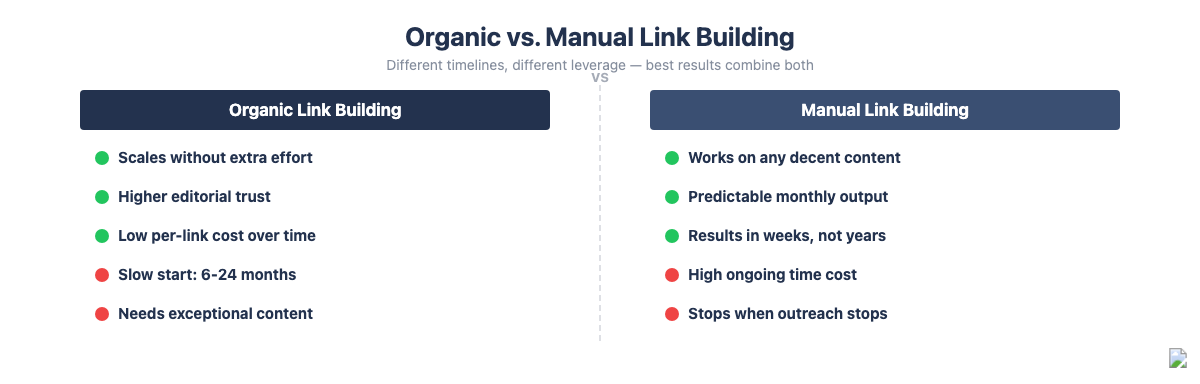
| Factor | Organic link building | Manual outreach |
|---|---|---|
| Speed | Slow: links accumulate over months | Faster: links placed in days or weeks |
| Link quality | Highest: pure editorial endorsement | High: editorial but solicited |
| Scalability | Unlimited: no outreach cap | Limited by team bandwidth |
| Cost structure | High upfront, low per-link over time | Steady ongoing cost per link |
| Content requirement | Must be genuinely exceptional | Good quality is sufficient |
| Compound effect | Strong: links beget more links | Linear: stops when outreach stops |
The practical approach: use manual outreach to build early authority for new content and to reach specific high-value domains that are unlikely to link without a direct prompt. Use organic link building strategy to create a self-sustaining base that reduces dependence on outreach over time.
Frequently Asked Questions
What is the difference between organic and natural link building?
The terms are interchangeable. Both describe backlinks earned without direct arrangement between the linking and linked sites. Some practitioners use “natural” to emphasize the absence of manipulation and “organic” to emphasize the growth analogy – links that grow from content quality rather than being planted artificially. In practice, the same tactics and content types generate both.
Does organic link building work for new sites?
It works but requires more patience. New sites lack the domain authority and search visibility to surface in organic search results, which is the primary driver of unsolicited organic links. The most effective approach for new sites is combining organic link building content (original research, tools) with targeted manual outreach to get initial distribution. As authority builds, the organic component takes over a larger share of link acquisition.
How do I know if a link is organic?
A link is organic when you did not arrange it. If you reached out, paid for it, exchanged it, or submitted the URL to a directory – it is not organic. If someone found your content independently and linked to it without any contact from you, it is organic. In practice, the line blurs when you distribute content to journalists who then cite it: the distribution was intentional, but the editorial decision was theirs. Most SEOs treat journalist-sourced links from genuine editorial coverage as organic even when you pitched the story.
What types of content earn the most organic links?
Original research and data studies consistently earn the most organic links across industries. Free tools and calculators are second, especially for SaaS and tech companies. Comprehensive definitive guides earn steady organic links over long periods. Original visual frameworks and infographics earn embeds with attribution links. Expert takes on contested topics attract citations from both sides of the debate.
How long does organic link building take?
Meaningful organic link accumulation typically begins 3-6 months after a linkable asset is published and distributed. The velocity depends on how much distribution you do, how competitive the topic is, and how well the content answers a need that existing content does not. Research assets often show faster organic link growth than guides because they are more citable as data sources. Plan for a 6-12 month horizon before an organic link building strategy shows material impact on rankings.