

Selling links means acting as the publisher: you place a paid link on your own site in exchange for money, in a guest post, an existing article, or dedicated sponsored content. It is the mirror image of buying backlinks. Pricing works differently on this side of the transaction, and so does the compliance burden and the list of places to find buyers. This guide walks through what counts as a sellable link, what Google says about the practice, how publishers price placements, and how to stay on the right side of the line while doing it.
What Does “Selling Links” Actually Mean?
Selling links means you, as a website or blog owner, accept payment from a business or SEO team in exchange for placing a link to their site on one of your pages. The link can live in a brand-new guest post, in an article you already have live, or inside sponsored content built for that advertiser. Three placement types, one basic exchange.
That is worth stating clearly because the same phrase gets used two different ways online. Some content treats “selling links” as a synonym for “link building as a ranking factor” and writes from the buyer’s perspective, explaining why a business would want to acquire links (see our companion guide on buying backlinks if that is the side of the transaction you are on). This guide is written from the other side of that transaction: you already have a site with traffic, and you are deciding whether, and how, to monetize it by hosting other people’s links.
The three most common formats are a guest post written around the buyer’s link, a niche edit that inserts a link into a page you already published, and a sponsored post that reads more like branded content than a guest contribution. A fourth format, straightforward advertising space, skips content entirely and just sells a link placement in a sidebar, resource page, or footer. All four are covered in more detail below.
Is Selling Links Against Google’s Rules?
It depends on how you mark the link up, not on whether money changed hands. Google’s own Search Essentials spam policies are explicit about this: “Buying or selling links for ranking purposes” is listed as a link scheme, and that includes “exchanging money for links, or posts that contain links” and “exchanging goods or services for links.” Read at face value, that sounds like an outright ban on selling links at all.
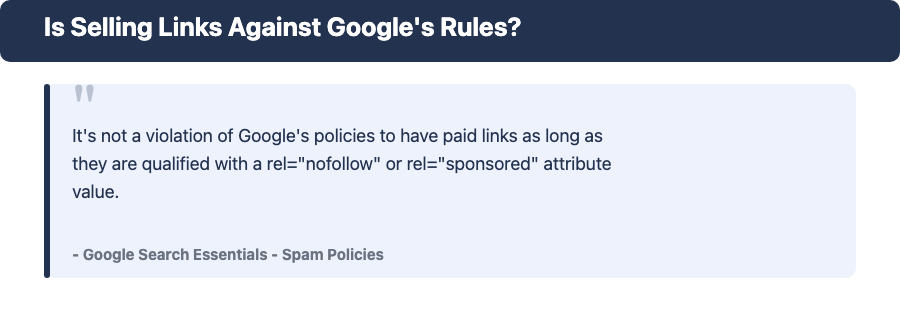
The next part of the same policy is the part publishers actually need to act on. Google states plainly that “buying and selling links is a normal part of the economy of the web for advertising and sponsorship purposes,” and that it is not a violation of Google’s policies to have such links “as long as they are qualified with a rel="nofollow" or rel="sponsored" attribute value to the <a> tag.” In other words, the problem was never the payment. The problem is a paid link dressed up as an organic editorial endorsement, quietly passing ranking credit (PageRank) to the buyer’s site without disclosing that it was paid for.

What this means in practice for a publisher selling placements:
- Every paid link you place must carry
rel="sponsored"(Google’s preferred value for commercial link relationships) or, at minimum,rel="nofollow". Arel="ugc"value is reserved for user-generated content like forum posts and blog comments, not sponsored placements you control. - “Text advertisements or text links that don’t block ranking credit” and “advertorials or native advertising where payment is received for articles that include links that pass ranking credit” are both named directly as link spam examples in Google’s policy.
- Getting this wrong risks either an algorithmic ranking demotion or, in more flagrant or repeated cases, a manual action against your site, not just against the buyer’s.
The compliance mechanism is simple once you know it: tag the link correctly, and selling link placements is an ordinary, permitted part of running a monetized website.
What Kinds of Links Can You Actually Sell?

Most sellable link placements fall into one of four formats. They differ in how much content work is involved, how permanent the placement is, and how transparent the sponsorship needs to be.
Guest Posts
A guest post is a brand-new article, written specifically for the buyer’s link, that you publish on your site under a byline (yours, a house byline, or occasionally the buyer’s, depending on your editorial policy). The link is embedded naturally in the body copy, usually with one or two contextual anchor text placements. This is the most content-intensive format to sell, since you either have to write the piece yourself or review and edit whatever the buyer’s team submits, but it also gives you the most control over quality and topical fit.
Niche Edits (Link Insertions)
A niche edit inserts a buyer’s link into an article you already have live and already ranking, with no new content required. That makes niche edits faster to sell and typically priced lower than a full guest post, though they carry their own risk if overused: stuffing an old article with unrelated inserted links can look unnatural to both readers and Google’s systems.
Sponsored Posts
A sponsored post reads like branded content rather than a guest contribution, built entirely around the advertiser’s product, service, or announcement as a clearly paid placement. Sponsored posts typically command a premium over a standard guest post because the buyer gets more prominent brand messaging, not just a link.
Advertising and Ad-Space Placements
The simplest format skips content altogether and sells a link as a static placement, in a sidebar widget, a curated resources page, a “recommended tools” list, or a footer credit. These placements are usually sold on a subscription or flat monthly basis rather than as a one-time fee, and because they carry no editorial content around them, they should almost always be marked rel="sponsored" rather than left as a bare dofollow link.
How Much Can You Charge for a Link?
There is no single market price for a link placement. Treat any guide that quotes one flat number without explaining the variables behind it with caution. What moves the price is a combination of Domain Rating (or a comparable authority metric), real organic traffic, how closely the buyer’s niche matches your site’s editorial focus, and which of the four placement formats above you are selling.
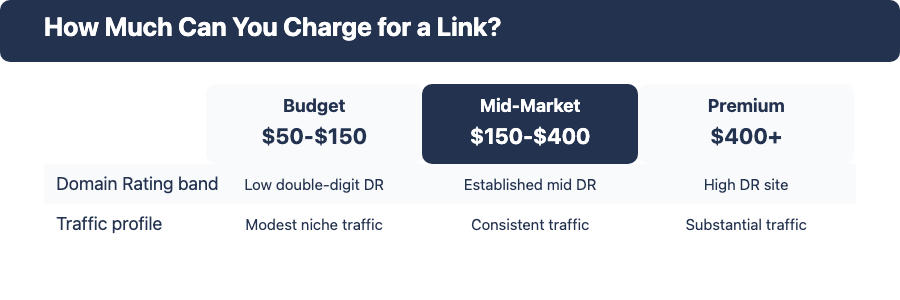
As a rough, evergreen frame of reference for where sites typically land, the market tends to break into three broad tiers:
| Tier | Typical Price Per Placement | Domain Rating Band | Organic Traffic Profile |
|---|---|---|---|
| Budget | Roughly $50 – $150 | Low double-digit DR, newer or niche sites | Modest but real organic traffic, narrow topical focus |
| Mid-market | Roughly $150 – $400 | Established mid-range DR sites | Consistent organic traffic with topical authority in a specific niche |
| Premium | $400 and up | Higher-DR sites with strong backlink profiles | Substantial organic traffic, recognized authority in a competitive niche |
Treat these as directional bands, not a price list. A niche edit on a mid-DR site will usually sell for less than a full guest post on the same site, and a sponsored post with heavier content and design work built in will usually sell for more than either. Buyers also pay a premium for sites in genuinely competitive niches (finance, legal, health) where authoritative placements are harder to find, and for sites with a clean, spam-free backlink profile of their own, since that profile is exactly what a buyer’s SEO team will check before paying.
How to Sell Links Without Getting Penalized
Once you have decided to sell placements, a short list of habits keeps the practice compliant and keeps your own site’s reputation intact.
- Tag every paid link with
rel="sponsored"orrel="nofollow", without exception, per Google’s link-scheme guidance above. This is the single most important habit on this list. - Stay inside your site’s actual niche. A finance blog selling links to unrelated gambling or payday-loan sites is the clearest possible signal to both readers and Google’s spam systems that a placement is not editorial.
- Avoid categorically toxic verticals for a general-interest or professional site: casino and gambling, adult content, payday and predatory lending, and unregulated pharmaceuticals are the categories most likely to drag down trust in your own backlink profile.
- Keep a mix of sponsored and non-sponsored content. A site where every single new post is paid placement reads as a link farm, to readers and algorithms alike.
- Vet the buyer, not just the payment. A quick check of the buyer’s own site (does it look legitimate, does it have real content, is it in a category you are comfortable being associated with) protects your site’s reputation more than any rel attribute can.
- Limit the number of paid outbound links on any single page. A page with a dozen sponsored links reads as manipulative regardless of how each individual link is tagged.
Disclosure matters beyond Google’s own policy, too. In the United States, the FTC’s endorsement guidance requires that sponsored or paid content be clearly and conspicuously disclosed to readers, not just tagged correctly for search engines. A simple “Sponsored” or “Advertisement” label at the top of a paid guest post or sponsored article satisfies both the reader-facing disclosure expectation and reinforces the intent behind the rel="sponsored" attribute. Treat the two requirements, search engine disclosure and reader disclosure, as a single habit rather than two separate boxes to check.
Selling Directly vs. Through a Link Building Marketplace
Publishers who decide to sell links generally choose between three channels, and each trades control and margin for speed and convenience differently.
- A direct sponsorship page on your own site. You publish a page (often called “Advertise With Us” or “Sponsored Post Guidelines”) listing your rates and requirements. Buyers contact you directly. This keeps the entire margin, since there is no intermediary, but you handle your own outreach, invoicing, and buyer vetting.
- An agency partnership. SEO and content agencies that manage link building services for multiple clients will often work with a shortlist of publishers directly, sending you a steadier stream of placement requests than one-off buyers would. The tradeoff is a closer, ongoing relationship where you are expected to hold quality and turnaround standards consistently, not just fulfill a single order.
- A link building marketplace. Platforms built specifically to connect publishers with buyers, LinkForce is one example, handle buyer outreach, price transparency, and payment processing on your behalf, so you do not have to build your own sales funnel. The tradeoff is that a marketplace typically takes a percentage of each placement, and you have less direct control over exactly who reaches out to you, since the platform manages the buyer relationship rather than you.
There is no universally correct choice among the three. A publisher with the time and audience to build a direct sponsorship page and a buyer list keeps more margin doing it alone; a publisher who wants placements to happen with minimal ongoing sales effort generally gets there faster through a marketplace or agency relationship instead. Many established publishers end up running more than one channel at once, listing on a marketplace while also keeping a direct sponsorship page live for buyers who find the site organically.
Is Your Site Ready to Sell Links?
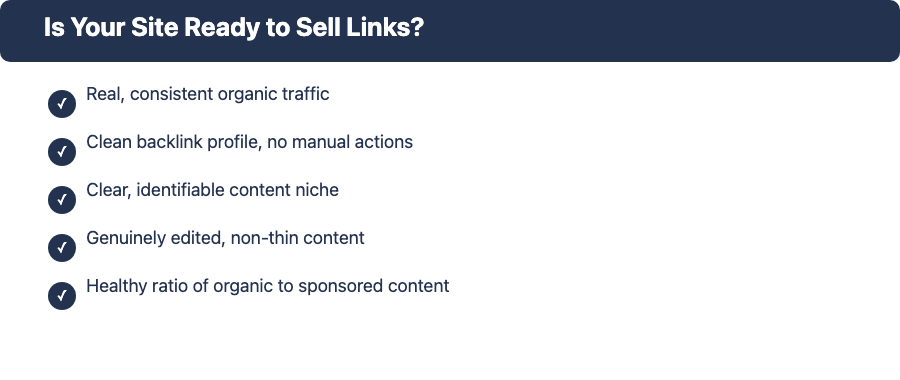
Before listing your site for paid placements anywhere, run through a short readiness check. A “no” on any of these does not mean you cannot sell links, but it does mean you should fix the underlying issue first, since buyers (and the marketplaces and agencies that vet publishers on their behalf) check for exactly these signals.
- Does your site have real, consistent organic traffic, not just social or referral spikes?
- Is your backlink profile clean, with no history of manual actions or obvious past link-scheme participation?
- Does your site have a clear, identifiable niche a buyer can point to, rather than covering everything loosely?
- Is your existing content genuinely edited and maintained, not thin or auto-generated?
- Can you commit to keeping a healthy ratio of non-sponsored to sponsored content going forward, rather than converting the whole site into paid placements?
If you can answer yes to all five, your site is in a solid position to start selling placements through any of the three channels described above.
Frequently Asked Questions About Selling Links
Is selling links illegal?
No. Selling links is not illegal. It is governed by Google’s own Search Essentials policies (which affect ranking, not legality) and, in some jurisdictions, by advertising-disclosure rules like the FTC’s endorsement guidance in the United States, which require sponsored content to be clearly labeled to readers.
Do I need to use nofollow or sponsored on every paid link?
Yes. Google’s link-scheme policy requires paid links to carry rel="nofollow" or rel="sponsored" so they do not pass ranking credit. Leaving a paid link as a plain dofollow link is the single most common mistake publishers make when selling placements.
What is the difference between a dofollow and a nofollow link for a sold placement?
A dofollow link passes ranking signal (PageRank) to the linked site; a nofollow or sponsored link explicitly tells search engines not to treat the link as an editorial endorsement that should influence rankings. Paid placements should be nofollow or sponsored, not dofollow, regardless of how much the buyer requests otherwise.
Should I sell links directly or through a marketplace like LinkForce?
It depends on how much time you want to spend on sales versus content. Selling directly keeps the full margin but requires you to find buyers yourself; a marketplace handles buyer outreach and vetting in exchange for a share of each placement. Many publishers use both at once.
How is a niche edit different from a guest post when selling links?
A niche edit inserts a buyer’s link into an article you already have published; a guest post is new content written specifically to carry the buyer’s link. Niche edits are faster to sell since no new writing is required, while guest posts typically sell for more because of the added content work.