

Traffic value is an SEO metric that estimates the monthly cost of a website’s organic traffic if that traffic were purchased via PPC ads instead of earned through rankings. It doesn’t measure actual revenue. It measures the hypothetical ad spend required to replicate what a site is getting for free through organic search.
Quick example: if a website gets 10,000 organic visits per month from keywords where advertisers pay an average of $3 per click, the traffic value is roughly $30,000. That number tells you a lot about the commercial intent behind the site’s keyword portfolio.
What Is Traffic Value in SEO?
Traffic value (often called organic traffic value) is the estimated cost equivalent of a website’s organic search traffic in paid advertising terms. It answers one practical question: how much would you have to spend on Google Ads each month to get the same clicks that the site is currently earning for free?
The metric was popularized by Ahrefs, where it appears prominently in Site Explorer. Semrush calls a similar metric “organic traffic cost.” SE Ranking shows it as “traffic cost.” Different tools, same concept.
| Metric | What It Measures |
|---|---|
| Organic Traffic | Estimated number of monthly visitors from organic search |
| Traffic Value | Estimated monthly cost to buy those visitors via PPC |
This distinction actually matters quite a bit. A site can have modest traffic but high traffic value if it’s ranking for expensive, high-intent keywords. And a site can have massive traffic but low value if its rankings are all informational queries with near-zero CPC.
How Is Traffic Value Calculated?
Traffic value is calculated by summing up the product of estimated monthly clicks and CPC across every keyword a site ranks for.
Formula: Traffic Value = Sum of (Estimated Monthly Clicks x CPC) for all ranking keywords
SEO tools pull this together automatically. For each keyword a domain ranks for, the tool estimates how many clicks that ranking position generates per month, multiplies that by the keyword’s CPC from advertiser data, and adds all those figures together.
Worked Example
Say a site ranks for three keywords:
| Keyword | Monthly Clicks (estimated) | CPC | TV Contribution |
|---|---|---|---|
| “project management software” | 1,200 | $8.50 | $10,200 |
| “best CRM for small business” | 800 | $12.00 | $9,600 |
| “what is a backlink” | 3,000 | $0.80 | $2,400 |
| Total | 5,000 | $22,200 |
Total traffic value: roughly $22,200 per month. Notice that the keyword driving the most traffic contributes the least to the figure. That’s exactly why traffic and traffic value are different signals and shouldn’t be used interchangeably.
One caveat: CPC figures vary between Ahrefs, Semrush, and Google Keyword Planner, so traffic value figures will differ across tools. Don’t compare numbers across platforms.
Organic Traffic Value vs. Paid Traffic Cost
Ahrefs draws a distinction that other tools don’t always make explicit:
| Metric | Definition | What It Tells You |
|---|---|---|
| Organic Traffic Value | Hypothetical PPC cost of all organic rankings | How valuable your organic keyword portfolio is |
| Paid Traffic Cost | Estimated actual spend on PPC campaigns | How much a competitor is investing in paid search |
When you see a high paid traffic cost for a competitor in Ahrefs Site Explorer, it means they’re actively spending on ads for those terms. High organic traffic value means they have strong organic rankings for commercially valuable terms. They’re separate signals and you shouldn’t conflate them.
For most link building and competitor research use cases, organic traffic value is the relevant metric.
What Does Traffic Value Actually Tell You?
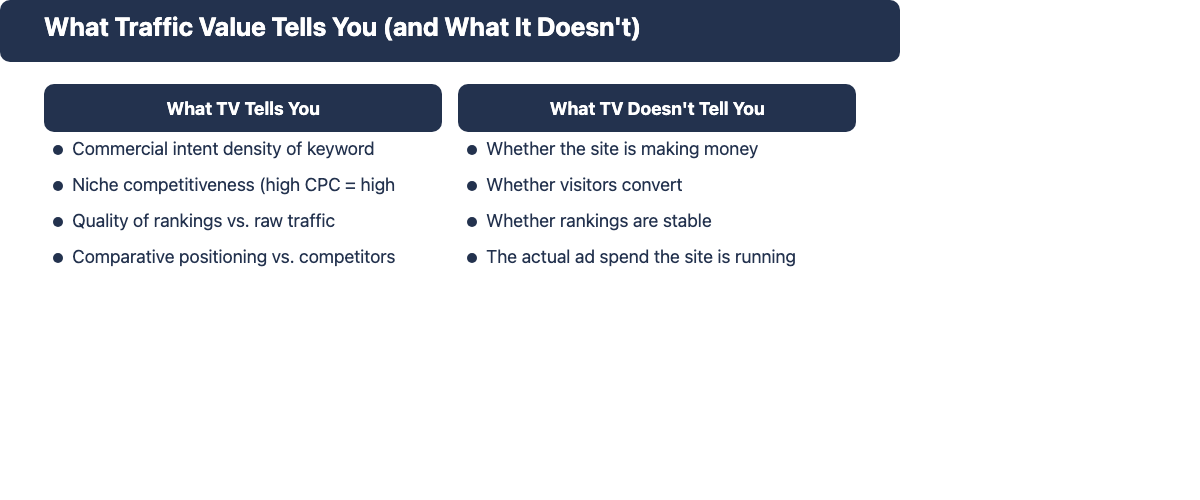
Traffic value is a signal, not a business metric. Here’s what it reliably tells you and what it doesn’t:
What traffic value tells you:
- Commercial intent density: sites with high TV relative to traffic volume are ranking for expensive, buyer-intent keywords
- Niche competitiveness: high CPC keywords attract high TV because advertisers value those clicks
- Keyword portfolio quality: you can have 500,000 visitors and a low TV, or 50,000 visitors and a high TV
- Comparative site positioning: comparing TV across competing sites shows who’s targeting commercial vs. informational content
What traffic value doesn’t tell you:
- Whether the site is making money
- Whether visitors convert
- Whether the rankings are stable
- The actual ad spend the site is running
Use traffic value as a directional signal and comparative benchmark. Don’t treat it as a standalone KPI.
How to Use Traffic Value in Practice
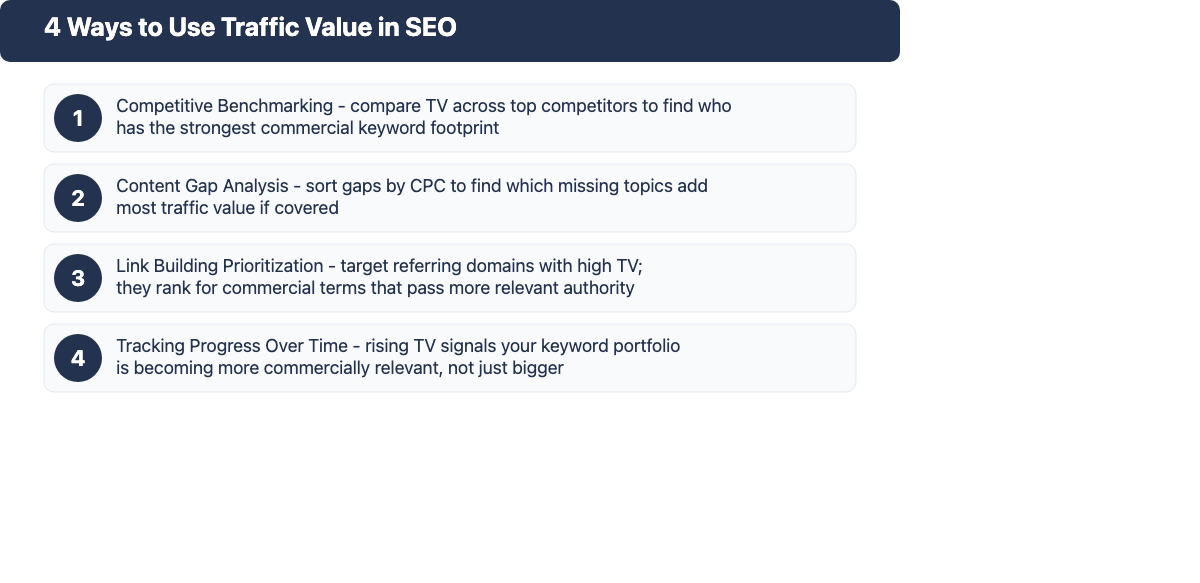
Competitive Benchmarking
Comparing traffic value across competing domains quickly shows which sites have the most commercially valuable organic presence. In Ahrefs, open Site Explorer, enter a competitor’s domain, and check the “Traffic value” figure in the Overview tab. Do this for your top five competitors and you’ll have a ranked view of who has the strongest commercial keyword footprint.
A competitor with lower traffic but higher TV than you is a clear signal they’ve got better intent alignment in their keyword strategy.
Content Gap Analysis
Traffic value helps prioritize content gaps. If a competitor has a cluster of high-TV pages and you don’t cover the same topics, those gaps represent both a traffic opportunity and a commercial value opportunity.
In Ahrefs, use the Content Gap tool (under Competitive Analysis) to find keywords where competitors rank but you don’t. Sort by CPC to identify gaps that would contribute most to traffic value if you closed them.
Link Building Prioritization
Traffic value is one of the most useful signals in link prospecting. A page or domain with high traffic value is ranking for commercially valuable keywords, which means it has link authority that matters in competitive niches. Getting a link from a high-TV page is more likely to benefit your commercial rankings than getting a link from a high-traffic but low-TV page.
When building a prospect list:
- Pull referring domains from a competitor in Ahrefs
- Sort by the referring page’s traffic value (use URL Rating and organic traffic as proxies, or export and filter)
- Prioritize domains where referring pages have both relevant content and meaningful TV
A site with $50,000 monthly traffic value in your niche is a stronger link target than a high-DA site with $500 monthly traffic value in an unrelated niche.
Tracking Your Own Progress Over Time
Rising traffic value is a stronger performance signal than raw traffic growth because it shows your keyword portfolio is becoming more commercially relevant. An SEO campaign that doubles traffic while also improving TV from $10,000 to $40,000 is outperforming one that triples traffic but keeps TV flat.
In Ahrefs, Site Explorer’s overview chart tracks traffic value over time. Check it monthly to verify that growth is coming from commercial keywords, not just informational volume.
What Increases Traffic Value?
Traffic value rises when your keyword portfolio becomes more commercially dense. Here are the main levers:
- Rank higher for existing commercial keywords. Moving from position 8 to position 3 for a $5 CPC keyword doesn’t just increase traffic, it dramatically increases estimated clicks because of the click-curve effect, and those extra clicks are all multiplied by the same CPC.
- Add pages targeting buyer-intent queries. Alternative pages, comparison pages, pricing pages, and review pages tend to target high-CPC keywords. Each new page that ranks for these terms adds to the total TV.
- Build links to commercial pages. Better rankings for commercial keywords are almost always correlated with stronger backlink profiles pointing to those pages. Link building that targets your commercial pages is one of the highest-leverage ways to improve traffic value.
- Target keywords in more competitive categories. A cybersecurity company and a recipe blog might have identical traffic volumes but wildly different TV. Niche selection is the highest-level TV driver.
Traffic Value vs. Revenue: What You Need to Know
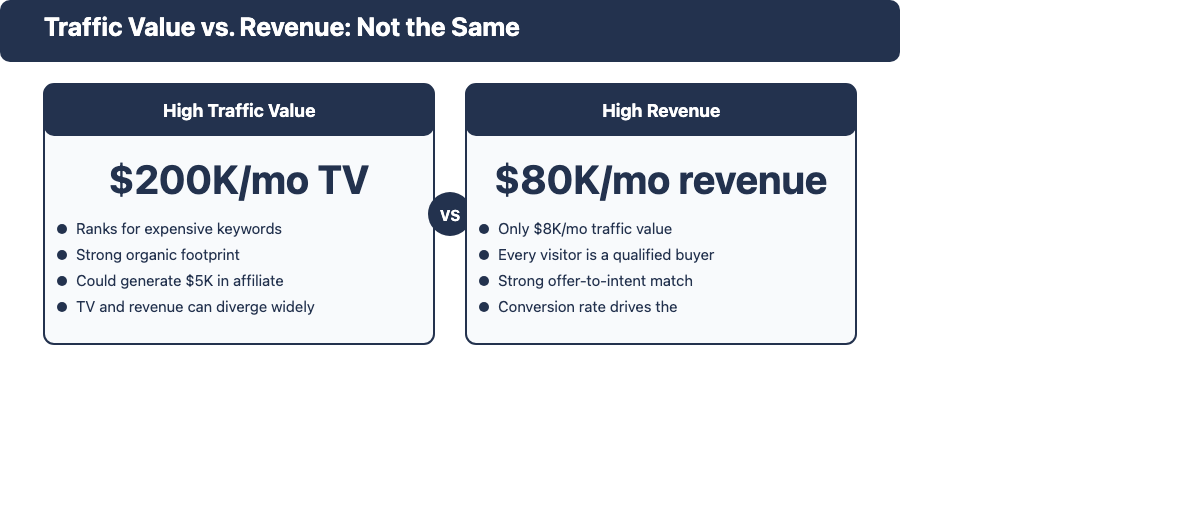
Traffic value isn’t a revenue estimate. This matters because the dollar figure can mislead teams into treating it as a proxy for earnings.
Here’s a concrete contrast: a site with $200,000 monthly traffic value might generate $5,000 in affiliate commissions and nothing else. Another site with $8,000 monthly traffic value might generate $80,000 in SaaS subscriptions because every visitor is a qualified buyer.
What drives that gap:
- Conversion rate: TV measures traffic potential, not conversion behavior
- Offer alignment: high TV means expensive keywords, but expensive keywords don’t guarantee the visitor’s intent matches your offer
- Monetization model: a lead-gen business, a SaaS, and a content publisher all monetize the same traffic at different rates
Traffic value is a signal of organic keyword quality and competitive positioning. For business performance, you need revenue data, conversion rates, and customer value metrics.
Frequently Asked Questions
What is a good traffic value for a website?
There’s no universal benchmark. Traffic value depends on niche, site size, and keyword strategy. A B2B SaaS site with 10,000 monthly visitors might have $150,000 in traffic value if it ranks for high-CPC software keywords. A recipe blog with 500,000 visitors might have $20,000 in TV because food keywords have low CPCs. Compare TV within your niche and against direct competitors, not across industries.
Is traffic value the same in Ahrefs and Semrush?
No. The figures differ because each tool uses different click-through rate models, different CPC data sources, and different keyword databases. Don’t compare TV across tools. Use one tool consistently and compare relative figures within that tool.
Can you increase traffic value without increasing traffic?
Yes. If you improve rankings for high-CPC keywords without adding new keywords, estimated clicks on those terms increase (higher positions earn higher CTR) and the TV rises. If you shift your content strategy toward higher-CPC topics and existing pages start ranking for more expensive terms, TV increases even without raw traffic growth.
How often does Ahrefs update traffic value?
Traffic value in Ahrefs doesn’t have a single universal update schedule because it’s a composite metric derived from two separate data streams. CPC and search volume data update every few weeks, at minimum once per month per keyword. Organic traffic estimates are calculated on a rolling 30-day basis, with ranking data refreshed every 1-2 days for high-volume keywords and every 1-2 months for lower-volume terms. Site Explorer’s overview display refreshes every 12 hours. In practice, TV figures for competitive, high-search-volume keywords can shift noticeably within days, while figures for niche terms may appear stable for weeks. Look at the 3-month trend in the Site Explorer chart rather than any single snapshot. If TV drops suddenly, check whether it reflects a ranking change or a CPC shift in the advertiser market; these have different implications for your SEO strategy.