

Outreach marketing is the practice of proactively contacting people outside your existing audience to build relationships, earn visibility and achieve specific goals. You don’t wait for them to find you. You identify the right people, reach out directly and offer something worth responding to.
For link builders and SEO practitioners, outreach marketing is the engine behind most backlink acquisition. For broader marketing teams, it covers influencer collaborations, media coverage and co-marketing deals.
What Is Outreach Marketing?
Outreach marketing means initiating contact with people who haven’t engaged with your brand yet. Those people might be journalists, bloggers, influential people in your niche, website owners, podcast hosts or potential business partners.
Here’s the core idea: reaching someone through a trusted voice produces better results than advertising to them directly. When a journalist covers your product, or an influencer mentions your tool, or a respected site links back to your content, the credibility comes from the intermediary, not from you.
That’s what separates outreach marketing from paid advertising. Ads interrupt. Outreach earns placement by offering something genuinely useful to the person you’re contacting.
Types of Outreach Marketing
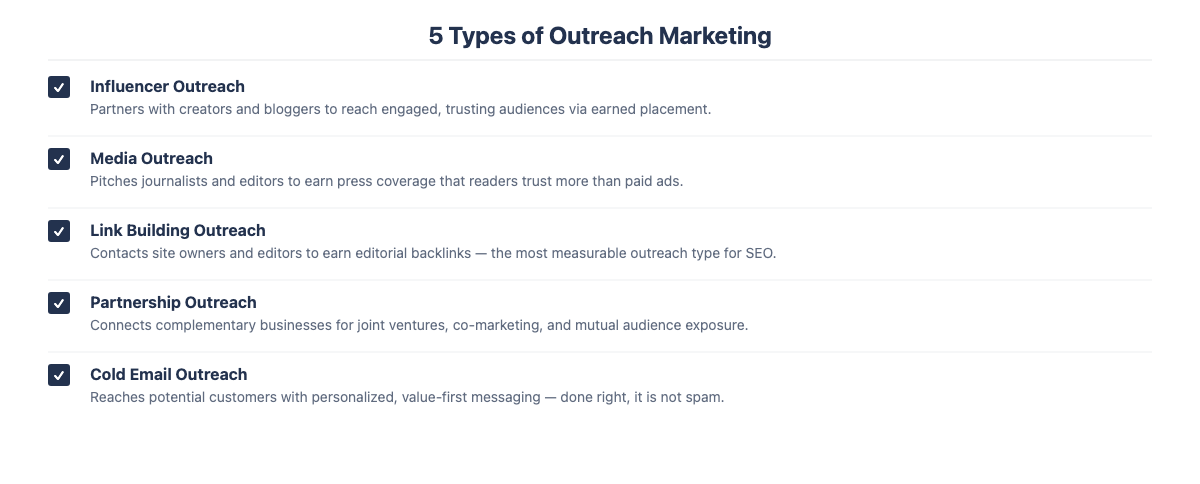
Outreach takes different forms depending on your goal. Here are the five most common types.
Influencer Outreach
Influencer outreach means partnering with creators, bloggers or social media figures to reach their audiences. You might collaborate on a review, a mention, a co-created piece of content or a product feature. The influencer’s credibility transfers trust to your brand in a way that paid placements rarely achieve.
Media Outreach
Media outreach targets journalists, editors and publications. You pitch a story, provide a data-backed angle or offer an expert comment for a piece they’re already working on. When a publication covers your brand, you gain earned media: coverage that didn’t cost you ad spend and that readers trust more than paid content.
Link Building Outreach
Link building outreach is outreach marketing applied to SEO. You contact website owners, editors or bloggers to request a backlink to your content. Common tactics include guest posting, broken link replacement, resource page suggestions and unlinked mention reclamation.
Done well, link building outreach produces the kind of editorial backlinks that move rankings. It’s the most results-measurable form of outreach marketing because you can track placements, domain ratings and ranking changes directly. Our guide to backlink outreach covers the process end to end.
Partnership Outreach
Partnership outreach identifies complementary businesses for joint ventures, co-marketing initiatives or product integrations. The goal is mutual audience exposure. A webinar co-hosted with a partner, a bundled offer or a cross-promotional email list swap all fall into this category.
Cold Email Outreach
Cold email outreach contacts potential customers who haven’t interacted with your brand before. Done right, it’s personalized, specific and offers clear value. Done wrong, it’s spam. The tactic doesn’t change between the two, although the execution does. The difference is almost always in the research and targeting that happens before you write the message.
Why Outreach Marketing Works
Outreach marketing works because people trust recommendations from sources they already follow. A stranger’s advertisement rarely moves a buyer. A mention by a journalist they read, a blogger they follow or a peer they respect carries a different weight.
This trusted intermediary effect means outreach produces borrowed credibility. Your brand reaches audiences that didn’t choose to see your ad, but are receptive because the context comes from a voice they trust. That’s what makes outreach marketing one of the most cost-efficient ways to grow visibility.
For SEO, the benefits are structural. Backlinks earned through outreach signal to search engines that your content is worth referencing. Each well-placed link from a relevant, authoritative domain contributes to your domain authority and supports organic rankings. Outreach marketing is one of the few strategies that builds SEO equity, brand visibility and audience relationships at the same time.
Compare outreach marketing side by side with paid advertising and content marketing to see where it fits your channel mix.
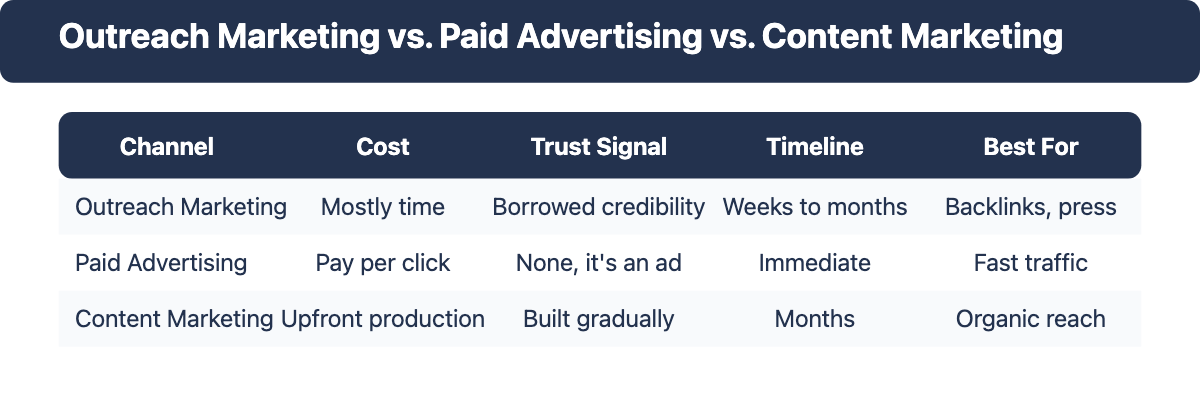
| Channel | Cost Model | Trust Signal | Typical Timeline | Best Use Case |
|---|---|---|---|---|
| Outreach marketing | Time and relationship-building effort, largely non-cash | Borrowed credibility from a trusted intermediary | Weeks to months, depends on the recipient’s schedule | Earning backlinks, press coverage or partnerships without ad spend |
| Paid advertising | Pay per click or per impression | None inherent, the audience knows it’s an ad | Immediate, stops when spend stops | Fast, controllable traffic volume |
| Content marketing | Upfront production time and cost, compounds over time | Built gradually through consistent publishing | Months to build organic traffic | Durable organic visibility for a broad audience |
How to Build an Outreach Marketing Strategy
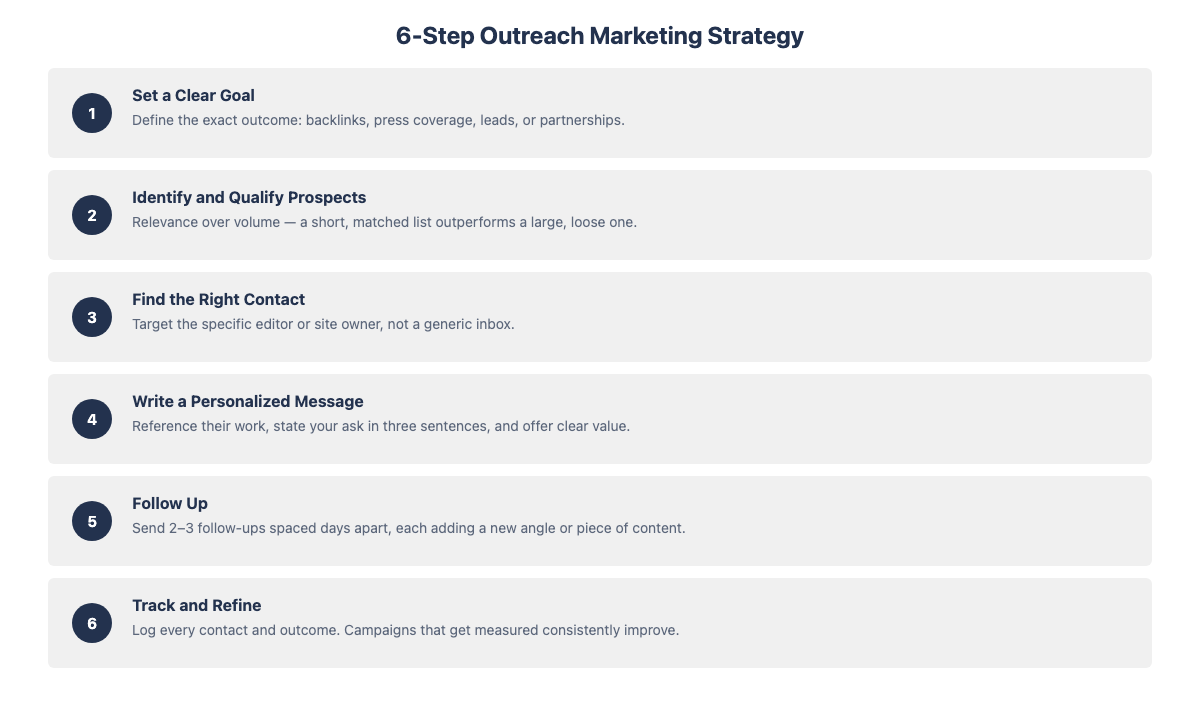
A repeatable outreach strategy follows six steps. Skipping steps increases noise and reduces response rates.
Step 1: Set a Clear Goal
Decide what you want from the outreach campaign before you start. It’s a five-second decision that saves weeks of wasted messages. Backlinks, press coverage, influencer mentions, partnership conversations and sales leads all require different targeting, messaging and follow-up logic. A campaign built around one goal produces better results than one trying to serve all of them at once.
Step 2: Identify and Qualify Prospects
Relevance matters more than volume. A short list of well-matched prospects outperforms a large list of loosely related contacts, and it’s not close. For link building, that means targeting sites in your niche with genuine editorial standards. For media outreach, it means finding journalists who cover your topic area. For influencer campaigns, it means checking engagement rates and audience alignment before you reach out to anyone.
Before you add anyone to an outreach list, run them through four quick checks.
- Activity: have they published or engaged recently? A dormant site or an inactive influencer flat-out won’t respond, no matter how well they fit otherwise.
- Relevancy: does their audience or topic area genuinely overlap with what you’re offering, not just share a keyword?
- Audience fit: is their audience the right size and type for your goal? A smaller, tightly matched audience often outperforms a bigger, loosely related one.
- Engagement: do their posts get real replies, comments or shares, not just passive views? Engagement predicts responsiveness better than follower count does, no question.
Step 3: Find the Right Contact
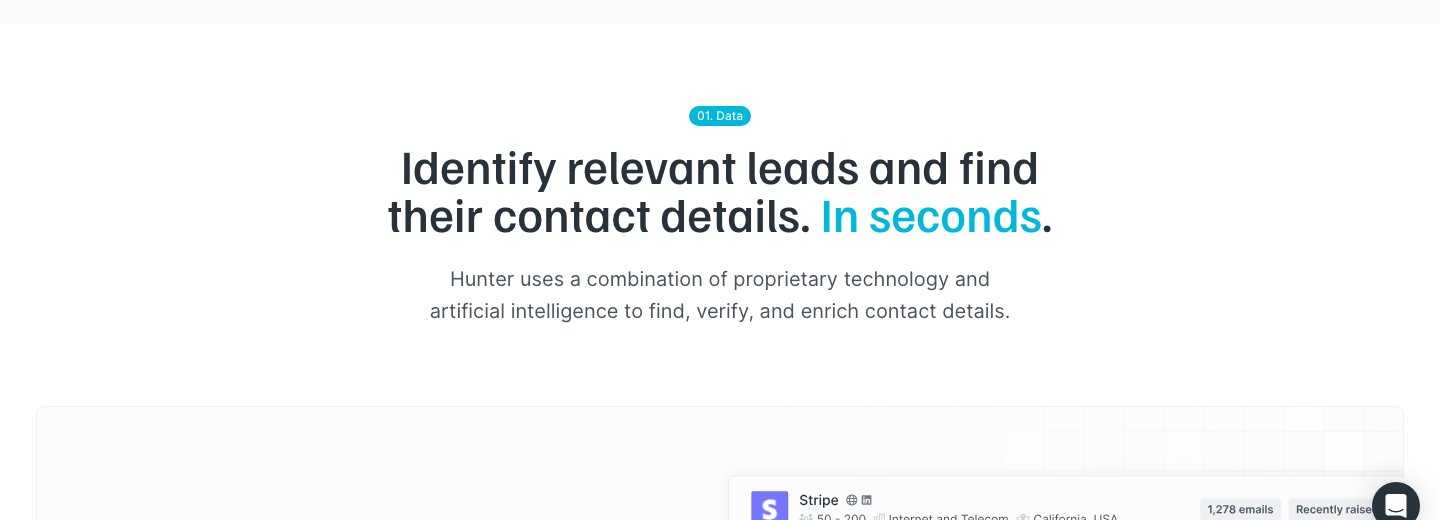
Generic inboxes get filtered. Identify the specific person who handles the type of request you’re making. For editorial outreach, that’s the editor or section lead. For link placement, it’s the content manager or site owner. Tools like Hunter.io make it faster to find verified contact details at scale.
Step 4: Write a Personalized Message
Generic templates get generic results. That’s clearly non-negotiable in a crowded inbox. A message that references recent work from the recipient, explains why you’re reaching out specifically and presents a clear benefit gets opened and answered. Keep the pitch short: state what you want in the first three sentences. For practical templates and subject line patterns, our guide to outreach emails covers this in full.
Step 5: Follow Up
Most responses don’t come from the first message. Send two to three follow-ups spaced several days apart. Each follow-up should add something: a new angle, a related piece of content or a brief reminder, although never a word-for-word restatement of the original message.
Step 6: Track and Refine
Log every contact, response and outcome. You can’t refine what you don’t track. Track response rates by prospect type, message format and time of send. Outreach campaigns that get measured improve. Outreach campaigns that don’t get measured repeat the same mistakes.
What Makes Outreach Messages Work
Brevity is the first requirement. A pitch that takes more than 30 seconds to understand has already lost most readers. Cut every sentence that doesn’t move the recipient toward a yes.
Personalization means more than inserting a name. It means referencing something specific: an article they published, a topic they cover, a problem your content or product directly addresses. Generic compliments and obvious template-filling signal a mass campaign and get ignored, no matter how polished the wording is.
A clear ask matters as much as the pitch. Tell the recipient exactly what you want: a link, a quote, a guest post slot, a meeting. Vague requests get vague responses.
Subject lines should be specific and direct. Curiosity-driven subject lines that promise value without sensationalizing the ask outperform both bland generic headers and clickbait. Test short subject lines against longer descriptive ones and let your own data decide.
Example Outreach Asks
Seeing the difference between a vague pitch and a specific one makes the personalization rule concrete.
- Cold link building ask: “Your post on [topic] doesn’t cover [specific gap]. I put together a guide that fills it, happy to point to it if it’s useful for your readers.”
- Warm partnership ask: “We both cover [shared topic] for a similar audience. Would a short co-hosted guide or a link swap between our two most relevant pages make sense?”
How to Measure Outreach Marketing Success
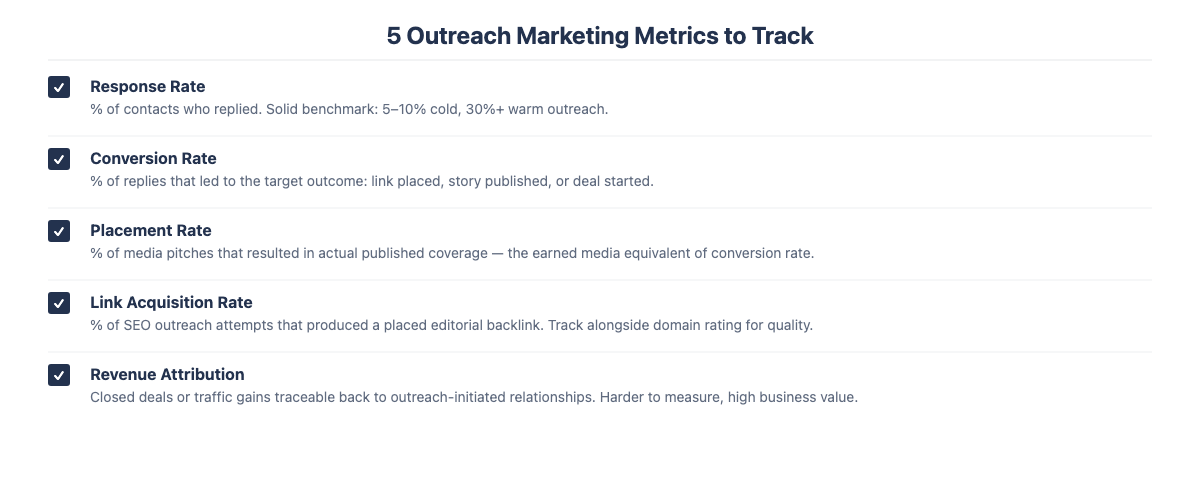
Five metrics give you a reliable view of outreach performance.
Response rate measures the percentage of contacted people who replied. A 5 to 10 percent response rate on cold outreach is solid across most industries, full stop. Warm outreach, where there’s an existing connection or prior engagement, regularly exceeds 30 percent.
Conversion rate tracks what percentage of responses led to your desired outcome: a link placed, a story published or a sales conversation started.
Placement rate applies to media outreach. It measures how many pitches resulted in actual coverage. That number matters most when your goal is earned media rather than backlinks.
Link acquisition rate is the SEO equivalent. It tracks how many outreach attempts produced a placed backlink. Monitoring this alongside domain rating helps you judge the quality, not just the count, of links earned.
Revenue attribution connects closed deals or significant traffic gains back to outreach-initiated relationships. This is harder to measure cleanly but matters for assessing the business impact of partnership and sales outreach.
Outreach Marketing Tools
Tools help. They don’t replace judgment. The right tools reduce time spent on manual research and follow-up without removing the human judgment that makes outreach work.
Prospecting tools help you find and evaluate contacts. BuzzSumo surfaces popular content and the influential people behind it. Ahrefs identifies which sites rank for your target topics and link to your competitors. Hunter.io finds and verifies email addresses at scale.
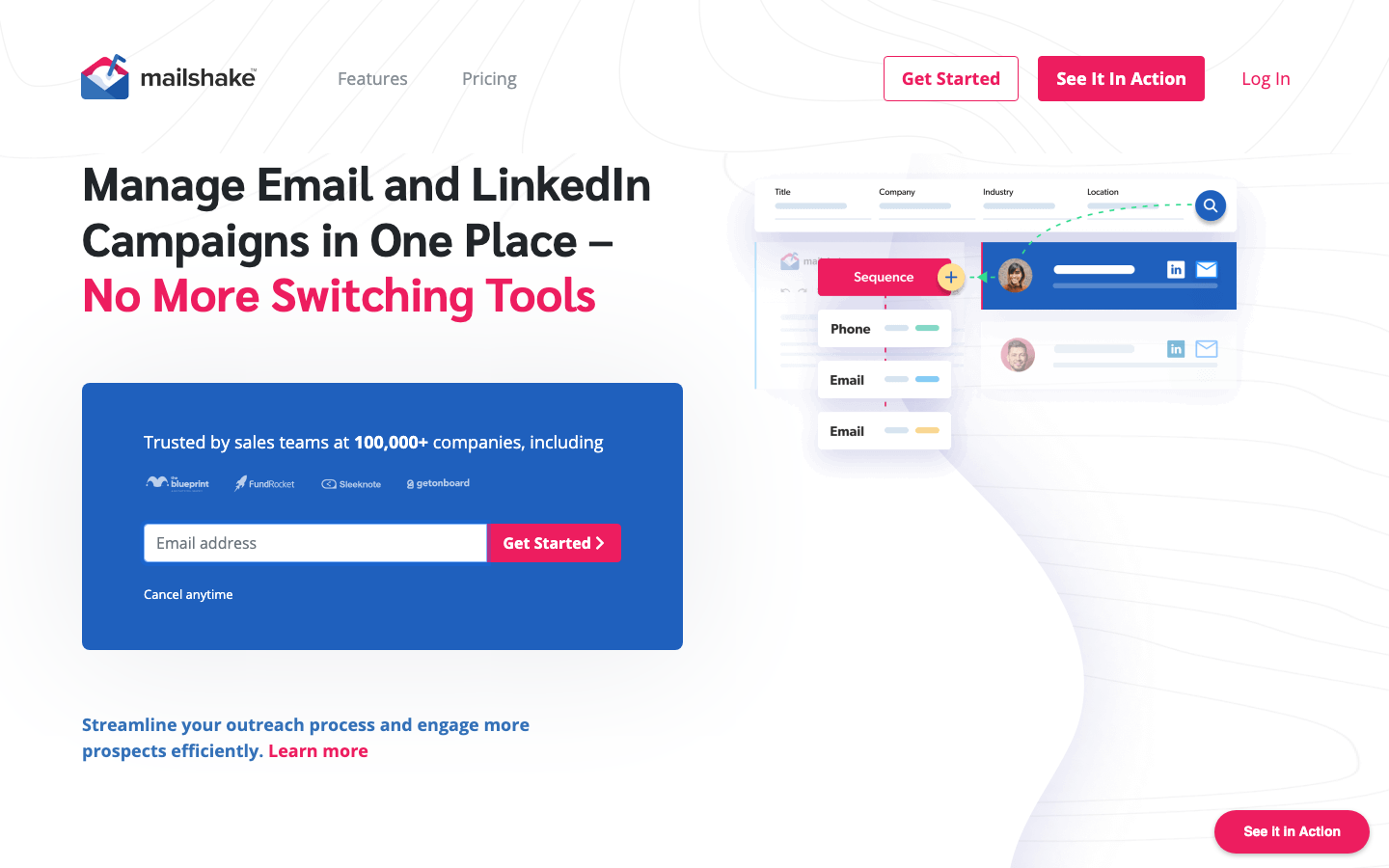
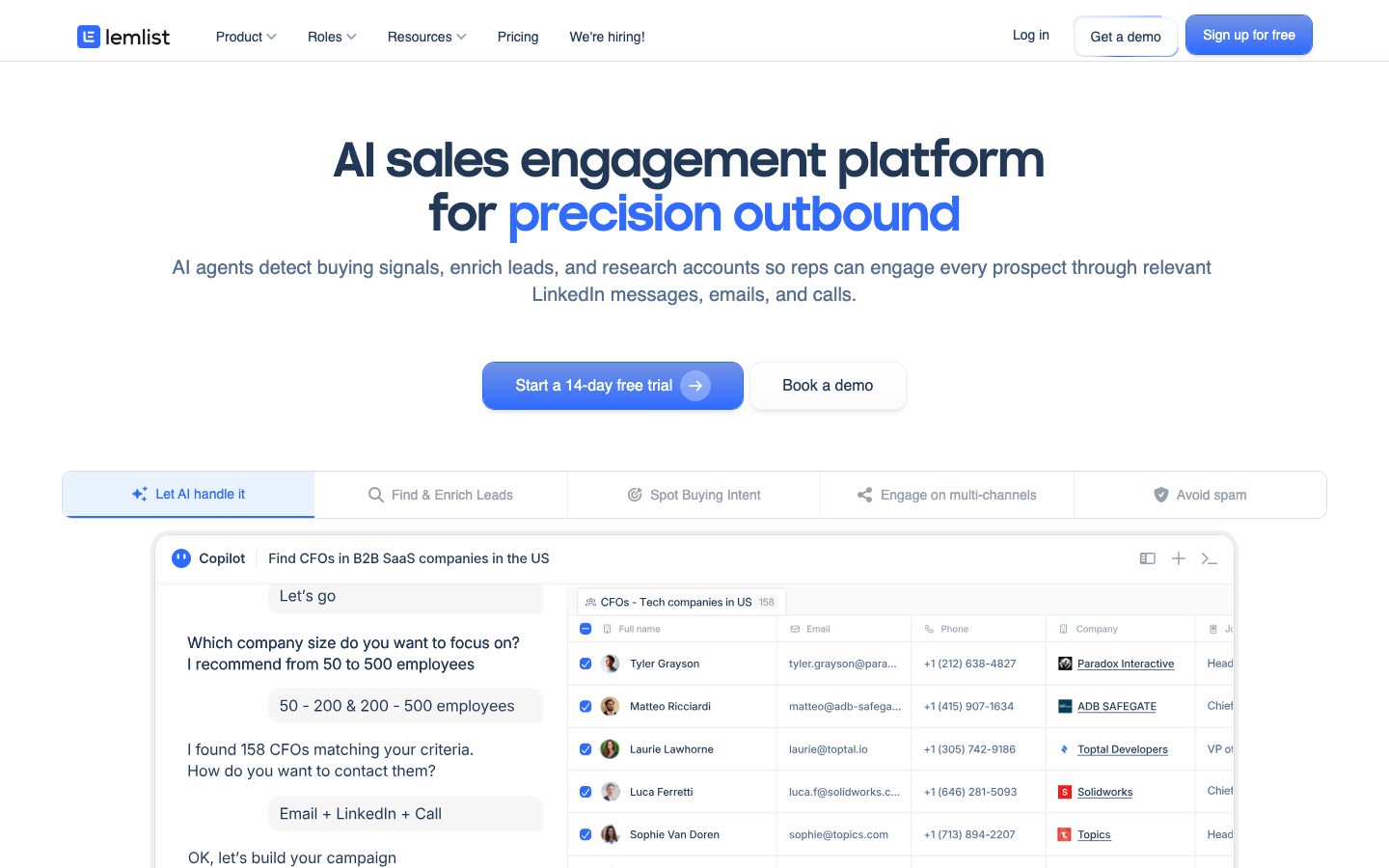
Email outreach tools manage campaigns, automate follow-ups and track opens and replies. Mailshake and Lemlist both handle personalized sequences with solid tracking dashboards. GMass integrates directly into Gmail for smaller-volume outreach.
CRM and tracking tools keep your contact history organized. HubSpot handles this for larger teams. Streak or Notion work well for smaller operations that don’t need a full CRM.
For a deeper look at tools built specifically for link building, see our guides to linkbuilding tools and link building software.
FAQ
Is outreach marketing the same as advertising?
No, outreach marketing isn’t the same as advertising, because outreach earns placement through a trusted third party while advertising pays for guaranteed space. An ad interrupts an audience with a message it already knows is promotional. Outreach persuades one relevant person, a journalist, blogger or site owner, to feature or link to you because the content is genuinely useful to their audience.
What is the difference between outreach marketing and influencer marketing?
Influencer marketing is one specific form of outreach marketing. Outreach marketing is the broader category that includes media outreach, link building, cold email and partnership outreach. Influencer campaigns are just one part of it. When people say influencer marketing, they usually mean paid or gifted collaborations with social media creators. Outreach marketing covers both paid deals and unpaid editorial relationships, including SEO-driven link building.
How long does outreach marketing take to produce results?
The timeline depends on the type of outreach. Cold email campaigns aimed at direct sales can produce responses within days. Link building and media outreach take weeks to months because they depend on the recipient’s editorial schedule and decision cycle. Relationship-based partnership outreach often takes the longest, since trust builds over multiple touchpoints before an agreement’s reached.
What is a good response rate for outreach?
A response rate of 5 to 10 percent on cold outreach is considered solid across most industries. If your response rate falls below 3 percent, the problem’s usually in targeting or messaging, not in the tactic itself. Warm outreach, where you’ve had prior contact or a shared connection, regularly produces response rates above 30 percent.
Does outreach marketing work for small businesses?
Outreach marketing works well for small businesses, and in some cases it’s more valuable for smaller operations than for large brands. Small businesses often can’t compete on paid ad spend, but a well-placed media mention, a backlink from a relevant site or a partnership with a complementary business can shift visibility meaningfully. The barrier is time, not budget. Outreach requires research and personalization, but it doesn’t require significant ad spend to produce real results.