

What Is International Link Building?
International link building is the practice of earning backlinks from websites based in the countries or regions you’re trying to rank in, regardless of what language those sites publish in. A US company opening an Australian office wants Australian-hosted, Australia-relevant links, even though the content on both sides stays in English. That’s international link building without a language problem to solve. Multilingual link building solves a related but separate problem: it targets links that match the language of the page, not necessarily the country. A Spanish-language page aimed at readers in Spain, Mexico and Argentina needs Spanish-language links, and those links can come from any of several countries. Put plainly, international link building is organized by country and market; multilingual link building is organized by language. Most real campaigns need both, layered on top of each other, because a page usually has a target country and a target language at the same time. Here’s how those two signals overlap.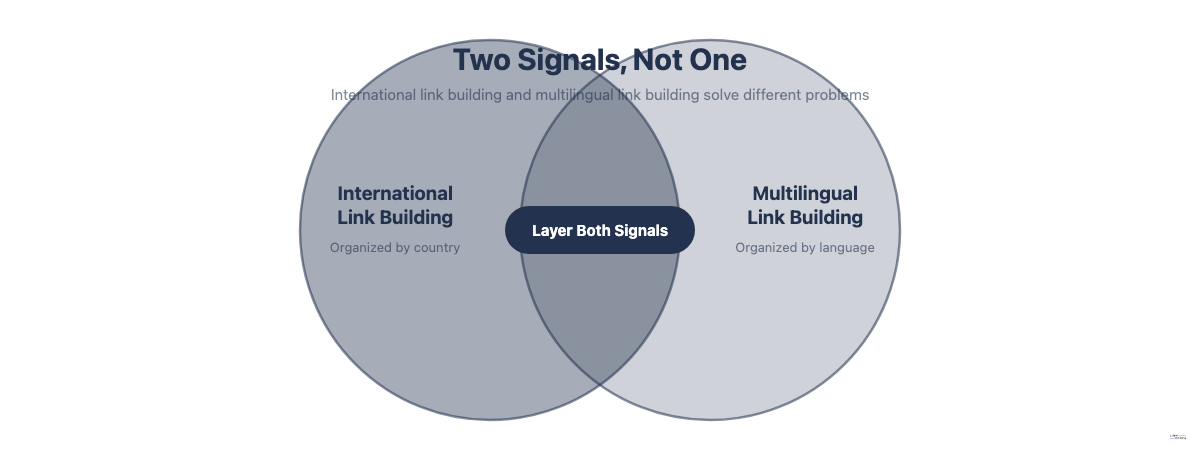
What Is Multilingual Link Building?
Multilingual link building is the practice of earning backlinks from sites that publish in the same language as the page you want to rank. It’s the language-first half of the international link building strategy described above. If you’re targeting French-speaking users, your French pages need links from French-language sources. If you’re targeting German markets, your German pages need links from German publishers. This is different from general international SEO. International SEO covers your entire technical and content setup across markets. Multilingual link building is the specific offsite component that makes your language-targeted pages competitive in each market’s search results. The reason it matters: close to 75% of users prefer to buy products and consume content in their native language. Search engines reflect this preference. Google evaluates language signals at the link level and uses them to determine which version of your content to surface for which audience. A site with a strong English backlink profile but no French-language links will rank well in English markets. It won’t rank in France, no matter how good the content is.Why Language Match Matters More Than Domain Authority
A high domain-authority English site linking to your French page passes PageRank, but that’s not the whole story. It doesn’t reinforce language relevance. Google’s systems evaluate language signals from the anchor text, the surrounding text on the linking page and the primary language of the linking domain. When those signals don’t match your target page’s language, you’re building generic SEO authority without building targeted language relevance. This is what causes relevance dilution. You build a strong English link profile, then add a French subdirectory and expect it to rank in France. But the link signals all point to an English-language context. Google’s language targeting for /fr/ stays weak because no links actually confirm it as a French resource. Local search engines reinforce this dynamic: Google.fr, Baidu for Chinese-language markets, Yandex for Russian-speaking markets and Naver for Korea each evaluate language and regional relevance signals differently. A link from a .de domain to your German page sends a cleaner signal to German Google than a generic .com link ever will. The fix isn’t to ignore English links. They still contribute to domain strength. The fix is to pair them with language-specific links that lock in each page’s market signal. A French page that earns links from French publishers, with French anchor text, in French editorial contexts, sends a clean signal. That’s what competitive multilingual link building looks like.Get the Technical Foundation Right Before You Start Outreach
Link building amplifies the signals you already have, which is exactly why white-hat link building standards matter more once you’re operating across borders. If your technical SEO setup sends mixed signals, more links won’t fix that. They’ll make it bigger. Fix the foundation first.Choose a URL Structure Google Can Separate

| Structure | Example | Geotargeting signal | Link equity | Setup cost |
|---|---|---|---|---|
| Subdirectories | site.com/fr/ | Medium | Consolidated under root domain | Low |
| Subdomains | fr.site.com | Medium | Treated more like a separate site | Medium |
| ccTLD | site.fr | Strongest | Separate domain, no equity sharing | High |
Implement Hreflang Correctly
Hreflang tells Google which page version to serve to which language audience. Without it, Google has to guess, and it’ll often serve the wrong version to the wrong audience, wasting your link equity. Most international sites have hreflang errors, and here’s where they typically go wrong:- Missing self-referencing tags: every page must include a hreflang tag pointing to itself, in addition to tags for all other language versions
- Incorrect ISO language codes: use valid ISO 639-1 codes (fr, de, es) and optionally ISO 3166-1 region codes (fr-CA, en-GB); wrong codes are silently ignored
- Missing reciprocal tags: if Page A links to Page B via hreflang, Page B must link back to Page A; one-way tags are treated as errors
- Missing x-default: use hreflang=”x-default” for your fallback page (served to users whose language isn’t explicitly listed)
- Relative URLs instead of absolute: hreflang requires absolute URLs including the protocol (https://example.com/fr/, not /fr/)
- Conflicting canonical tags: if canonicals point to a different version than hreflang expects, Google discounts one or both
How to Build Links in Each Target Language Without Losing Relevance

Translate and Localize Content Worth Linking To
Machine translation creates content that native-language publishers won’t link to. The quality signals are obvious to editors and readers who use that language daily. For link building purposes, this means your outreach content gets rejected or accepted on low-quality sites, and neither outcome builds real SEO value. The more accurate concept is transcreation: adapting content so it resonates natively, not just translating it word-for-word. Transcreation means replacing your English examples with relevant local equivalents, using regional data instead of global statistics where a local figure exists and adjusting tone, idioms and cultural references to match how that market communicates. When selecting what to localize, prioritize top-performing content. A guide that earns links in English will likely earn links in French if properly transcreated. Original research with local respondents, comparison guides covering the regional competitive landscape and calculators solving real problems for that market’s users are the formats that travel best across language markets.Guest Post on Native-Language Sites
Guest posting is the most direct outreach method for multilingual link building, but most teams execute it wrong. They pitch in English to non-English publications, or they submit machine-translated content with English-language anchor text. The correct pattern: pitch in the target language, write in the target language and use target-language anchor text in the link. In German, your link’s anchor text should read “Linkaufbau-Strategien”, not “link building strategies”. In French, “création de liens”, not “link building”. Search engines don’t just read the words; they read anchor text in context. Language-matched anchor text reinforces the relevance signal the whole SEO campaign is trying to build. Finding opportunities: use Google in the target language and search for guest post callouts, the same discovery process used for domestic guest posting sites. In German: “Gastbeitrag schreiben” or “Artikel einreichen”. In French: “soumettre un article” or “écrire pour nous”. In Spanish: “escribe para nosotros”. This surfaces editorial sites that actively accept external content. Ahrefs and Semrush both let you filter prospect lists by linking domain language and country, which makes this research faster at scale. Here’s what that looks like for a German-language query.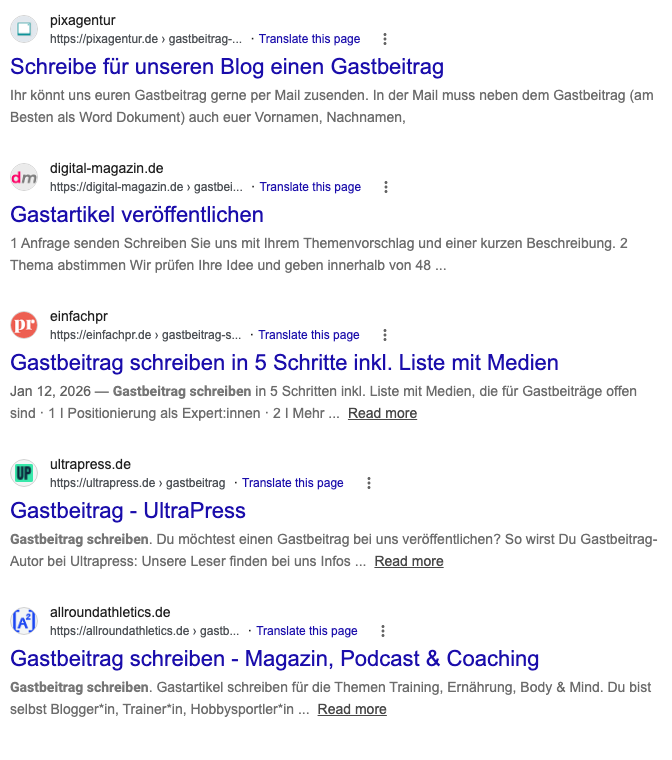
Run Language-Specific Digital PR
Press releases and data studies earn editorial links when they’re relevant to the media outlet’s audience, the same principle that drives any digital PR campaign regardless of market. The mistake most teams make with multilingual PR is translating an English campaign and expecting French or German journalists to pick it up. French media editors aren’t looking for translated English research. They’re looking for stories relevant to French readers, with French-language statistics, local framing and sources they recognize. A campaign that speaks to their audience earns coverage. A translated campaign doesn’t. Build your PR assets market by market. If you’re targeting German-speaking markets, commission research with German respondents, source local market data and pitch to German publications with a German-language story. The link earned from a credible German publication carries more language relevance weight than ten translated press release pickups on low-quality international sites. Another approach is newsjacking in the target language: commenting on breaking news or trending topics in that market. This doesn’t require original research and can generate editorial pickup quickly when your take adds something the local coverage missed. Multilingual digital PR requires coordinating native-language writers, local media contact lists and market-specific distribution. The structure mirrors your English PR operation but runs independently per language, not as a translation arm of it.Use Local Directories and Regional Platforms
Country-specific directory link building reinforces local and language relevance signals. A listing on a well-established German industry portal tells Google that your German content is associated with the German business ecosystem. Country-specific directories like Gelbe Seiten (Germany), Pages Jaunes (France) or Páginas Amarillas (Spain) are the first citation sources for multilingual link building. The value isn’t primarily the link itself. It’s the contextual signals: the surrounding content is in the target language, the audience is in that market and the directory’s own authority comes from years of serving that specific region. Beyond general directories, regional social platforms carry high contextual relevance for specific markets. Xing is the professional network for German-speaking markets. VKontakte dominates Russian-speaking audiences. WeChat and Weibo are essential for Chinese-language visibility. LinkedIn, Facebook and Twitter remain active in most markets and consistent profile presence on these platforms with language-specific content contributes to your overall language-relevance profile. Maintain consistent NAP (Name, Address, Phone) information across all local directory listings. Inconsistent NAP data creates conflicting geo-signals that undermine the local relevance you’re trying to build. Focus on quality over volume. A handful of strong, established regional directories in each market is worth more than dozens of generic international listings.Build Links Through Native-Language Influencers and Communities
Language-specific communities generate organic links with strong contextual signals. When a German-language forum thread discusses your German-language resource and links to it, the surrounding context is exactly what you want: native-language editorial content pointing to your page, from a native-speaking audience. Research suggests 76% of consumers prefer buying in their native language. Influencers embedded in those native-language communities drive both direct traffic and earned links through authentic endorsements. Influencer-earned links in the target language can generate community engagement rates well above generic international placements. These links are usually editorially earned rather than outreach-acquired. Google tends to weight editorially-earned community links more heavily because the context is authentic: the thread, the responses, the platform and the audience all operate natively in the target language. Cultural relevance goes beyond translation here. Content that earns links in native-language communities needs to adapt idioms, tone, humor and cultural references, not just the words. A resource that resonates emotionally and contextually in that language earns mentions, and a translated one usually doesn’t. To access these communities, invest in native-language participation. Have someone who speaks the language natively contribute to discussions before pitching resources. Generic link drops in foreign-language communities get removed. Genuine participation is what earns the mention. Here’s which links survive that scrutiny and which get diluted.What Causes Relevance Dilution and How to Avoid It

Multilingual vs. Multiregional Link Building
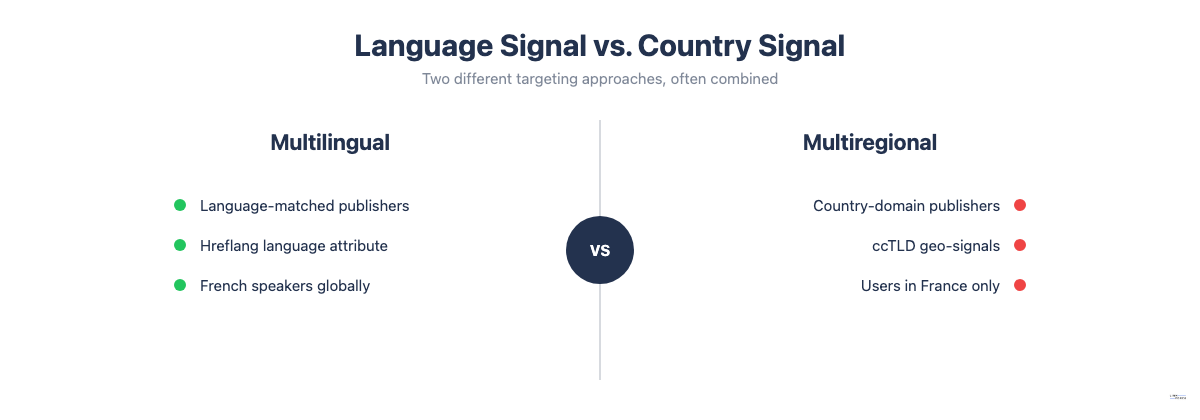
| Multilingual | Multiregional | |
|---|---|---|
| Targets | Users by language | Users by country |
| Reach | French speakers globally (France, Belgium, Canada, Switzerland) | Users in France specifically |
| Link source priority | Language-matched publishers | Country-domain publishers (.fr, .de) |
| Technical signal | Hreflang language attribute | ccTLD, geo-tagged content |
| Combined ideal | A .fr domain publishing in French delivers both signals simultaneously | |