A linkable asset is a piece of content created specifically to earn backlinks from other websites. Unlike product pages or service descriptions, linkable assets are designed to be useful to audiences who aren’t necessarily your customers, giving other sites a genuine reason to link to them.
Most content earns very few natural links because it’s built to convert visitors, not to serve the broader web. Linkable assets (sometimes called linkable content) flip that logic. They prioritize editorial value first, which makes them worth referencing, citing, and sharing across the web.
Why linkable assets matter for link building
Sustainable link building depends on giving other websites something worth linking to. Without that, every link requires either a paid arrangement or a personal favor, and neither scales.
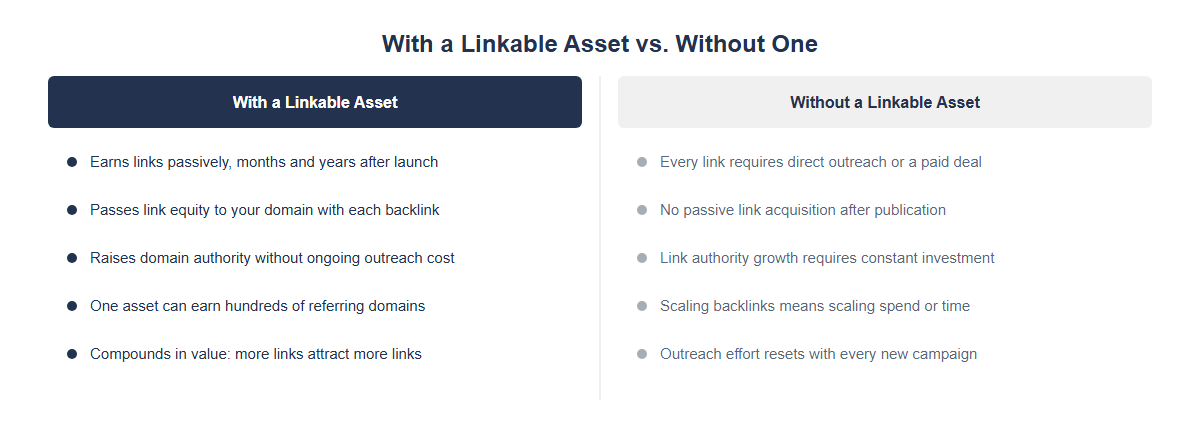
Linkable assets earn links at scale because they solve a real problem for audiences outside your customer base. A data study gets cited when bloggers need a source. A guide gets linked when writers want to send readers somewhere useful. A free tool earns links from resource pages, directories, and articles explaining the problem it solves. Each referring domain passes link equity to your site, raising domain authority and improving organic search rankings over time.
The result is a passive, sustainable strategy. Unlike paid advertising or constant manual outreach, a strong linkable asset continues collecting referring domains for months or years after publication, without ongoing costs per link. A single well-executed linkable asset can outperform years of regular blog content on link acquisition because it gives writers a primary source to cite, not just another opinion piece.
6 types of linkable assets (with examples)
Not all asset types are equal. Some require significant investment but produce very high link volumes. Others are faster to create but earn fewer links. The table below gives a quick comparison before we break each type down.
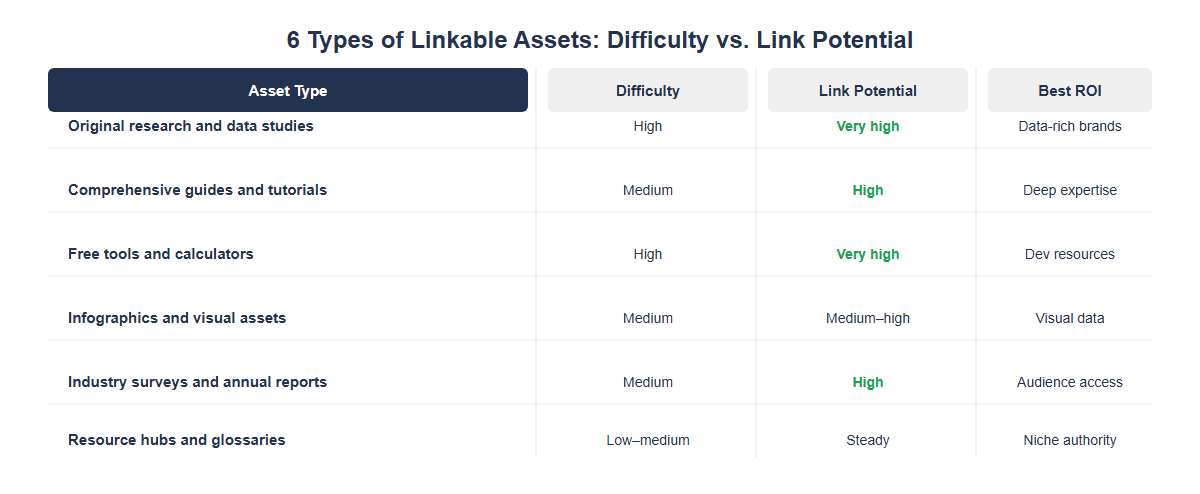
| Asset type | Difficulty | Link potential | Best for |
|---|---|---|---|
| Original research and data studies | High | Very high | Brands that can collect proprietary data |
| Comprehensive guides and tutorials | Medium | High | Topic areas where you have genuine depth |
| Free tools and calculators | High | Very high | Brands with development resources |
| Infographics and visual assets | Medium | Medium–high | Data or processes that benefit from visualization |
| Industry surveys and annual reports | Medium | High | Brands with access to a survey audience |
| Resource hubs and glossaries | Low–medium | Steady | Brands building a reference destination in their niche |
Original research and data studies
Original research is one of the most effective linkable asset types because bloggers, journalists, and content teams need sources. When you publish data nobody else has, you become the citation every other article on that topic needs to reference.
The Ahrefs study „How Long Does It Take to Rank in Google“ has collected over 1,800 links from more than 470 referring domains. Anyone writing about SEO timelines needs to cite something, and primary research beats opinion every time.
The barrier to entry is real. You need either a dataset, a survey methodology, or access to proprietary platform data. But the return is proportionally high. A single well-executed study can outperform years of regular blog content on link acquisition.
Outreach angle: Pitch to bloggers and content teams who’ve written about the topic without citing any data. They’re the easiest link opportunities because your study fills a gap they already have.
Comprehensive guides and tutorials
A comprehensive guide works as a linkable asset because it becomes the go-to reference on a topic. When writers want to point readers to an explanation of something, a guide that covers the topic fully saves every website the effort of writing its own version.
W3Schools‘ HTML tutorial has collected over 1 million links from more than 4,400 referring domains, not because it’s visually impressive, but because it’s consistently the clearest explanation of HTML fundamentals on the web. Depth and reliability compound over time.
The key requirement is genuine expertise. A guide that covers a topic you don’t understand deeply will read like a summary of other summaries, which earns almost no links.
Outreach angle: Find older guides on the same topic that have stopped being updated or have become shallow. Reach out to sites linking to those older resources and let them know about your updated version.
Free tools and calculators
Free tools earn links because they solve a specific, recurring problem. Every article that discusses the problem your tool solves becomes a potential link source, often without any outreach at all.
CoSchedule’s Headline Analyzer has earned over 16,000 links from more than 3,600 referring domains. The tool does one thing: it helps writers evaluate headline quality. But it does it in a way that’s genuinely useful, easy to share, and applicable to a huge audience.
The development cost is the main barrier. Most useful tools require a developer or a no-code platform investment. But a single well-built tool can outperform every other content investment in a link building program over a 12-month period.
Outreach angle: Search for resource pages, tutorials, and how-to articles that discuss the problem your tool solves. Many of these pages actively want to link to tools. They just haven’t found yours yet.
Infographics and visual assets
Infographics earn links when they make a complex idea simple enough for any website to embed or share. The best ones take something that takes paragraphs to explain in text and compress it into something you can read in 20 seconds.
Search Engine Land’s „Periodic Table of SEO Success Factors“ has collected over 8,600 links from more than 2,300 referring domains. The format works because SEO is a topic people always want to explain visually, and that infographic became the version people reached for when they needed one.
The biggest trap with infographics is repacking generic statistics that everyone has already seen. An infographic needs an original framing, a unique dataset, or a genuinely new way of looking at a familiar idea. Visual design alone doesn’t earn links.
Outreach angle: Target websites that regularly publish or embed infographics in your niche. Embed codes lower the friction of someone using your visual on their own site.
Industry surveys and annual reports
Annual surveys and state-of-industry reports are among the highest-return linkable asset types because they produce proprietary data nobody else has. If you publish a „State of [Your Industry]“ report each year, it becomes the citation source for any website writing a trend piece or analysis on that topic.
HubSpot’s annual marketing reports consistently earn hundreds of referring domains per publication cycle, not because HubSpot runs better surveys than everyone else, but because they publish consistently and the reports cover topics writers need to cite.
The logistics are manageable with a small audience. Even a 200-person survey can generate publishable data if the questions are the right ones and the respondents are genuinely relevant to your topic area.
Outreach angle: Time your report release to coincide with industry planning cycles or major events. Pitch directly to journalists and analysts who cover your space. They need fresh data and you can be the source.
Resource hubs and glossaries
Resource hubs and glossaries earn links steadily over time because they become the reference destination for a topic. This type of linkable asset works well for websites building authority in a niche. Writers who want to explain a term or concept without covering it themselves link to the most complete and trusted source available.
Moz’s SEO Learning Center and Ahrefs‘ SEO glossary have built large link profiles not through aggressive outreach but through being the most complete and reliable reference material for terms that thousands of articles need to explain.
The creation investment is lower than a data study or a custom tool, but the maintenance overhead is ongoing. A glossary that stops being updated will lose trust and eventually lose links to a more current alternative.
Outreach angle: Reach out to writers who’ve explained a term or concept in their own article without linking to a reference. Offer your glossary entry as the source they can cite next time.
What makes content a linkable asset?
Not every piece of content qualifies as a linkable asset, even if it’s well written. The following characteristics separate content that earns links from content that doesn’t.
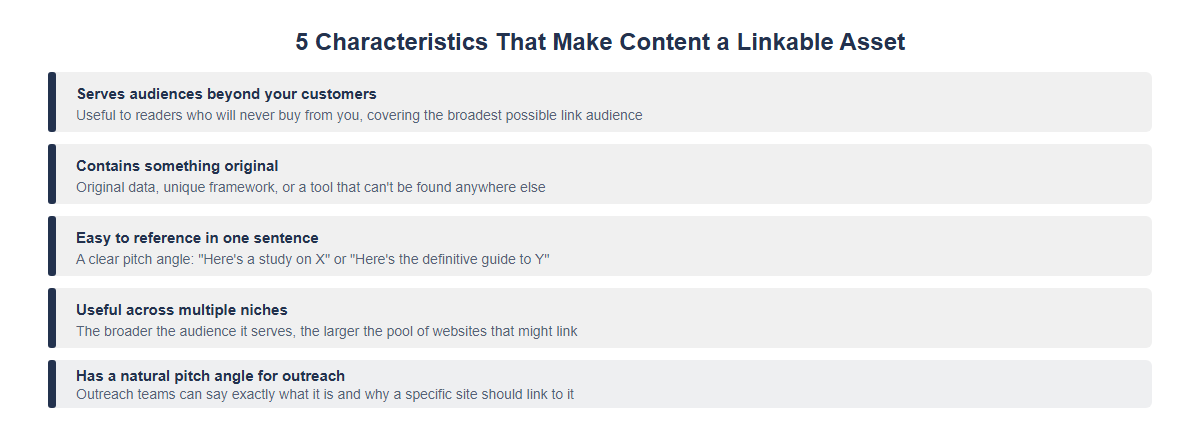
- It serves audiences beyond your customers. A sales page only matters to people who might buy from you. Linkable content is useful to readers who will never become your customer, which covers most of the web.
- It contains something original. Original data, a unique framework, a tool, a perspective nobody else has published. Something that can’t be found by reading the same ten articles everyone else has already read. High-quality linkable assets often include proprietary data from surveys or experiments that other websites want to cite.
- It’s easy to reference. A linkable asset should be describable in one sentence: „Here’s a study on X,“ or „Here’s the best guide to Y.“ If explaining why someone should link to it takes a paragraph, the pitch angle isn’t clear enough.
- It serves multiple niches. The broader the audience that could find it useful, the larger the pool of websites that might link to it. A data study on remote work can earn links from HR blogs, tech publications, real estate sites, and business news outlets simultaneously.
- It has a natural pitch angle. Every strong linkable asset gives outreach teams something specific to say: „We published data on X that you cited an opinion about,“ or „We built a tool that solves the problem you wrote about last month.“
How to create a linkable asset
Creating a linkable asset that actually earns links requires more than picking a format and writing something long. These four steps reduce the chances of building something nobody links to.
- Audit what already earns links in your niche. Use Ahrefs or a similar tool to find the most linked-to content from sites similar to yours. Understanding what works in your specific topic area is more reliable than guessing based on general best practices. You’re reverse-engineering success rather than building on instinct.
- Pick the asset type that matches your real resources. A free tool is the highest-ROI asset type for many sites, but it requires development time. If that’s not available, original research or a comprehensive guide is more realistic. Choosing a format you can’t execute well is worse than choosing a less impressive format you can do properly.
- Build around a documented gap. The asset should do something the existing content in your niche doesn’t: cover more depth, provide original data, present things visually, or offer a tool. If five similar assets already exist and yours isn’t clearly better, there’s no compelling reason for anyone to link to yours over the alternatives.
- Design the promotion plan before you finish the asset. Before launch, know which sites you’ll pitch, which outreach angle you’ll use, and how you’ll seed the asset to your own audience. An asset without a promotion plan will earn links slowly if at all, regardless of quality.
How to promote a linkable asset and earn links
Creating a strong asset is only half the job. Assets don’t earn links by existing. They earn links when the right people know about them. These four promotion tactics are the most consistent methods for converting a new asset into referring domains.
Resource page outreach. Many websites maintain resource pages: curated lists of the best tools, guides, and references in a given topic area. Find pages in your niche that link to similar assets and pitch yours as an addition. These pages are actively maintained to be useful, so a relevant addition tends to land. Use Ahrefs‘ Content Explorer or a search like intitle:resources "link building" to find prospects quickly.
Journalist and blogger outreach. If your asset contains data or research, identify writers who’ve already covered that topic and send them a brief, specific pitch. The most effective angle is pointing to a claim they made without citing data and offering your research as the source they were missing. Keep the email short. Make the value obvious in the first two sentences.
Broken link building. Find pages in your niche that link to outdated or dead resources similar to yours. Reach out to the linking site, let them know the link is broken, then offer your asset as a replacement. The pitch is helpful rather than promotional, which improves response rates significantly. Ahrefs‘ broken backlinks report makes finding these opportunities straightforward.
Seed distribution to your own audience first. Share the asset with your email list, social channels, and any communities where your audience is active. Your existing audience is more likely to link to it than cold prospects, and early links create a track record that makes subsequent outreach more credible. A page with five referring domains is easier to pitch than one with zero.
FAQ
What is the difference between a linkable asset and regular blog content?
Regular blog content is written to attract and inform your own audience or rank for specific keywords. A linkable asset is built with a different primary goal: earning backlinks from other websites. The distinction is in intent and design. A linkable asset prioritizes utility for a broad audience and includes something worth citing, whether that’s original data, a unique framework, or a tool.
How long does it take to earn links from a linkable asset?
With active outreach starting at launch, a well-targeted asset can start earning links within the first two to four weeks. Passive accumulation through organic discovery is much slower and less predictable. Assets with strong outreach programs tend to see the fastest early link growth, while assets left to accrue links on their own may take months to gain meaningful momentum.
Do linkable assets work for all industries?
They work across most industries, but the right asset type varies by context. B2B software companies tend to earn links well with original research and data studies. Service businesses often do better with comprehensive how-to guides. Consumer brands with large audiences can get strong results from surveys and annual reports. Match the asset type to the credibility your brand already has and the audiences that are most likely to link in your topic area.
What makes a linkable asset fail?
Most failed linkable assets have one of two problems. The first is building something that already exists in a better version. If there’s no clear reason to link to yours over the alternatives, outreach won’t convert. The second is no promotion plan. A well-built asset left without a launch strategy will sit unnoticed regardless of its quality. Promotion isn’t optional. It’s half of what makes a linkable asset actually work.